Hi, what do you want to do?





eSchool Today
E School Today: Energy
Explains different kinds of energy, covering kinetic, potential, gravitational, mechanical, sound, thermal, chemical, electrical, and radiant energy. Also looks at storage, transfer, and dissipation of energy. Includes a short...

TeachEngineering
Teach Engineering: Energy of Motion
By taking a look at the energy of motion all around us, students learn about the types of energy and their characteristics. They first learn about the two simplest forms of mechanical energy: kinetic and potential energy, as illustrated...
eSchool Today
E School Today: Renewable Energy Sources
Learn what renewable energy is, the different types, and why it's important to conserve energy.
US Department of Energy
U.s. Department of Energy: Science Education
Use this resource to learn about how the Department of Energy provides information on science competitions, energy conservation, case studies and more.

Khan Academy
Khan Academy: Energy Through Time
The quest for energy has always been a balancing act. As humans have gained greater control over their environment, they've found abundant resources - and faced numerous challenges. This article traces the history of our quest for energy.

American Association for the Advancement of Science
Aaas: Project 2061: Energy: Forms, Transformation, Transfer, and Conservation
[Free Registration/Login Required] Create a science test that checks for student understanding in science, for common misconceptions, as well as for correct ideas. This is a list of key ideas related to Energy: Forms, Transformation,...
State Energy Conservation Office-Texas
State Energy Conservation Office: Electricity From the Sun [Pdf]
Discusses forms of renewable energy that rely on the sun. For example, wind is created when solar energy heats the air, and biomass is solar energy that has been stored in plants.
State Energy Conservation Office-Texas
State Energy Conservation Office: Using Energy Wisely [Pdf]
The importance of energy conservation and energy efficiency are discussed, with reference to where Americans' energy use compares to that of the rest of the world.
State Energy Conservation Office-Texas
State Energy Conservation Office: Renewable Energy for the Home [Pdf]
Discusses different ways to heat and cool a home, and perform a variety of tasks, using renewable energy sources. Examples include window shades, a solar water heater, solar-powered toys, etc.
State Energy Conservation Office-Texas
State Energy Conservation Office: Passive Solar Design for Homes [Pdf]
Discusses different features that can be incorporated into a home's design in order to harness solar energy.
State Energy Conservation Office-Texas
State Energy Conservation Office: Learning About Photovoltaic Systems [Pdf]
Explains how photovoltaic systems work and how Texas homeowners are using them. Discusses how a homeowner can use solar energy and still be on the electricity grid system.
State Energy Conservation Office-Texas
State Energy Conservation Office: Solar Electricity Works for Texas [Pdf]
Discusses photovoltaic energy systems and their many applications, e.g., in telecommunications, consumer products, space technology, solar lights, etc.
State Energy Conservation Office-Texas
State Energy Conservation Office: Energy Sources: Fuels From Biomass: Biodiesel
Discusses biodiesel fuel production and the benefits that this renewable energy resource has for the environment and the economy.
Vision Learning
Visionlearning: Energy in Living Systems: Energy Metabolism I
Detailed explanation of how food is broken down and metabolized in our bodies to be used for energy.
Other
Great Lakes Bioenergy Research Ctr.: Exploring Energy Transformations in Plants
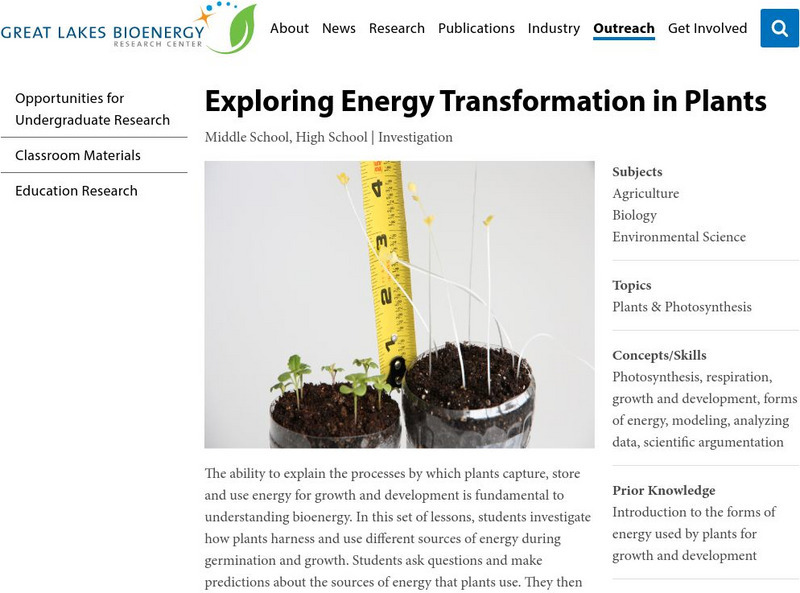
This set of lessons has learners investigate how plants obtain energy from different sources to support their growth and development. Students conduct investigations, make predictions, and construct scientific explanations of the...

CK-12 Foundation
Ck 12: Physical Science: Conservation of Energy in Chemical Reactions
[Free Registration/Login may be required to access all resource tools.] Describes the law of conservation of energy and how energy is conserved in chemical reactions.
US Department of Energy
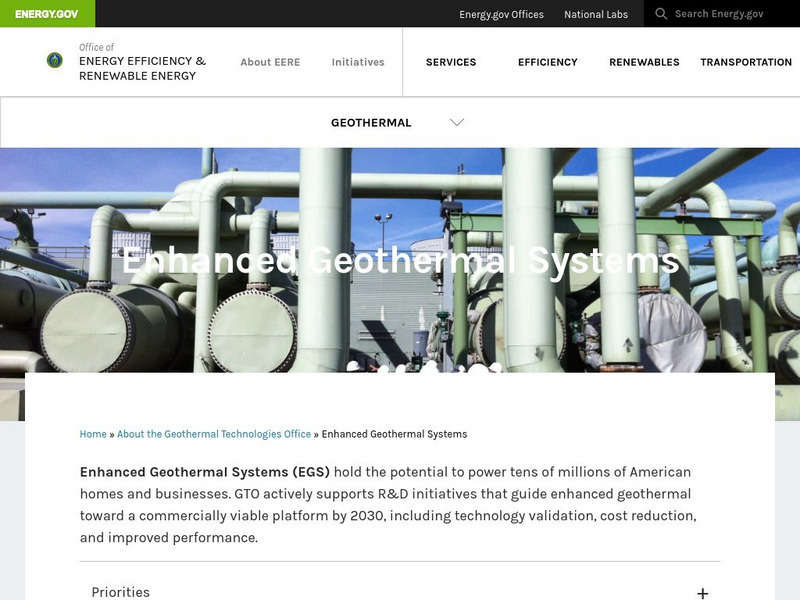
U.s. Department of Energy: Geothermal Technologies: Enhanced Geothermal System
Through both an interactive animation and a short video, learn about the enhanced geothermal system as a means to utilize the Earth's heat as an energy source for our electricity needs.

Khan Academy
Khan Academy: Activity: The Appetite for Energy
The purpose of this activity is to gain a sense of how much and what types of energy we use today in order to help us understand how much things have really changed over the last 500 years. It also helps us think about how our energy...
eSchool Today
E School Today: Non Renewable Energy
Learn what non-renewable energy is and the different types.
Georgia State University
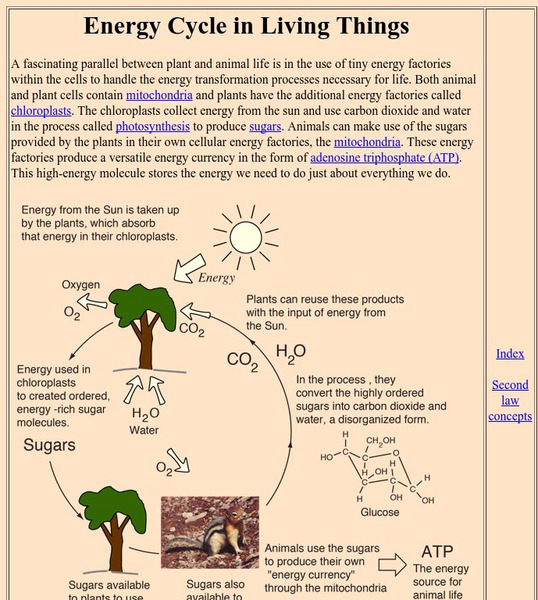
Georgia State University: Hyper Physics: Energy Cycle From Plants to Animals
Find out about the essential role energy plays in cell function and in sustaining life. Trace energy transformations as they pass from one living thing to another.
Concord Consortium
Concord Consortium: Energy of a Pendulum
In this interactive, drag a pendulum to set its initial height and observe how height is related to potential energy. Then release the pendulum and observe the change from potential energy to kinetic energy, and ultimately to thermal...
Climate Literacy
Clean: How Much Energy Is on My Plate?
Using concept sketches, students study energy requirements of food production explain why different sources of food require different inputs of energy. They also investigate how variables like farming methods, processing methods and...
Other
Energy Star: You Can Be an Energy Star [Pdf]
The "Who's Guide to Saving Our Planet" helps students protect the environment through superior energy efficiency.
Cynthia J. O'Hora
Mrs. O's House: Energy Saving Survey Take Action
Students will explore ways that people can conserve energy. Beginning with a classroom survey, students research, consider changes that can be made, and evaluate which changes will be easier to do than others and explain why.