Hi, what do you want to do?






NASA
Nasa: Tour of the Electromagnetic Spectrum: Visible Light
Visible light waves are the only electromagnetic waves we can see. We see these waves as the colors of the rainbow. Each color has a different wavelength. Red has the longest wavelength and violet has the shortest wavelength. When all...
NASA
Electromagnetic Spectrum: Ultraviolet Waves
Ultraviolet (UV) light has shorter wavelengths than visible light. Though these waves are invisible to the human eye, some insects can see them. The specific wavelength values are given. Uses and applications of these waves are explained.
Space Telescope Science Institute
Amazing Space: Star Light, Star Bright
This online exploration provides an opportunity to identify the different properties of waves and the relationship that exists between energy, wavelength, and frequency. Correlate images from the Hubble Telescope to the wavelength,...
Stanford University
Stanford University: Invisible Rays
This lesson focuses on investigating the electromagnetic spectrum using ultraviolet beads. Students learn how material properties change as the size of the material decreases to the nanoscale.
Friesian School
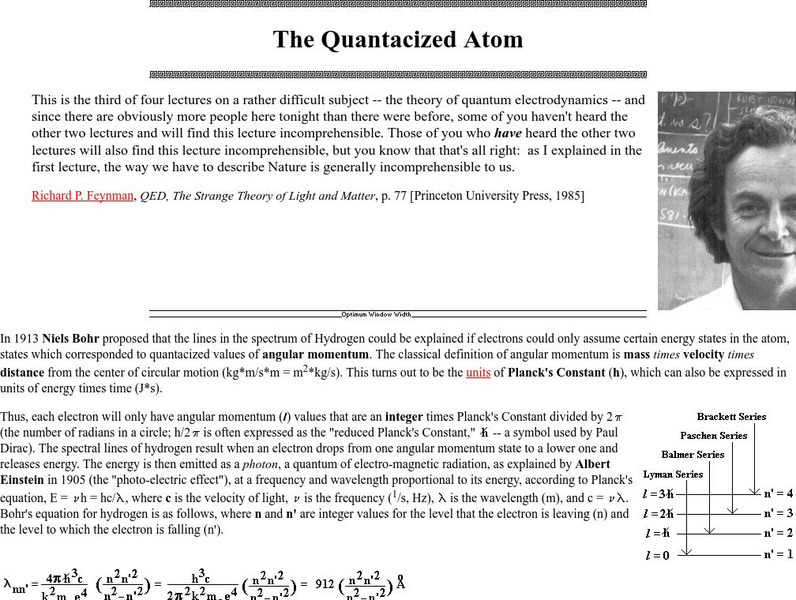
Proceedings of the Friesian School/the Quantacized Atom
A very lengthy page from friesian.com discussing Bohr's theory of electronic energy levels and the explanation of commonly observed atomic emission line spectra. The concept of a photon and Einstein's observation of the photoelectric...
Lawrence Berkeley National Laboratory
Berkeley Lab: Micro Worlds Project: Advanced Light Source
A discussion of the Advanced Light Source (ALS) facility and its use in material analysis and medicine.
Carnegie Mellon University
Telstar: The Sun and Its Energy
The sun's energy is the primary source of energy for all surface phenomena and life on Earth. Combined with the material of the Earth (including the molecules held close by the Earth's gravitational force called the atmosphere), this...
Carnegie Mellon University
The Sun and Its Energy
The sun's energy is the primary source of energy for all surface phenomena and life on Earth. Combined with the material of the Earth (including the molecules held close by the Earth's gravitational force called the atmosphere), this...

California Institute of Technology
Ipac: Iras Gallery
This site from IPAC is a series of images of various celestial objects and regions as viewed in infrared light. Each photo is accompanied by a caption.