Hi, what do you want to do?






The Great War
Poison Gas Warfare In WW1
Lungs burning, eyes blurry—chemical weapons cause great destruction. Scholars view a short video analyzing the first use of chemical weapons in World War I. The eighth lesson of a 32-part series on the Great War investigates the legality...

PBS
Gideon v. Wainwright
Could you defend yourself in a trial when pitted against a professional lawyer? A short video clip explains to young learners the need for a proper defense. They explore the Supreme Court case Gideon v. Wainwright, analyzing and...

PBS
Having a Strong National Government
How did American political parties form? Scholars research the end of the Washington era and the beginning of politics in America. Video evidence and discussion questions allow insight into the emergence of the three branches of...

TED-Ed
A Day in the Life of an Ancient Egyptian Doctor
How did ancient Egyptians treat a scorpion bite? Scholars analyze the life of a doctor during trying times of Ancient Egypt. They investigate treatments and issues that arise with the various medical concerns of the era. To conclude,...

The School of Life
Philosophy - Nietzsche
Have you built your home on the slopes of Mount Vesuvius? Why not? Friedrich Nietzsche challenges viewers to live a fulfilled and dangerous life, to use the humanities as a guide to life, and to own up to one's envy, as explained in...

Macat
An Introduction to Edmund Gettier's Is Justified True Belief Knowledge?
Teenagers are at the perfect age to start holding strong beliefs and opinions—and to explore whether those beliefs are the same as having knowledge. A short video analysis of Edmund Gettier's paper "Is Justified True Belief Knowledge?"...

The School of Life
Philosophy - Montaigne
You can reach achievement with an ordinary, moral life without the proper education of past philosophy! So says Michel de Montaigne in a short analysis video that succinctly explains his views on academia, the virtue of a good...

Macat
An Introduction to John Stuart Mill's On Liberty
Having a unique and individual perspective can be helpful for society as well as for yourself! A video analysis of John Stuart Mill's On Liberty examines the British philosopher's views of freedom and liberty, as well as...

Crash Course
The Economics of Happiness
Money may not be able to buy happiness, but economic security can certainly contribute to overall happiness. A video from Crash Course economics presents the ways happiness can and cannot be quantified, including the value of intrinsic...

Crash Course
Foreign Aid and Remittance
Is providing aid to foreign countries always beneficial? High schoolers explore the basics of foreign aid and remittance, including the percentage of the United States budget that is allocated to foreign aid, and the ways that nonprofits...

Classroom Clips
First Continental Congress (Part II)
Supplement your traditional textbook chapter with this instructional video on the first Continental Congress, which highlights key points such as the passage of the Intolerable Acts, boycott of British goods, and primary...

Jacob Clifford
Intro - Costs of Production and Perfect Competition
Here is a brief introduction to the concepts covered in an economics course unit on the costs of production and perfect competition.

ouLearn
The Principle of Comparative Advantage
In the fourth episode of 60-second video clips on economics, you will review the principle of comparative advantage with your learners, explaining the benefits of international free trade as countries specialize and export their...

ouLearn
The Phillips Curve
How does employment affect wages and prices? Can this really all be explained by a simple curve? Here you will find a brief video clip that uses cartoon animations to explain the correlation between employment and inflation according to...

ouLearn
The Paradox of Thrift
When you have money in your pockets, is it better to save or spend? Weigh the benefits of saving money in banks versus spending money to create opportunities for employment with this brief animated video, which is part of a series of six...

ouLearn
The Invisible Hand
How did economist Adam Smith shock the world in 1776? By telling the world that the best way for a government to control an economy is to not control it, and to leave people to buy and sell freely. Use this brief video as a way to...

Geography Now
Geography Now! Luxembourg
Luxembourg is so small, one can drive across it in 45 minutes. However, many consider the nation the European cultural capital, as it's home to numerous ancient and medieval sites. A video resource shows off some of these while...
Other
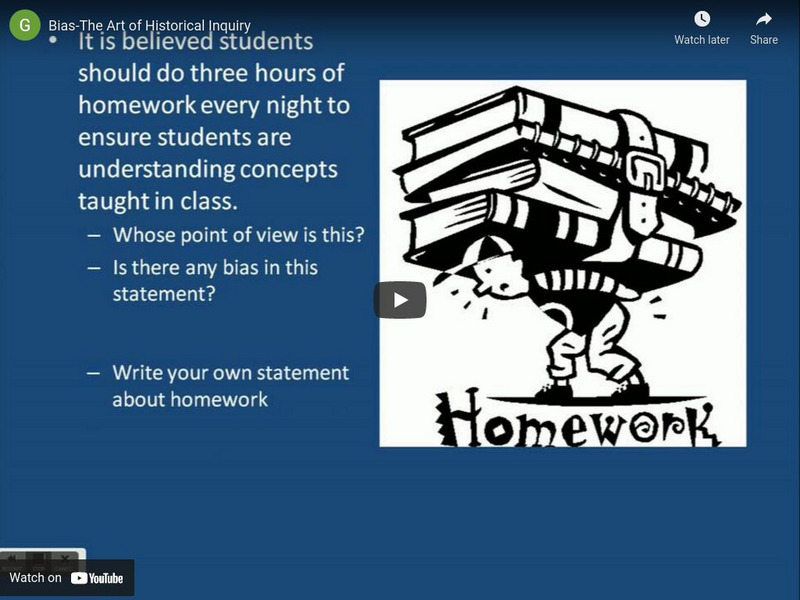
Gerald Oehler: Bias the Art of Historical Inquiry
This video provides an examination of bias and point of view and why this is an important skill to know when studying his/her story. [5:30]