Hi, what do you want to do?






CommonLit
Common Lit: "Down the Rabbit Hole" by Lewis Carroll
CommonLit.org is a wonderful resource to use in a Language Arts classroom. Each story or article is accompanied by guided reading questions, assessment questions, and discussion questions. In addition, students can click on words to see...
Thinkport Education
Thinkport: Totalitarianism in Stalinist Russia
A module where students analyze how the author uses text structure to emphasize key points or explanations in order to achieve the purpose for writing or point of view.

Texas Education Agency
Texas Gateway: What's Your Point (Of View)? Practice 6 (English I Reading)
[Accessible by TX Educators. Free Registration/Login Required] Identify point of view and understand how it shapes fiction.
Wisconsin Response to Intervention Center
Wisconsin Rt I Center: Character Map [Pdf]
Teachers will learn about importance of character maps. Teachers will learn how to implement character maps; measure progress with character maps; and find research to support the use of character maps. Several reproducible character...
Texas Education Agency
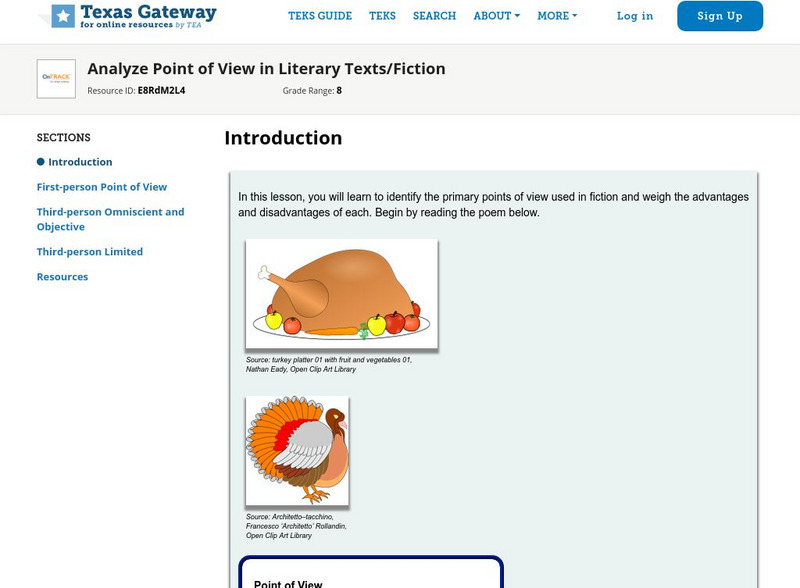
Texas Gateway: Analyze Point of View in Literary Texts/fiction
[Accessible by TX Educators. Free Registration/Login Required] In this lesson, you will learn to identify the primary points of view used in fiction and weigh the advantages and disadvantages of each.
PBS
Pbs Learning Media: Gorillas
Learn about the lives of gorillas born in captivity in this video segment from Nature. [8:21]
TES Global
Blendspace: Ri/rl 5.6 Point of View
Work through twenty-two links to pictures, charts, and videos to learn more about point of view in both informational and literary texts.
TES Global
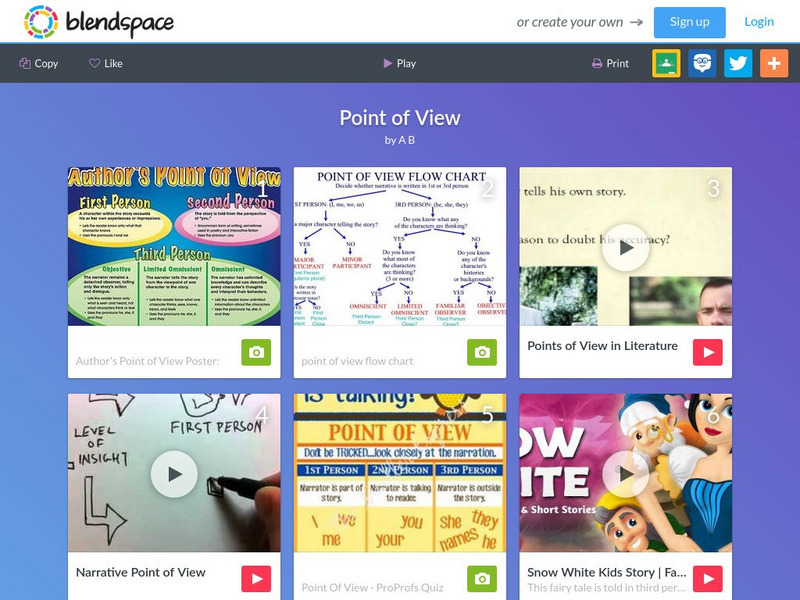
Blendspace: Point of View
A learning module with six links to videos and charts that demonstrate first, second, third limited, and third omniscient points of view.