Hi, what do you want to do?






Exploratorium
Jacques Cousteau in Seashells
Visionaries create images out of dots to demonstrate the eye-brain connection. Through this activity, they learn that the brain interprets data collected by the eye into recognizable information. Search online for "Jacques Cousteau in...

Exploratorium
Blind Spot
A small card with a dot and an X is held at arm's length and used to show youngsters where their blind spot is. This illuminating little activity is a compact addition to your lesson on the structure of the eye as it explains the part of...

Exploratorium
Afterimage
To illuminate how afterimage occurs, create a star, square, or other geometric-shaped light for learners to look at for 30 seconds. Then, have them explain what they see as they shift their focus to a blank wall. A full explanation of...

Nemours KidsHealth
Vision
From the iris and retina to glasses and contact lenses, learners will be excited to see what activities are in store for them as they learn about the complex organ of the human eye.

PBS
Blow the Roof Off!
Blow the minds of young scientists with this collection of inquiry-based investigations. Based on a series of eight videos, these "hands-on, minds-on" science lessons engage young learners in exploring a wide range of topics...

Exploratorium
Far Out Corners
Construct a three-dimensional optical illusion when your class is exploring vision and how the eye and brain work together. Three concave corners are mounted inside of a black box, but as a light is shined upon them, they appear to be...

Curated OER
Understanding Eyeglasses
Kids wonder about eyeglasses, and why people have to wear eyeglasses. This should shed some light on the subject. Learners develop an understanding about eyelgasses, and also other visual aids, such as magnifying glasses. In fact, they...

Curated OER
What is It? Susie Sees!
Students explore the five senses. In this cross curriculum five senses lesson, students view an "I Can See Colors" PowerPoint presentation and sort items by color and shape. Students mix primary color paints to create secondary...

Curated OER
Penny and Cup Game
Students perform activities to discover if one eye is better than two. They test their sense of sight with both monocular and binocular vision. Students drop a penny and see if it lands in the cup of water. They rely on their sense of...

Curated OER
I Think, Therefore I See
Students participate in a memory experiment to discover how the eye works. After reading an article, they analyze a new technique which examines how the brain registers sight. They develop their own memory game and conduct trials using...

Curated OER
Find the Differences: Rabbit with an Umbrella
In this find the differences worksheet, 3rd graders analyze the details in 2 pictures, circle 10 things that are different, then write a list of the different things.

Curated OER
I Can See You
Second graders explore living without sight. In this senses lesson, 2nd graders review the different senses and what they use for each sense. Students discuss what it would be like to not be able to see and they read a story about a...

Curated OER
Similar/Different: Nervous System
In this nervous system learning exercise, students identify 2 ways that a computer and brain, a telephone wire and the spinal cord and a camera and an eye are similar and different.

Curated OER
Eye Spy
Fourth graders study the functions of the human eye and how it processes information.

Curated OER
Oh, Say Can You See
Students explore different parts of the eye and functions of each part through a video and a dissection of a cow's eye. They discover different causes of blindness.

Curated OER
Which Butterfly Is Different?
In this butterfly visual discrimination worksheet, students analyze 5 rows of butterfly pictures, each with three pictures. Students determine which butterfly in each row is different from the others and circle it.

Curated OER
Mechanism of Our Eyes
Students study the eye as the organ of vision, They look at a drawing of the eyes and study the names of the parts. While working with a partner, they observe what happens when the lights are turned lower and lower. Finally, they look at...

Curated OER
How We See: The First Steps of Human Vision
Learners notice how various images and colors update constantly as they are affected by factors such as distance, background and lighting. They also examine how optometrists developed a standard to evaluate eyesight.
Exploratorium
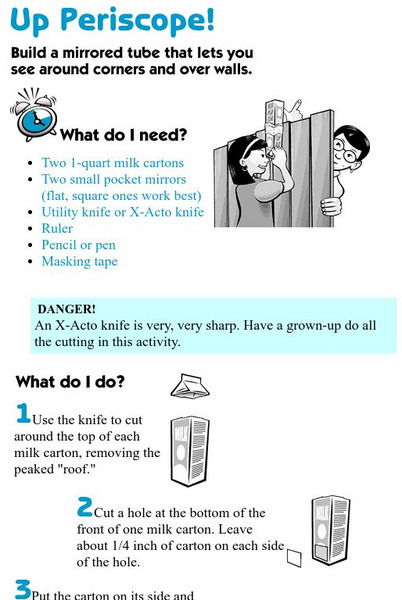
Exploratorium: Up Periscope!
Children can look around corners with this homemade periscope. Great instructions at this Exploratorium site on how to build a periscope.

Other
Nea: The Pillars of Planning, Mission, Values, Vision
Discusses the writing of mission, value, and vision statements. Discusses all the approaches you can use to write them.
Donald Clark
Visioning
Lesson plan, complete with scenario, for practice in writing a vision statement.
Physics Classroom
The Physics Classroom: Light Waves/color: Visible Light and the Eye's Response
Students learn how the eye responds to visible light, and how that function ultimately allows us to see.
Physics Classroom
The Physics Classroom: Refraction/ray Model of Light: Image Formation/detection
Students discover the four parts of the eye are the most instrumental in the task of producing images that are discernible by the brain.
CK-12 Foundation
Ck 12: Life Science: 11.48 Eyes
Learn about the structure and function of the human eye.