Hi, what do you want to do?






Curated OER
Idler Pulley Lesson
Students interpret drawings and reproduce them in a CAD format. In this design lesson students complete an assembly drawing of a pulley system.

Curated OER
Brown Paper Bag Simple Machine
Students explore simple machines. In this simple machines science lesson, students work with a partner to identify what kind of simple machine is represented by a variety of household objects placed in paper bags. Students...

Curated OER
Simple Machines - Museum of Science and Industry
In this museum student guide worksheet, students make a mini-book about simple machines to be used during a visit to the Museum of Science and Industry. They locate the exhibits that demonstrate the wedge, inclined plane, screw, lever,...

Curated OER
Simple Machines
For this physics worksheet, students use the clues given on the sheet to complete the crossword puzzle on simple machines. There are 18 clues to solve in the puzzle.

Curated OER
Lift and Pull
Middle schoolers examine the mechanical advantage of pulleys. In this pulleys instructional activity students are given a challenge to help save a whale by setting up different pulleys systems to move it.

Curated OER
Simple Machines
Students discover what simple machines are and identify a gear, a pulley, and a lever. In teams, they build at least two models each of simple machines and challenge them with specific instruction cards. Finally, students present and...

Curated OER
How Do We Use Simple Machines?
In this simple machines worksheet, students will come up with five problems that we use simple machines for to help us solve that particular problem.

Curated OER
Secrets of Lost Empires I-Colosseum
Sixth graders identify how to use pulleys to change the direction of force. Students develop ways to evaluate designs, noting that no one best design exists and that different tasks require different designs. Students designs will vary.
TeachEngineering
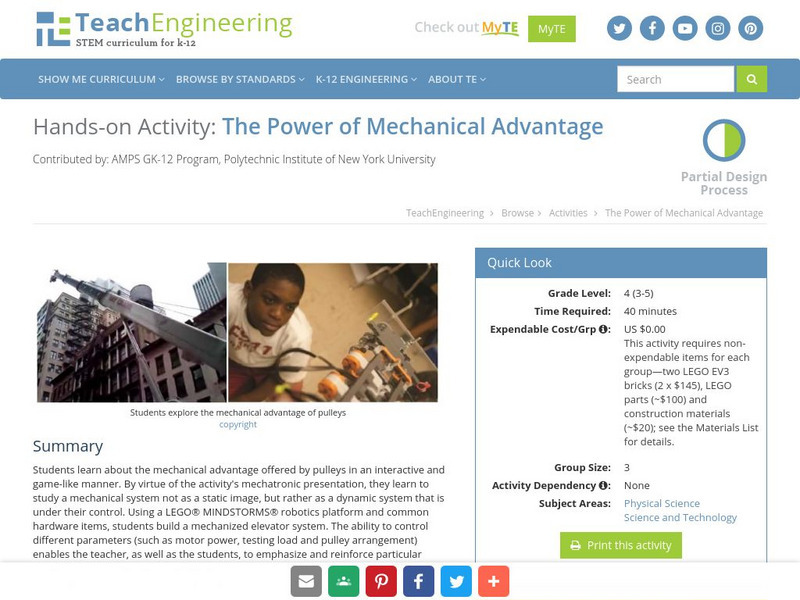
Teach Engineering: The Power of Mechanical Advantage
Students learn about the mechanical advantage offered by pulleys in an interactive and game-like manner. By virtue of the activity's mechatronic presentation, they learn to study a mechanical system not as a static image, but rather as a...