Hi, what do you want to do?






Physics Classroom
The Physics Classroom: Journey of a Typical Electron
In the wires of electric circuits, an electron is the actual charge carrier. In this article, an electron's path through the external circuit is introduced.
State Energy Conservation Office-Texas
State Energy Conservation Office: Learning About Photovoltaic Systems [Pdf]
Explains how photovoltaic systems work and how Texas homeowners are using them. Discusses how a homeowner can use solar energy and still be on the electricity grid system.
University of Colorado
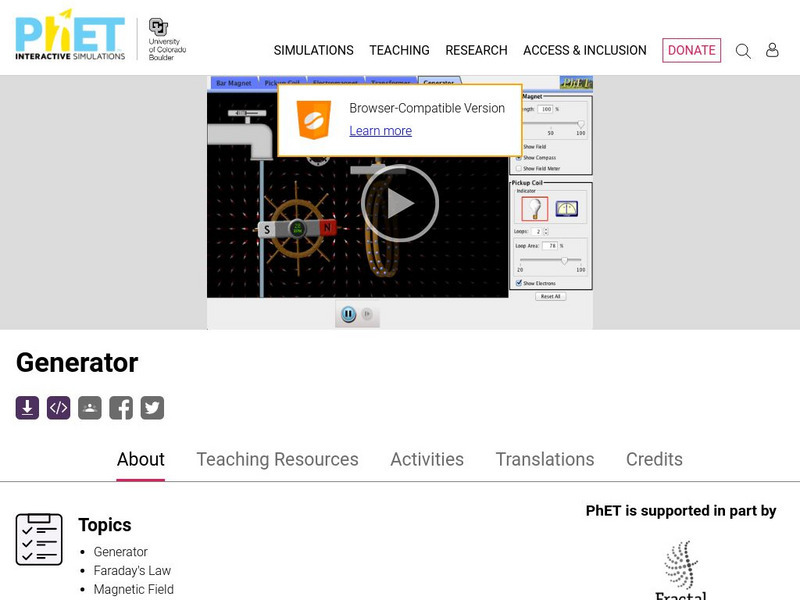
University of Colorado: Ph Et Interactive Simulations: Generator
Generate electricity with a bar magnet! Discover the physics behind the phenomena by exploring magnets and how you can use them to make a bulb light. Java required.

Other
California Energy Commission: Science Projects
A number of electrical, nuclear, solar, and wind science projects and energy activities are described on this page, with links to each activity.
Utah Education Network
Uen: Trb 3:5 Investigation 6 Heat From Machines
Learn how heat energy can be produced by mechanical and electrical machines.
National High Magnetic Field Laboratory
Magnet Academy: Luigi Galvani
Luigi Galvani was a pioneer in the field of electrophysiology, the branch of science concerned with electrical phenomena in the body. His experiments with dissected frogs and electrical charges led him to suggest the existence of a...
National High Magnetic Field Laboratory
Magnet Academy: Hans Christian Orsted
A discovery by Hans Christian Orsted forever changed the way scientists think about electricity and magnetism. While preparing to perform an experiment during a lecture at the University of Copenhagen, he found that the magnetized needle...
National High Magnetic Field Laboratory
Magnet Academy: Michael Faraday
A self-educated man with a brilliant mind, Michael Faraday was born in a hardscrabble neighborhood in London. Through the combination of insatiable curiosity and a powerful will to succeed, he transcended his austere beginnings to...
National High Magnetic Field Laboratory
Magnet Academy: William Crookes
English scientist William Crookes was very innovative in his investigations with vacuum tubes and designed a variety of different types to be used in his experimental work. Crookes tubes are glass vacuum chambers that contain a positive...
Physics Classroom
The Physics Classroom: Static Electricity: Lesson 2: Charging by Induction
Investigate how to charge objects by induction. Follow up with the suggested interactivity which helps drive home the concept of charging by induction and ends with a game. Test understanding of the concept with provided comprehension...
eSchool Today
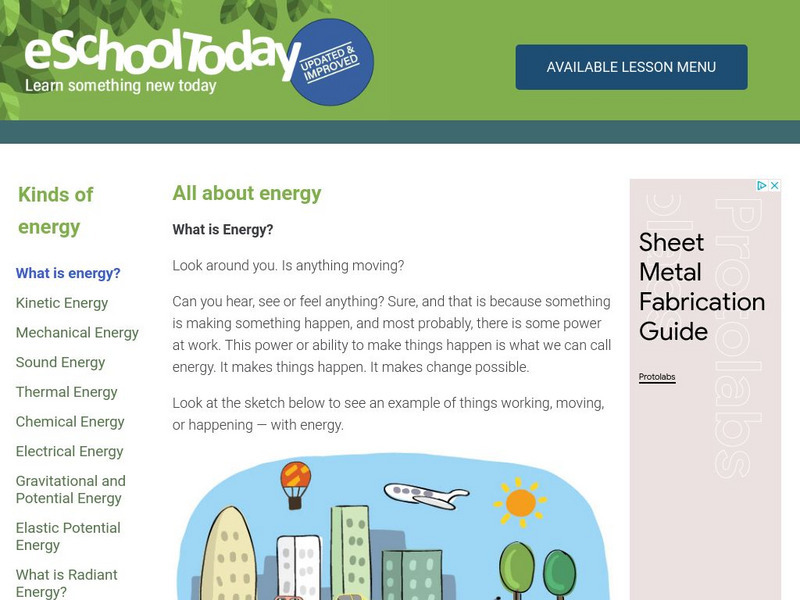
E School Today: Energy
Explains different kinds of energy, covering kinetic, potential, gravitational, mechanical, sound, thermal, chemical, electrical, and radiant energy. Also looks at storage, transfer, and dissipation of energy. Includes a short...
National Geographic
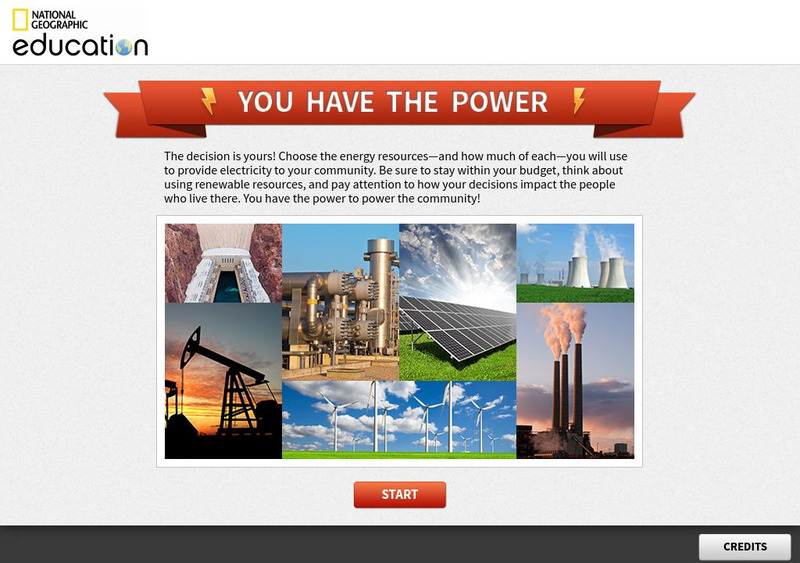
National Geographic: You Have the Power
What factors are important to consider in order to make informed energy decisions? In this interactive, you select one of three locations and the energy resources and then try to provide 100% of that community's electricity needs while...
Exploratorium
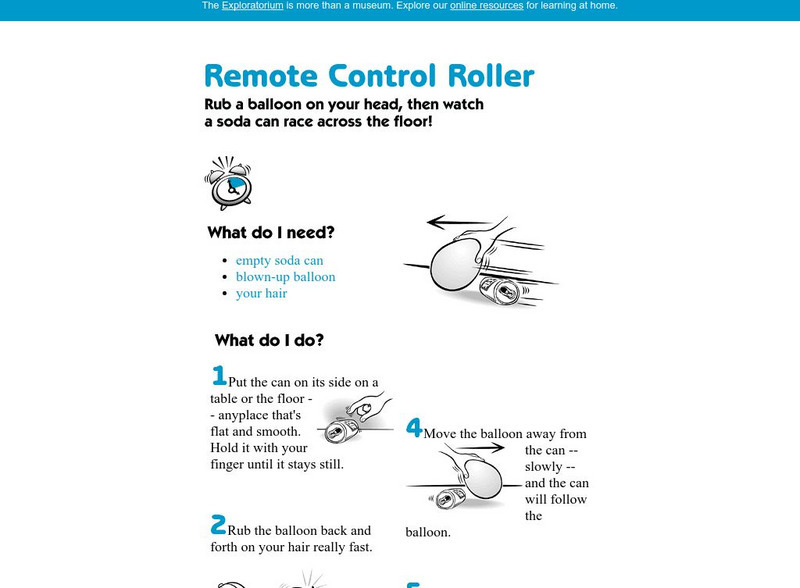
Exploratorium: Remote Control Roller
Students can make a empty soda can roll with an electrically charged balloon.
National High Magnetic Field Laboratory
Magnet Academy: Wimshurst Machine 1880
In the modern world, virtually everyone is familiar with electricity as an accessible, essential form of energy. In electricity's earlier days, scientists used the buildup and release of static electricity.

National High Magnetic Field Laboratory
Magnet Academy: William Thomson, Lord Kelvin
William Thomson, known as Lord Kelvin, was one of the most eminent scientists of the nineteenth century and is best known today for inventing the international system of absolute temperature that bears his name. He made contributions to...
Curated OER
A View on Cities: New York: General Electric Building
General Electric Building (New York)
University of Colorado
University of Colorado: Ph Et Interactive Simulations: Circuit Construction Kit
Build circuits with resistors, light bulbs, batteries, and switches. Take measurements with the realistic ammeter and voltmeter. View the circuit as a schematic diagram, or switch to a life-like view.
PBS
Pbs: Tesla, Master of Lighting
Inventor Nikola Tesla is the subject of this extensive PBS site. In addition to information on Tesla's life and work, the site offers insight into the ways in which society and invention affect each other.
National High Magnetic Field Laboratory
Magnet Academy: Wheatstone Bridge 1843
Read about the device used for measuring resistance in a circuit which was discovered in 1843, but had been invented a decade earlier. The inventor's name was not Wheatstone.
Physics Classroom
The Physics Classroom: Requirements of a Circuit
What four arrangements would result in the successful lighting of a lightbulb? And more importantly, what does each of the four arrangements have in common that would lead to an understanding of the two requirements of an electric...
CK-12 Foundation
Ck 12: Voltage
[Free Registration/Login may be required to access all resource tools.] This lesson looks at what voltage is and how to solve problems involving voltage. Includes a simulation for exploring how charges work in an electric field.
Science Education Resource Center at Carleton College
Serc: Do All Types of Lights Follow Ohm's Law?
In this physics lab students investigate whether Ohm's Law applies to common electric devices. Students submit their findings in a written report or class discussion.
Physics Classroom
The Physics Classroom: Resistance
An electron traveling through the wires and loads of the external circuit encounters resistance. In this tutorial, the concept of resistance is introduced. For an electron, the journey from terminal to terminal is not a direct route....
CK-12 Foundation
Ck 12: Combined Series Parallel Circuits
[Free Registration/Login may be required to access all resource tools.] Presents methods for solving electrical circuit problems where there is a combination of series and parallel circuit features.