Hi, what do you want to do?






Concord Consortium
Making and Breaking Bonds: The Effect of Temperature
Time to turn the heat up on your next bonding lesson! Young chemists explore temperature, kinetic energy, and bonding through an interesting interactive. The controls allow individuals to vary the temperature, as well as pause progress...

Concord Consortium
Reaction Between Hydrogen and Oxygen Molecules
When molecules of hydrogen and oxygen are combined, how does water form? Science scholars observe changes in kinetic and potential energy during a chemical reaction in an interactive. The resource features easy controls that allow users...

Concord Consortium
Reaction Between Hydrogen and Oxygen Atoms
Is this resource a great way for your class to observe bonding between oxygen and hydrogen? OH yeah! Scholars learn about the changes in kinetic and potential energy as molecules of oxygen and hydrogen interact. Kinetic, potential, and...

Concord Consortium
Van de Graaff Discharge
Your class will definitely get a charge out of an electric interactive! Show young scientists what really happens when you place a wand near a Van de Graaff generator using a simulation. Pupils add varying amounts of negative charge to...

PHET
Masses and Springs
Have you ever stretched out a Slinkie so much it wouldn't go back to its original shape? Slinkies, like all springs, follow Hooke's Law. A simulation uses springs and masses to demonstrate kinetic, potential, and thermal energy. It...

PHET
Pendulum Lab
How would a pendulum work on the moon or Jupiter? To answer that question scholars control up to two pendulums including their location, length, mass, and amplitude. Added controls include changing the friction and strength of gravity....

CK-12 Foundation
Electric Analogies
We can see the result of electricity but not the process itself. The simulation compares electric circuits to a water tower and water wheel cycle. Young scientists adjust the height of the tower, the amount of resistance, and if...

PBS
Real-World Ratio and Rate Reasoning: How to Power the Skate Park
Bring on the lights! Using an interactive, characters try to figure out how to light a skate park by examining area and ratios to determine the number of solar panels needed to power them. Pupils design a house with a roof to hold solar...

American Museum of Natural History
Talking to Fireflies
Fireflies are more than just mobile twinkle lights. An online interactive lesson teaches individuals about the light patterns fireflies use to communicate with each other. After they practice the patterns themselves, they could be...

American Museum of Natural History
What's This? Breathing
Crazy fact: Some animals can survive months without oxygen. An online resource describes some unique ways animals collect oxygen and even live without it for an extended time. Learners read about these special animals and use pop-up...

American Museum of Natural History
You are the Queen
A day in the life of a wasp queen is not as royal as it may sound. Pupils assume the role of the wasp queen to complete an interactive activity that simulates building a colony. They make decisions along the way and note the changes from...

Curated OER
Silas Marner by George Eliot
For this online interactive reading comprehension worksheet, students respond to 12 multiple choice questions about Silas Marner. Students may submit their answers to be scored.

Curated OER
Global Climate Change
In this environmental science worksheet, students read and study online resources on global climate change to complete 8 short answer questions on the topic.

Curated OER
Cavy Care 101
For this cavy care worksheet, students complete a ten question multiple choice online interactive quiz about details related to the care of guinea pigs. Prior knowledge is assumed.

Curated OER
Explorit's Tasty Food Quiz
In this foods worksheet, students complete a five question multiple choice online interactive worksheet about foods that we eat.
US Department of Energy
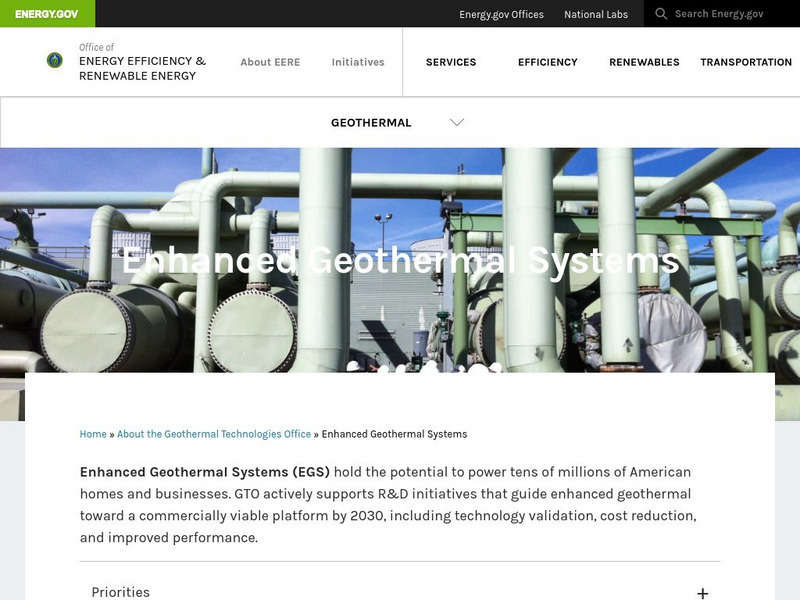
U.s. Department of Energy: Geothermal Technologies: Enhanced Geothermal System
Through both an interactive animation and a short video, learn about the enhanced geothermal system as a means to utilize the Earth's heat as an energy source for our electricity needs.

Concord Consortium
Concord Consortium: Energy of a Pendulum
In this interactive, drag a pendulum to set its initial height and observe how height is related to potential energy. Then release the pendulum and observe the change from potential energy to kinetic energy, and ultimately to thermal...
University Corporation for Atmospheric Research
Ucar: Energy Choices and Climate Change
Help the Joules family make choices that keep their greenhouse gas emissions low.
University of Colorado
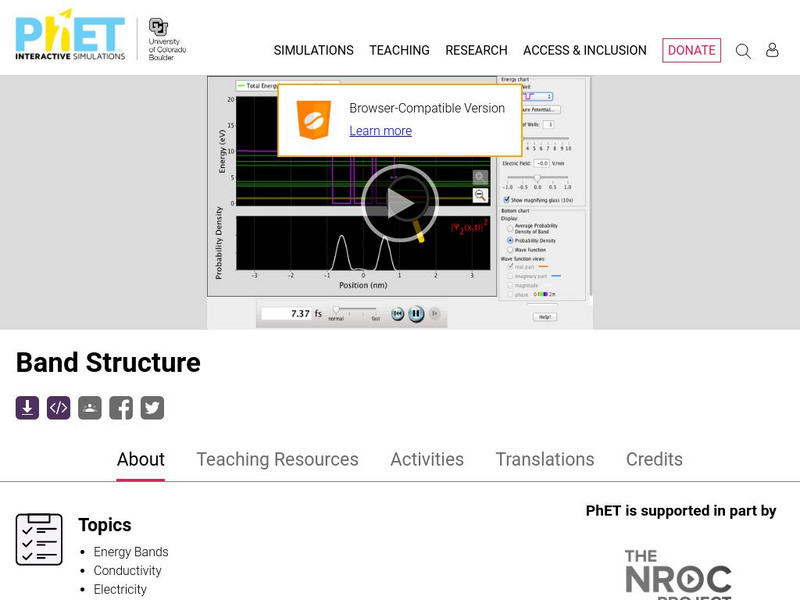
University of Colorado: Ph Et Interactive Simulations: Band Structure
Explore the origin of energy bands in crystals of atoms. The structure of these bands determines how materials conduct electricity. Java required.
National Geographic
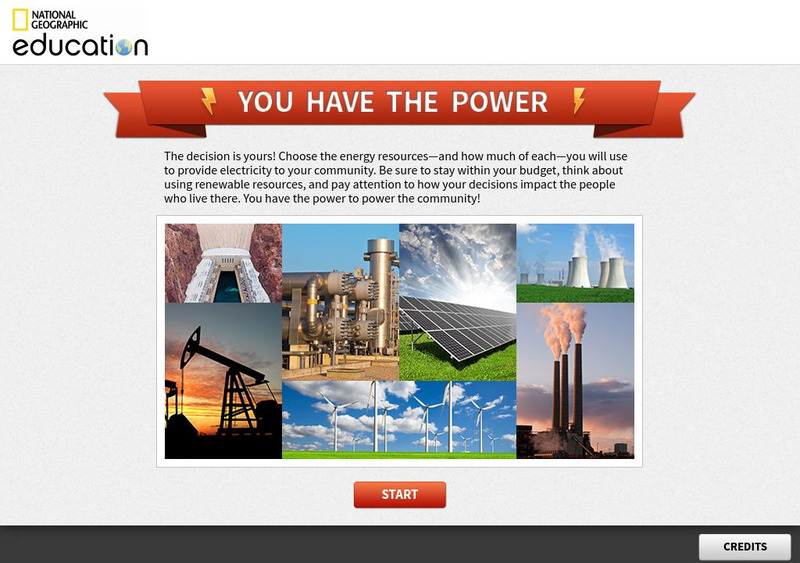
National Geographic: You Have the Power
What factors are important to consider in order to make informed energy decisions? In this interactive, you select one of three locations and the energy resources and then try to provide 100% of that community's electricity needs while...
Georgia State University
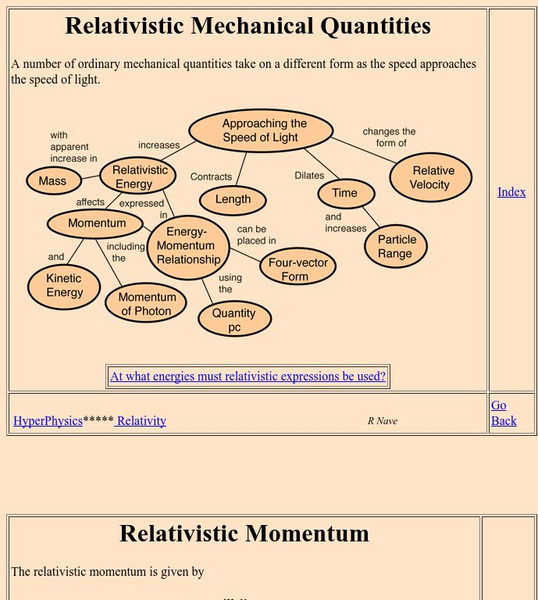
Georgia State University: Hyper Physics: Relativistic Momentum
A clear (as these things go) presentation of the calculation of relativistic momentum. Given with a handy calculator that even calculates the % error. The site goes on to Momentum of a Photon, and to Relativistic Energy in Terms of...
University of Colorado
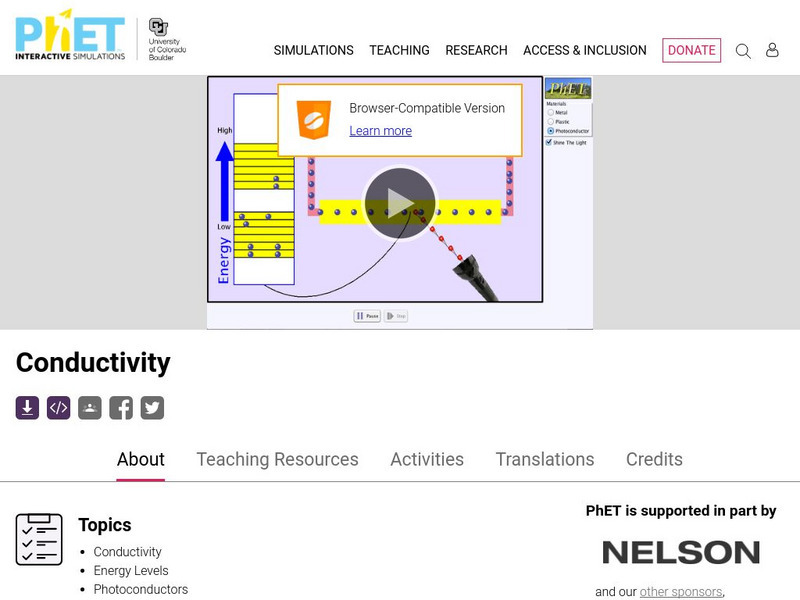
University of Colorado: Ph Et Interactive Simulations: Conductivity
Experiment with conductivity in metals, plastics and photoconductors. See why metals conduct and plastics don't, and why some materials conduct only when you shine a flashlight on them. Java required.
PBS
Kqed: Quest: How Nuclear Reactors Work
This interactive explorer allows students to click on a hot spot on the image and learn more about how nuclear reactors work.
Concord Consortium
Concord Consortium: Protein Folding
Generate all polar, all nonpolar, or random proteins and observe how the protein folds in response to these molecular properties. Explore how the potential energy of the system changes over time to draw conclusions about how proteins...