Hi, what do you want to do?






Curated OER
Adding Flowers
Reinforce counting and early adding skills by singing a counting song. Flowers on the door step 1-2-3! The song counts three flowers then counts three more, when added together there are six.

PBS
Dimetrodon: Our Most Unlikely Ancestor
Dimetrodon lived before flowers, and people often believe it was a dinosaur. Research, however, proves a different story. An informative video teaches more about the dimetrodon, a mammal often confused for a reptile. It explains the...

Steve Spangler Science
Helmet Safety - Cool Science Fair Project
Here is a very important demonstration on why it's so important to wear helmets when doing any kind of high speed activity. A third grader's science fair project tested four different types of helmet: football, ski, skateboard, and...

TED-Ed
What Causes Economic Bubbles?
What do tulips, real estate, and stock in a pet store have in common? Find out what happens when products or services sell for much more than they are worth.

Steve Spangler Science
The Coin Drop - Sick Science! #005
A simple activity visually demonstrates Newton's first law of motion to your physical science fanatics! Placing an index card atop a glass cup and a penny on top of that, they can flick the card away and the penny will drop straight...

Curated OER
Erupting Volcano - Sick Science! #070
Create your own volcano using this recipe for fun. Using yeast, hydrogen peroxide and water, your class can make their own volcanoes. This is an easy way to illustrate this natural phenomenon as well as chemical reactions.

Steve Spangler Science
Homemade Ice Cream - Sick Science! #041
Here is the recipe for making ice cream in a couple of zip-top plastic bags. It is a fun way to demonstrate phase changes, especially when the weather is hot! Use this in your elementary science curriculum when introducing the states of...

Steve Spangler Science
Make Your Own Compass - Sick Science! #072
Have your class create their own compass. Using a needle, a container of water and a magnet, have learners explore magnetism. They will love making this useful tool and it will reinforce the fact that Earth has a magnetic field.

Khan Academy
Khan Academy: Vi Hart: Doodling in Math: Spirals, Fibonacci (Part 2 of 3)
Video explaining the principle by which plants arrange their flowers in order to maximize the gathering of sunlight, which relates to the Fibonacci series. [6:14]
![Khan Academy: Doodling in Math: Spirals, Fibonacci, and Being a Plant [2 of 3] Instructional Video](https://content.lessonplanet.com/knovation/original/216461-33e632cc59d8e94228867477311382f4.jpg?1661822532 "Khan Academy: Doodling in Math: Spirals, Fibonacci, and Being a Plant [2 of 3] Instructional Video")
Khan Academy
Khan Academy: Doodling in Math: Spirals, Fibonacci, and Being a Plant [2 of 3]
Video explaining the principle by which plants arrange their flowers in order to maximize the gathering of sunlight, which relates to the Fibonacci series.

Khan Academy
Khan Academy: The Great Mystic Virupa
Virupa is shown as an unorthodox figure with bulging eyes, a bushy beard, a large nose, and an expressive face. He wears flowers in his hair and a meditation band around his knee to keep his limbs in place during prolonged meditation....
Bozeman Science
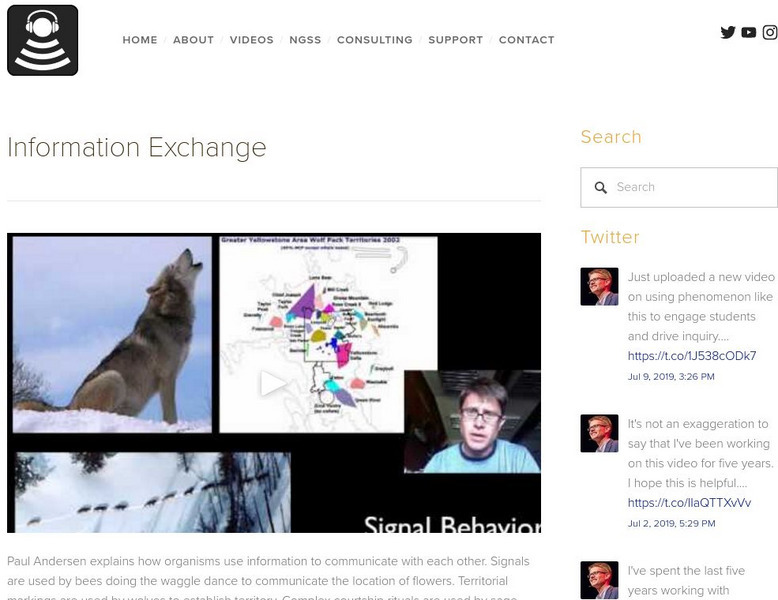
Bozeman Science: Information Exchange
Paul Andersen explains how organisms use information to communicate with each other. Signals are used by bees doing the waggle dance to communicate the location of flowers. Territorial markings are used by wolves to establish territory....