Hi, what do you want to do?






Curated OER
Rivers And Capitals
Students become familiar with the use of GIS for research and become aware of the importance of rivers to cities. They also analyze the placement of cities and learn the names of rivers in the United States.

Curated OER
Unit on Globalization and the Environment
Twelfth graders analyze issues affecting ecosystems. They examine the relationships between members of the international comunity. They also examine the concept of sustainable development.

Curated OER
Low-country Rice Planting and Cooking
Eighth graders compare the use of rice in the 1700s to the modern use of rice. In this lesson examining the importance of rice in US history, 8th graders learn about the role of rice in the early 1700s and compare the use of rice in...

Curated OER
Fisheries
High schoolers research and report on the ocean's problems of disappearing or diminishing species around the world. students examine ecosystems and food chains and present their findings to a mock panel of science experts.

Curated OER
"I've Been Working on the Railroad" - Federal Land Grants and the Construction of the Illinois Central Railroad in Mid-nineteenth Century Illinois
Eleventh graders, in groups, design a self-sufficient community. Groups present the communities they've designed. They compare and contrast the communities presented. They research the theories of Johann Heinrich von Thunen online and...

Curated OER
Australia's Religious Diversity
Students identify major world religions and forms of spirituality and recognise the religious diversity of communities in Australia. They brainstorm for the definition of religion. Students brainstorm to come up with a list of religions.

Curated OER
Immigration
Students explore the concept of immigration. In this immigration lesson plan, students read literature, analyze photographs, and evaluate political cartoons that reflect feelings about immigration in America during Industrialization....

Curated OER
The Arctic and Taiga Ecozone of Canada
Students examine the various sub-regions of the Arctic and Taiga zones in Canada. Using the online Canadian Atlas, they locate and describe the characteristics of each zone. They organize their information into a chart and share it with...

Curated OER
A Canadian Inventory: The Way We Are!
Students use the Canadian Atlas to discover an inventory of Canada's wealth and usage of resources. Using charts and graphs, they produce a wall of selected data of importance to the country and identify one issue of sustainability. ...

Curated OER
The Landscape Through Geographer's Eyes
Students examine different types of landscapes through a geographer's eye. Using a city block or a suburb, they organize their thoughts and take notes to survey a site. They discuss what they have seen and write about how looking at...

Khan Academy
Khan Academy: Activity: Population Growth
In this activity, you will study and analyze the nature and patterns of human population growth over the last 10,000 years. This will help you understand the differences between population growth before and after the Modern Revolution.

Center for Innovation in Engineering and Science Education, Stevens Institute of Technology
Ciese: Population Growth Project
In this collection of nine lessons, students use data from the U.S. Census to create population growth models and to examine the impact of changes in population factors such as age, demographic, etc.
Georgia Department of Education
Ga Virtual Learning: Ap Human Geography: Population
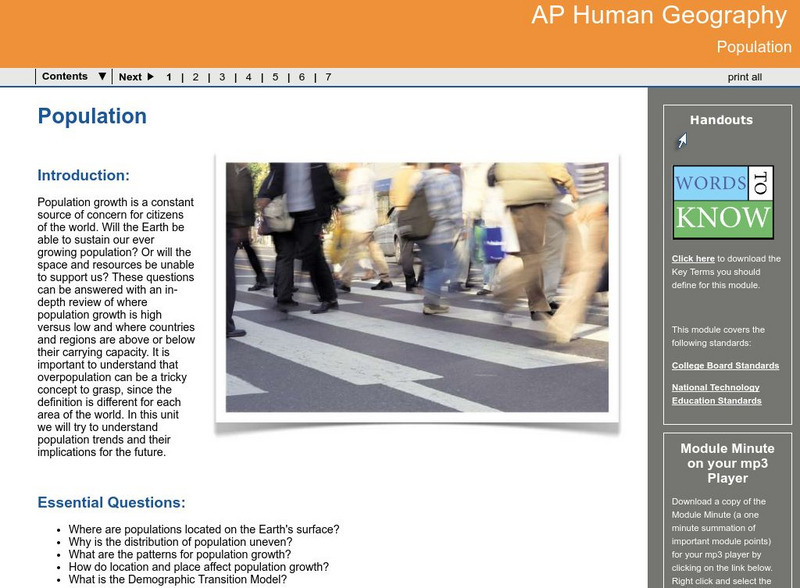
Learning module for AP Human Geography course explores population, including factors affecting distribution and growth.

Khan Academy
Khan Academy: Acceleration
Acceleration, an increase in the rate of change, is occurring both in the Universe and in human culture on planet Earth. This article explains these fascinating changes.