Hi, what do you want to do?






Curated OER
Paste Paper
Students watch the teacher demonstrate the process of making paste paper. They create their own wheat paste papers following the example of the teacher. Students make several pieces of paste paper, and use them to make collages.

Curated OER
Pattern Makers
Students are introduced to the notion of a repeating pattern. This is done by a number of means including the use of everyday objects. They are encouraged to create, describe and continue patterns.

Curated OER
Happy Birthday Martin Luther King
First graders listen to the book Happy Birthday Martin Luther King and sing a song about him. In this reading lesson, 1st graders develop listening skills as they listen to the book. They also discuss their feelings about the laws that...

Curated OER
The Way Things Work
Students explore how things are designed, built and function. Students interpret the film The Swiss Family Robinson. Students discuss and analyze medieval technology and the amazing craftsmen and stoneworkers it took to build such...
TeachEngineering
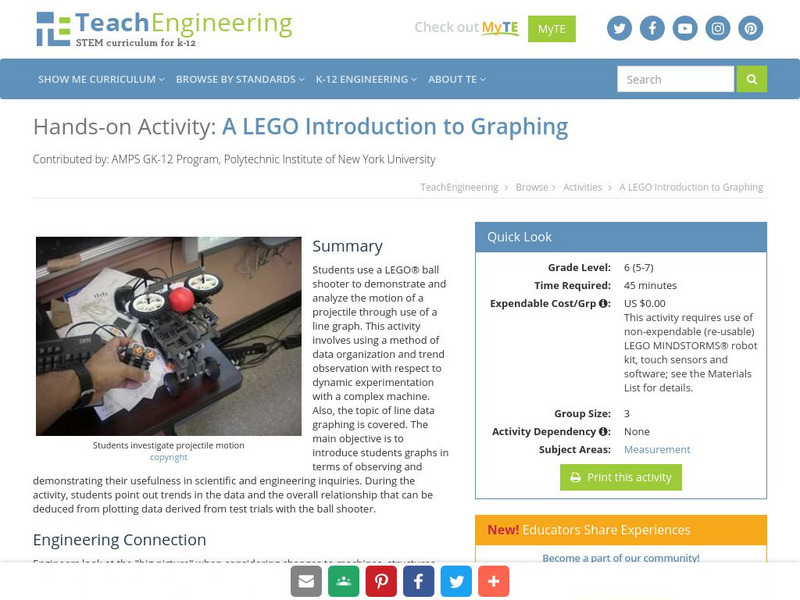
Teach Engineering: A Lego Introduction to Graphing
Students use a LEGO ball shooter to demonstrate and analyze the motion of a projectile through use of a line graph. This activity involves using a method of data organization and trend observation with respect to dynamic experimentation...
TeachEngineering
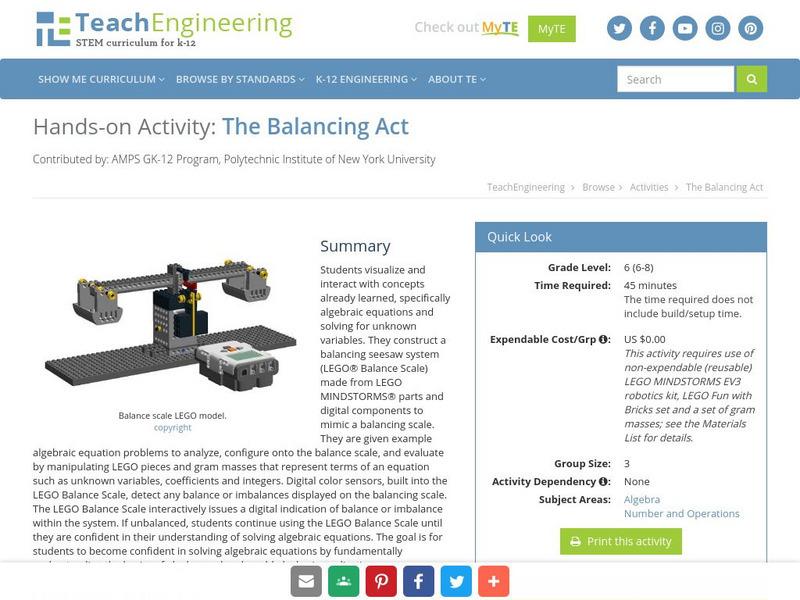
Teach Engineering: The Balancing Act
Students are given the opportunity to visualize and interact with concepts they have already learned, specifically algebraic equations and solving for unknown variables. Students construct a balancing seesaw system (LEGO Balance Scale)...
TeachEngineering
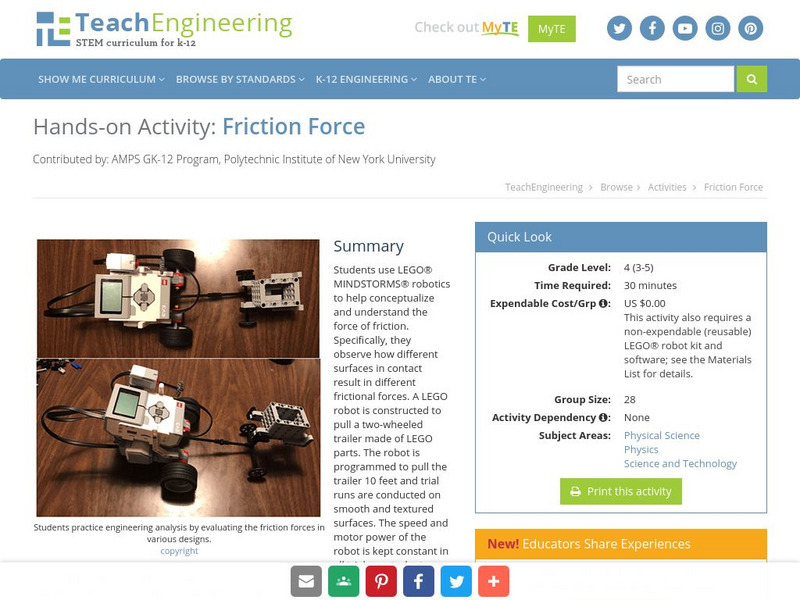
Teach Engineering: Friction Force
Students use LEGO MINDSTORMS robotics to help conceptualize and understand the force of friction. Specifically, they observe how different surfaces in contact result in different frictional forces. A LEGO robot is constructed to pull a...
TeachEngineering
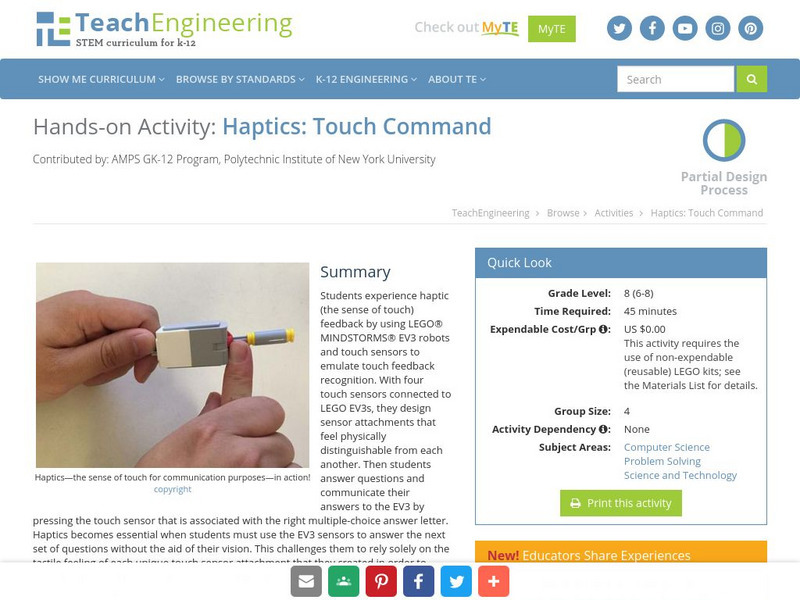
Teach Engineering: Haptics: Touch Command
Students experience haptic (the sense of touch) feedback by using LEGO MINDSTORMS NXT robots and touch sensors to emulate touch feedback recognition. With four touch sensors connected to LEGO NXTs, they design sensor attachments that...
TeachEngineering
Teach Engineering: Rock, Paper, Scissors Probability!
Students learn about probability through a LEGO MINDSTORMS NTX-based activity that simulates a game of "rock-paper-scissors." The LEGO robot mimics the outcome of random game scenarios in order to help students gain a better...
TeachEngineering
Teach Engineering: You've Got Triangles!
Students learn about trigonometry, geometry and measurements while participating in a hands-on interaction with LEGO MINDSTORMS NXT technology. First they review fundamental geometrical and trigonometric concepts. Then, they estimate the...
TeachEngineering
Teach Engineering: Determining Concentration
Students quantify the percent of light reflected from solutions containing varying concentrations of red dye using LEGO MINDSTORMS NXT bricks and light sensors. They begin by analyzing a set of standard solutions with known...
TeachEngineering
Teach Engineering: Decimals, Fractions & Percentages
Students learn about and practice converting between fractions, decimals and percentages. Using a LEGO MINDSTORMS NXT robot and a touch sensor, each group inputs a fraction of its choosing. Team members convert this same fraction into a...
TeachEngineering
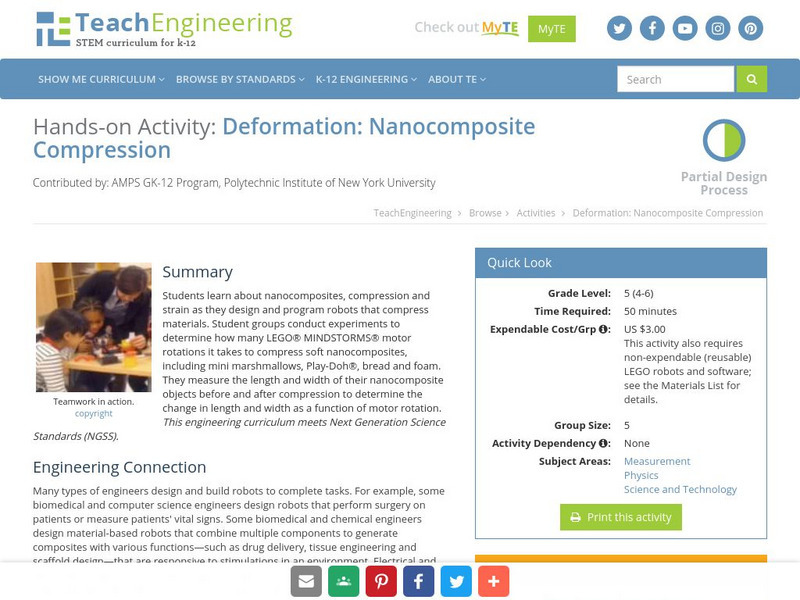
Teach Engineering: Deformation: Nanocomposite Compression
Students learn about nanocomposites, compression and strain as they design and program robots that compress materials. Student groups conduct experiments to determine how many LEGO MINDSTORMS NXT motor rotations it takes to compress soft...
TeachEngineering
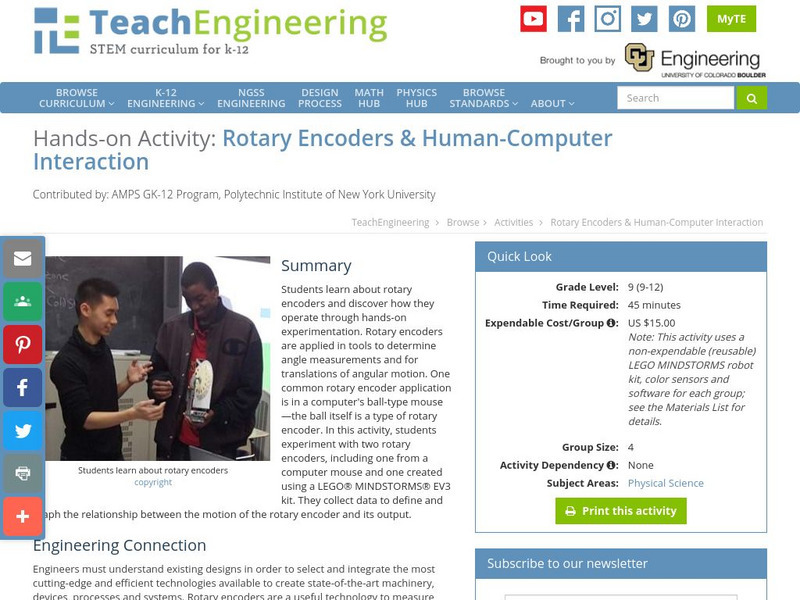
Teach Engineering: Rotary Encoders & Human Computer Interaction
Students learn about rotary encoders and discover how they operate through hands-on experimentation. Rotary encoders are applied in tools to determine angle measurements and for translations of angular motion. One common rotary encoder...
TeachEngineering
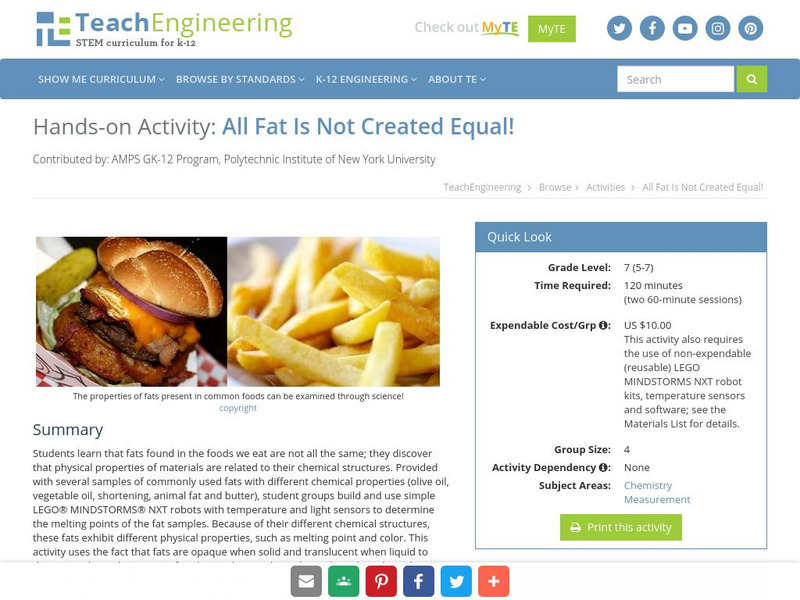
Teach Engineering: All Fat Is Not Created Equally!
Students learn that fats found in the foods we eat are not all the same; they discover that physical properties of materials are related to their chemical structures. Provided with several samples of commonly used fats with different...
TeachEngineering
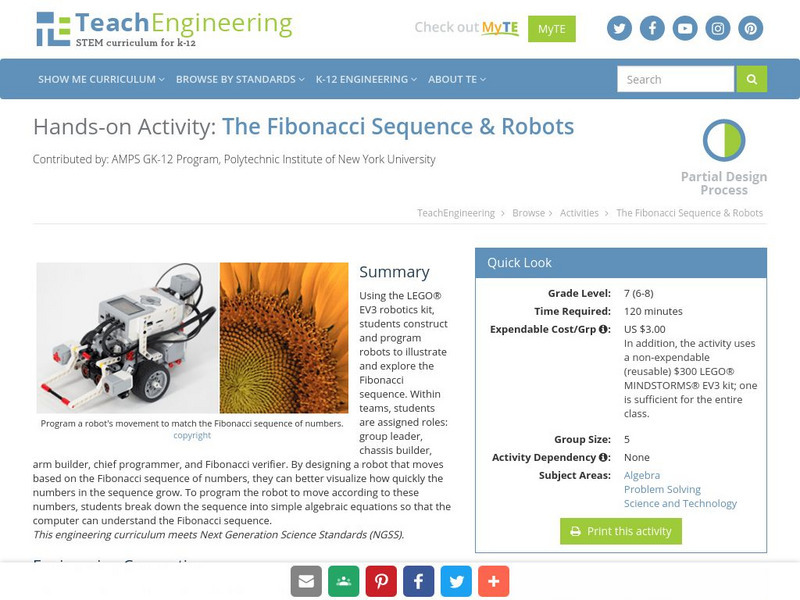
Teach Engineering: The Fibonacci Sequence & Robots
Using the LEGO NXT robotics kit, students construct and program robots to illustrate and explore the Fibonacci sequence. Within teams, students are assigned roles: group leader, chassis builder, arm builder, chief programmer, and...

TeachEngineering
Teach Engineering: Wide World of Gears
In an interactive and game-like manner, students learn about the mechanical advantage that is offered by gears. By virtue of the activity's mechatronics presentation, students learn to study a mechanical system as a dynamic system under...
TeachEngineering
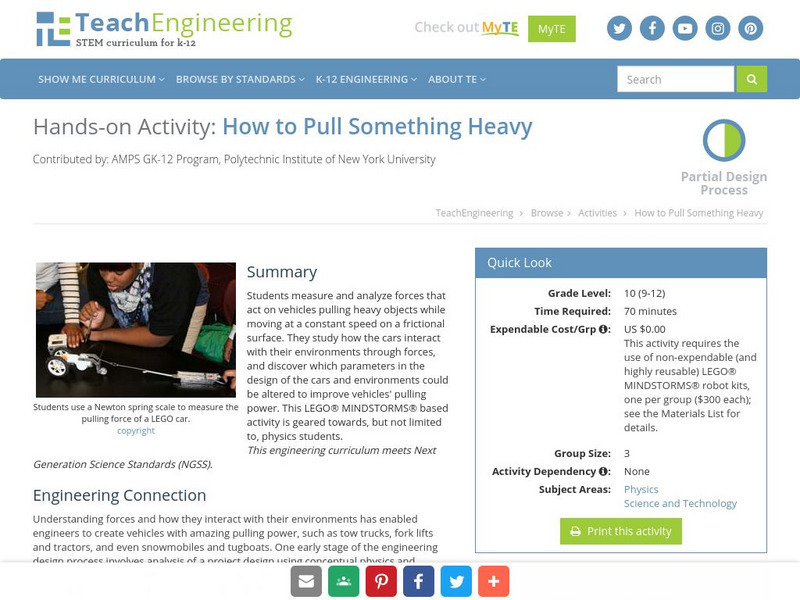
Teach Engineering: How to Pull Something Heavy
Students measure and analyze forces that act on vehicles pulling heavy objects while moving at a constant speed on a frictional surface. They study how the cars interact with their environments through forces, and discover which...
TeachEngineering
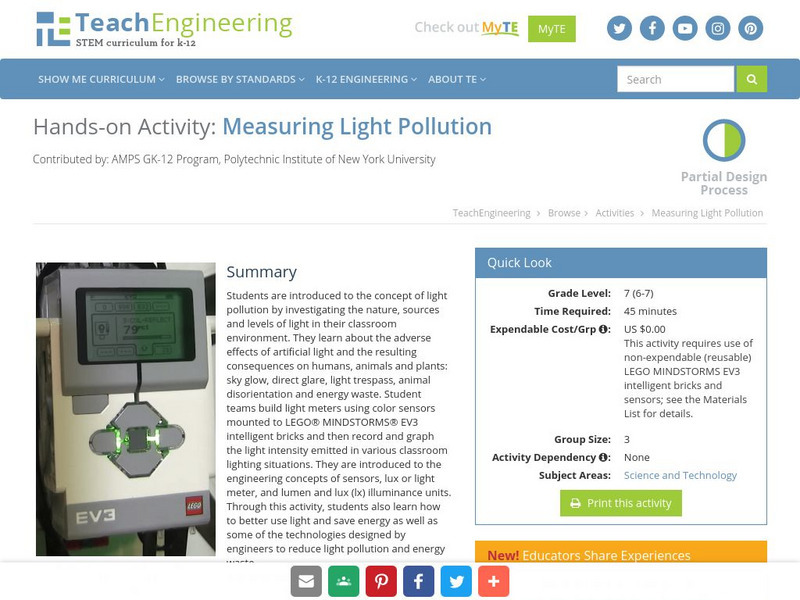
Teach Engineering: Measuring Light Pollution
Students are introduced to the concept of light pollution by investigating the nature, sources and levels of light in their classroom environment. They learn about the adverse effects of artificial light and the resulting consequences on...
TeachEngineering
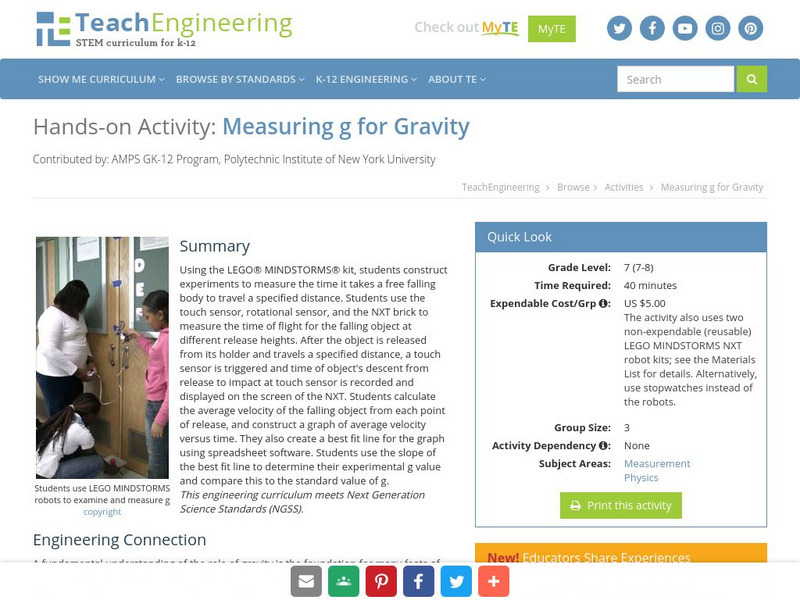
Teach Engineering: Measuring G
Using the LEGO MINDSTORMS NXT kit, students construct experiments to measure the time it takes a free falling body to travel a specified distance. Students use the touch sensor, rotational sensor, and the NXT brick to measure the time of...
TeachEngineering
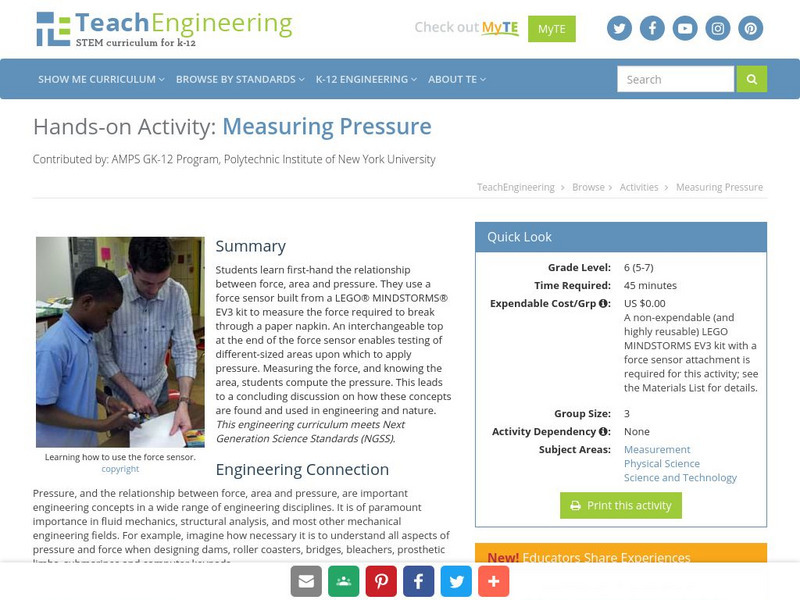
Teach Engineering: Measuring Pressure
Students learn first-hand the relationship between force, area and pressure. They use a force sensor built from a LEGO MINDSTORMS NXT kit to measure the force required to break through a paper napkin. An interchangeable top at the end of...

TeachEngineering
Teach Engineering: Means, Modes, and Medians
Students experience data collection, analysis and inquiry in this LEGO MINDSTORMS NXT -based activity. They measure the position of an oscillating platform using a ultrasonic sensor and perform statistical analysis to determine the mean,...
TeachEngineering
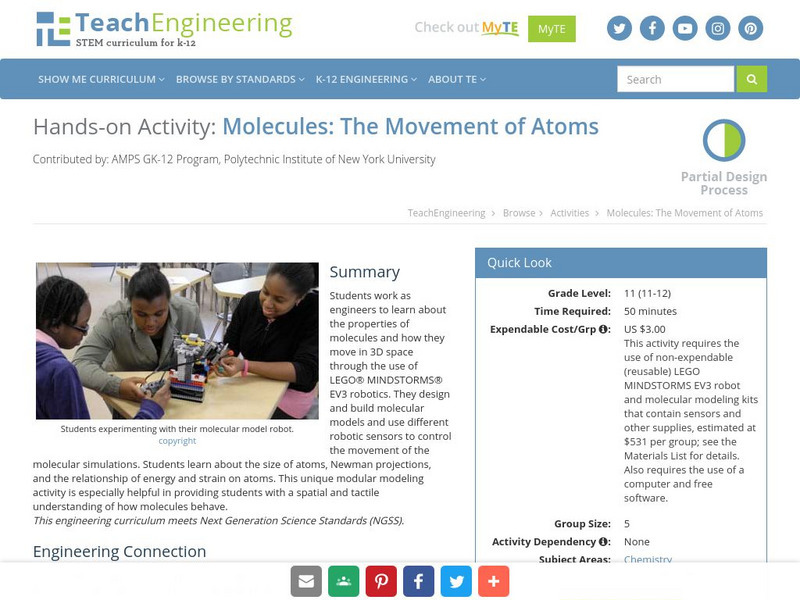
Teach Engineering: Molecules: The Movement of Atoms
Students work as engineers to learn about the properties of molecules and how they move in 3D space through the use of LEGO MINDSTORMS NXT robotics. They design and build molecular models and use different robotic sensors to control the...
TeachEngineering
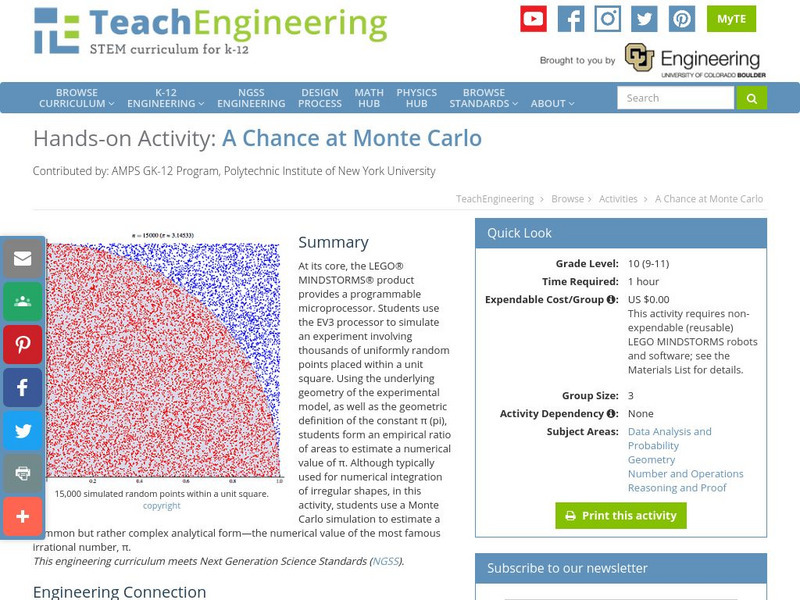
Teach Engineering: A Chance at Monte Carlo
At its core, the LEGO MINDSTORMS product provides a programmable microprocessor. Students use the EV3 processor to simulate an experiment involving thousands of uniformly random points placed within a unit square. Using the underlying...