Hi, what do you want to do?






Science Struck
Science Struck: History of Who Discovered Magnets and Other Facts
Learn how magnets were discovered and some of their many uses.
Georgia State University
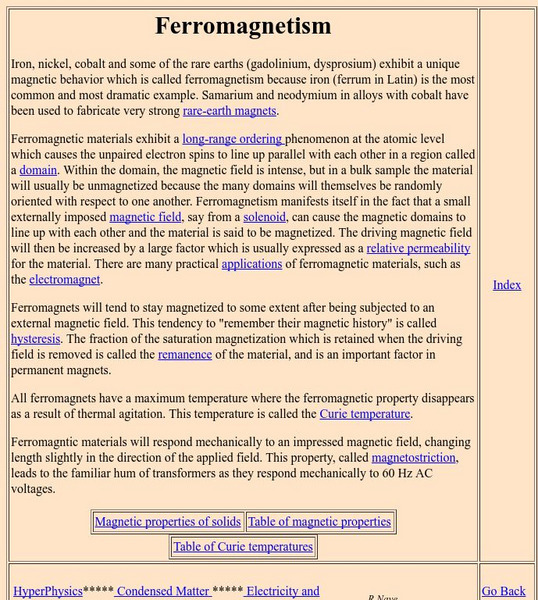
Georgia State University: Hyper Physics: Magnetic Domains
A great introduction to magnetic domains, including pictures which illustrate the effect on domains caused by external applied magnetic fields.
National High Magnetic Field Laboratory
Magnet Academy: Iron Hidden in Your Food
An activity where students investigate how much iron is in a sample of breakfast cereal.

National Institutes of Health
Niehs: Kids' Pages: What Are Electric and Magnetic Fields?
Informational fact sheet on electricity with emphasis on electric and magnetic fields.
National High Magnetic Field Laboratory
Magnet Academy: Svante Arrhenius
Svante Arrhenius was born in Vik, Sweden, and became the first native of that country to win the Nobel Prize. The award for chemistry was bestowed to him in honor of his theory of electrolytic dissociation. Arrhenius also developed the...
National High Magnetic Field Laboratory
Magnet Academy: Richard Feynman
Theoretical physicist Richard Phillips Feynman greatly simplified the way in which the interactions of particles could be described through his introduction of the diagrams that now bear his name (Feynman diagrams) and was a co-recipient...
National High Magnetic Field Laboratory
Magnet Academy: Robert Millikan
Robert Andrews Millikan was a prominent American physicist who made lasting contributions to both pure science and science education. He is particularly well known for his highly accurate determination of the charge of an electron via...
National Institutes of Health
Natural Course of Muliple Sclerosis Redefined
National Institute of Neurological Disorders and Stroke (NINDS) presented evidence that MS is a progressive disease from its onset. By using the magnetic resonance imaging (MRI) researchers have discovered MS can be active when symptoms...
Other
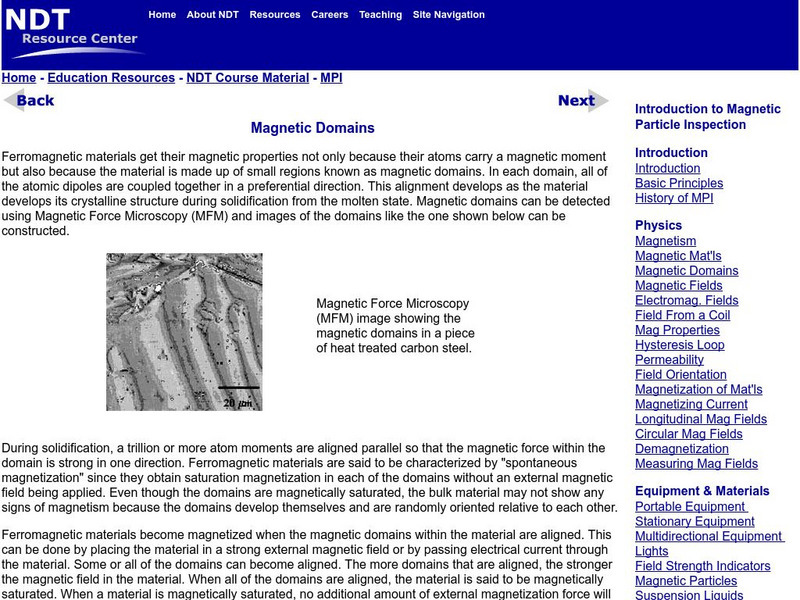
Ndt Resource Center: Magnetic Domains
This site is an introduction to magnetic domains, including a picture showing distinct domains taken through a process called "Magnetic force microscopy."

National High Magnetic Field Laboratory
Magnet Academy: Smoothing Iron 1882
Although not as celebrated as many other scientific inventions, the smoothing iron has its own rich history of development stretching all the way from 400 B.C. to the present.
National High Magnetic Field Laboratory
Magnet Academy: Wheatstone Bridge 1843
Read about the device used for measuring resistance in a circuit which was discovered in 1843, but had been invented a decade earlier. The inventor's name was not Wheatstone.
National High Magnetic Field Laboratory
Magnet Academy: Walter Brattain (1902 1987)
Walter Houser Brattain discovered the photo-effect that occurs at the free surface of a semiconductor and was co-creator of the point-contact transistor, which paved the way for the more advanced types of transistors that eventually...
National High Magnetic Field Laboratory
Magnet Academy: Gerd Binnig
Gerd Binnig co-developed the scanning tunneling microscope (STM) with Heinrich Rohrer. The STM allowed scientists entry into the atomic world in a new way and was a major advance in the field of nanotechnology. For their achievement,...
National High Magnetic Field Laboratory
Magnet Academy: Georg Bednorz
J. Georg Bednorz jointly revolutionized superconductivity research with K. Alex Muller by discovering an entirely new class of superconductors, often referred to as high-temperature superconductors. They managed to achieve...
National High Magnetic Field Laboratory
Magnet Academy: Wimshurst Machine 1880
In the modern world, virtually everyone is familiar with electricity as an accessible, essential form of energy. In electricity's earlier days, scientists used the buildup and release of static electricity.
National High Magnetic Field Laboratory
Magnet Academy: Willem Einthoven
Willem Einthoven invented a string galvanometer that lead to the electrocardiogram, which measures heart activity. For his discovery, Einthoven was awarded the Nobel Prize in Physiology or Medicine in 1924.
National High Magnetic Field Laboratory
Magnet Academy: Lee De Forest
American inventor Lee De Forest was a pioneer of radio and motion pictures. He received more than 300 patents over the course of his lifetime, the most important of which was for a three-electrode vacuum tube, or triode, that he called...
National High Magnetic Field Laboratory
Magnet Academy: Humphry Davy
Humphry Davy was a pioneer in the field of electrochemistry who used electrolysis to isolate many elements from the compounds in which they occur naturally. Electrolysis is the process by which an electrolyte is altered or decomposed via...
National High Magnetic Field Laboratory
Magnet Academy: William Crookes
English scientist William Crookes was very innovative in his investigations with vacuum tubes and designed a variety of different types to be used in his experimental work. Crookes tubes are glass vacuum chambers that contain a positive...
National High Magnetic Field Laboratory
Magnet Academy: Eric Cornell
Born in Palo Alto, California, and raised in Cambridge, Massachusetts - homes to Stanford and the Massachusetts Institute of Technology, respectively - you could say Eric Cornell was destined to become a renowned scientist. And while he...
National High Magnetic Field Laboratory
Magnet Academy: Leon Cooper
Leon Cooper shared the 1972 Nobel Prize in Physics with John Bardeen and Robert Schrieffer, with whom he developed the first widely accepted theory of superconductivity. Termed the BCS theory, it is heavily based on a phenomenon known as...
National High Magnetic Field Laboratory
Magnet Academy: Heinrich Hertz
The discovery of radio waves, which was widely seen as confirmation of James Clerk Maxwell's electromagnetic theory and paved the way for numerous advances in communication technology, was made by German physicist Heinrich Hertz. In the...
National High Magnetic Field Laboratory
Magnet Academy: Joseph Henry
Joseph Henry was an American scientist who pioneered the construction of strong, practical electromagnets and built one of the first electromagnetic motors. During his experiments with electromagnetism, Henry discovered the property of...
National High Magnetic Field Laboratory
Magnet Academy: Murray Gell Mann
Murray Gell-Mann is a theoretical physicist who won the Nobel Prize for Physics in 1969 for his contributions to elementary particle physics. He is particularly well known for his role in bringing organization into the world of subatomic...