Hi, what do you want to do?





National High Magnetic Field Laboratory
Magnet Academy: Luigi Galvani
Luigi Galvani was a pioneer in the field of electrophysiology, the branch of science concerned with electrical phenomena in the body. His experiments with dissected frogs and electrical charges led him to suggest the existence of a...
National High Magnetic Field Laboratory
Magnet Academy: Enrico Fermi
Enrico Fermi was a titan of twentieth-century physics. He outlined the statistical laws that govern the behavior of particles that abide by the Pauli exclusion principle and developed a theoretical model of the atom in his mid-twenties....
National High Magnetic Field Laboratory
Magnet Academy: Michael Faraday
A self-educated man with a brilliant mind, Michael Faraday was born in a hardscrabble neighborhood in London. Through the combination of insatiable curiosity and a powerful will to succeed, he transcended his austere beginnings to...
National High Magnetic Field Laboratory
Magnet Academy: Lev Davidovich Landau
While growing up in the Soviet Union, Lev Landau was so far ahead of his classmates that he was ready to begin college at age 13. His parents noticed a particular gift for math in their young son, who was considered a prodigy. It came as...
National High Magnetic Field Laboratory
Magnet Academy: John Daniel Kraus
For a man whose career involved the entire known universe, John Kraus had a remarkably insular upbringing. He was born and raised in Ann Arbor, Michigan, and earned his bachelor's, master's and doctoral degrees in physics, all at the...
National High Magnetic Field Laboratory
Magnet Academy: Klaus Von Klitzing
Klaus von Klitzing is a Nobel laureate who won the award in 1985 for his discovery of the quantized Hall effect, sometimes referred to as the quantum Hall effect. Von Klitzing's discovery resulted from his work exploring a phenomenon...
National High Magnetic Field Laboratory
Magnet Academy: Jack Kilby
The integrated circuit fueled the rise of microelectronics in the latter half of the twentieth century and paved the way for the Information Age. An American engineer, Jack Kilby, invented the integrated circuit in 1958, shortly after he...
National High Magnetic Field Laboratory
Magnet Academy: James Joule
James Prescott Joule experimented with engines, electricity and heat throughout his life. Joule's findings resulted in his development of the mechanical theory of heat and Joule's law, which quantitatively describes the rate at which...
National High Magnetic Field Laboratory
Magnet Academy: Karl Jansky
Karl Jansky discovered extraterrestrial radio waves while investigating possible sources of interference in shortwave radio communications across the Atlantic for Bell Laboratories, and is often known as the father of radio astronomy....
National High Magnetic Field Laboratory
Magnet Academy: Siegmund Loewe
Siegmund Loewe was a German engineer and businessman that developed vacuum tube forerunners of the modern integrated circuit. He pioneered both radio and television broadcasting, and the company he established with his brother, David...
National High Magnetic Field Laboratory
Magnet Academy: Wolfgang Pauli
Austrian-born scientist Wolfgang Ernst Pauli made numerous important contributions to twentieth-century theoretical physics, including explaining the Zeeman effect, first postulating the existence of the neutrino, and developing what has...
National High Magnetic Field Laboratory
Magnet Academy: Heike Kamerlingh Onnes
Heike Kamerlingh Onnes was a Dutch physicist who first observed the phenomenon of superconductivity while carrying out pioneering work in the field of cryogenics. An important step on the way to this discovery was his success in...
National High Magnetic Field Laboratory
Magnet Academy: Georg Ohm
Georg Simon Ohm had humble roots and struggled financially throughout most of his life, but the German physicist is well known today for his formulation of a law, termed Ohm's law, describing the mathematical relationship between...
National High Magnetic Field Laboratory
Magnet Academy: Karl Alexander Muller
In their search for new superconductors, Swiss theoretical physicist Karl Alexander Muller and his young colleague, J. Georg Bednorz, abandoned the metal alloys typically used in superconductivity research in favor of a class of oxides...
National High Magnetic Field Laboratory
Magnet Academy: James Clerk Maxwell
James Clerk Maxwell was one of the most influential scientists of the nineteenth century. His theoretical work on electromagnetism and light largely determined the direction that physics would take in the early twentieth century. Indeed,...
National High Magnetic Field Laboratory
Magnet Academy: Theodore Maiman
Theodore Maiman built the world's first operable laser. Ironically, Maiman's first paper announcing this momentous achievement, which many other scientists had been racing to complete themselves, was rejected. Since then, however, lasers...
National High Magnetic Field Laboratory
Magnet Academy: Max Planck
In a career that lasted seven decades, Max Planck achieved an enduring legacy with groundbreaking discoveries involving the relationship between heat and energy, but he is most remembered as the founder of the "quantum theory."
Georgia State University
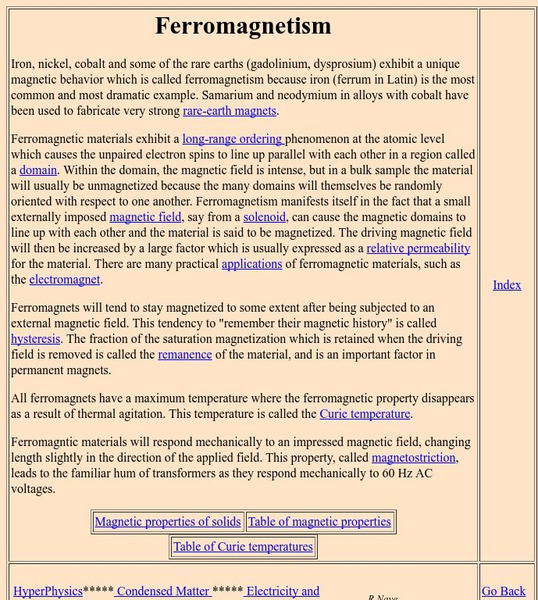
Georgia State University: Hyper Physics: Ferromagnetism
This site from the Georgia State University provides a good overview of ferromagnetic materials, introducing concepts such as magnetic domains, hysteresis, the curie temperature, and magnetostriction.
National High Magnetic Field Laboratory
Magnet Academy: Paul Dirac
Paul Adrien Maurice Dirac was an outstanding twentieth century theoretical physicist whose work was fundamental to the development of quantum mechanics and quantum electrodynamics. He was awarded the Nobel Prize for Physics jointly with...
National High Magnetic Field Laboratory
Magnet Academy: Making a Compass
A well illustrated activity where students make a simple compass. Includes facts about compasses.
University of Colorado
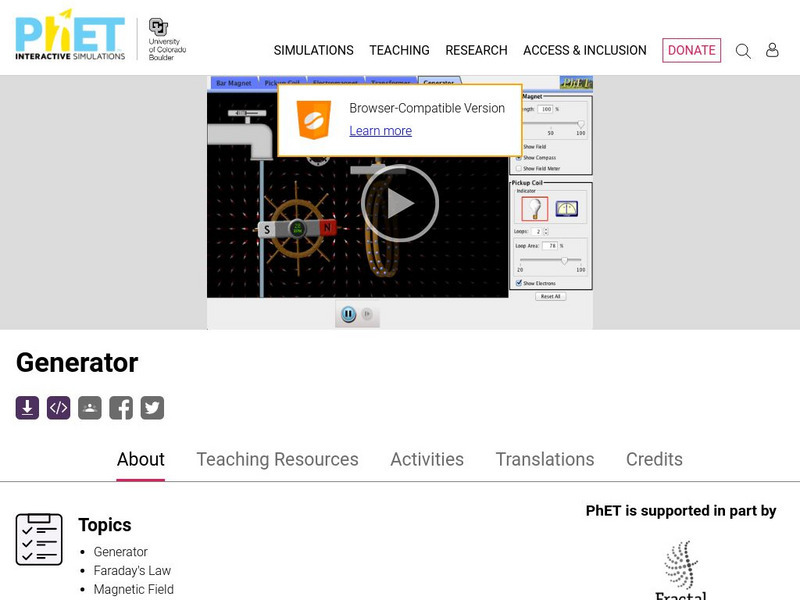
University of Colorado: Ph Et Interactive Simulations: Generator
Generate electricity with a bar magnet! Discover the physics behind the phenomena by exploring magnets and how you can use them to make a bulb light. Java required.
Wikimedia
Wikipedia: Ferromagnetism
This site from Wikipedia provides a wonderful in-depth explanation of ferromagnetism, covering the atomic behavior which is responsible for ferromagnetic properties. Also introduces the concepts of magnetic domains and the Curie...
Wikimedia
Wikipedia: Permeability
This site from the encyclopedia Wikipedia provides a concise definition of magnetic permeability given in terms of magnetic flux density and magnetic field strength.
Wikimedia
Wikipedia: Diamagnetism
Wikipedia.com offers a good introduction to diamagnetism and diamagnetic materials, including discussion of how superconductors exhibit diamagnetic properties.