Hi, what do you want to do?





Ducksters
Ducksters: Astronomy for Kids: Black Holes
On this site, you can learn about mysterious powerful forces that absorb light called black holes. Study the science of black holes in outer space.

University Corporation for Atmospheric Research
Ucar: High Altitude Observatory: Tycho Brahe (1546 1601)
This site contains information about Brahe's contributions to astronomy, and also discusses his planetary model.

Curated OER
Web Gallery of Art: Astronomy
An image of "Astronomy", created by Laurent De La Hire in 1649 (Oil on canvas).
Curated OER
Sky Server: Old Time Astronomy
This site from SkyServer provides information where students are introduced to Galileo and are transported back in time to learn what "Old Time Astronomy," was all about.
NASA
Electromagnetic Spectrum: Ultraviolet Waves
Ultraviolet (UV) light has shorter wavelengths than visible light. Though these waves are invisible to the human eye, some insects can see them. The specific wavelength values are given. Uses and applications of these waves are explained.
University Corporation for Atmospheric Research
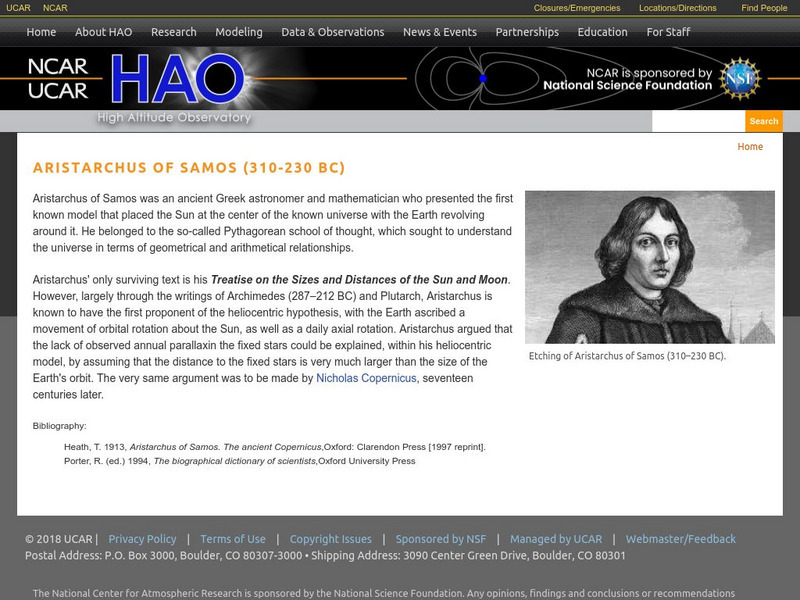
Ucar: High Altitude Observatory: Aristarchus of Samos (310 230 Bc)
A brief biography and discussion of Aristarchus' theories provided here.
Science Buddies
Science Buddies: Using the Soho to Determine the Rotation of the Sun
This project shows you how to use images from an orbiting observatory to measure how fast the Sun rotates.
Curated OER
Bureau of Land Management: Anasazi Heritage Center: Who Were the Anasazi?
A question-and-answer site giving information about the Anasazi, an ancestral Pueblo people. There is a discussion of their languages, farming methods, architecture, and use of astronomy.
Smithsonian Institution
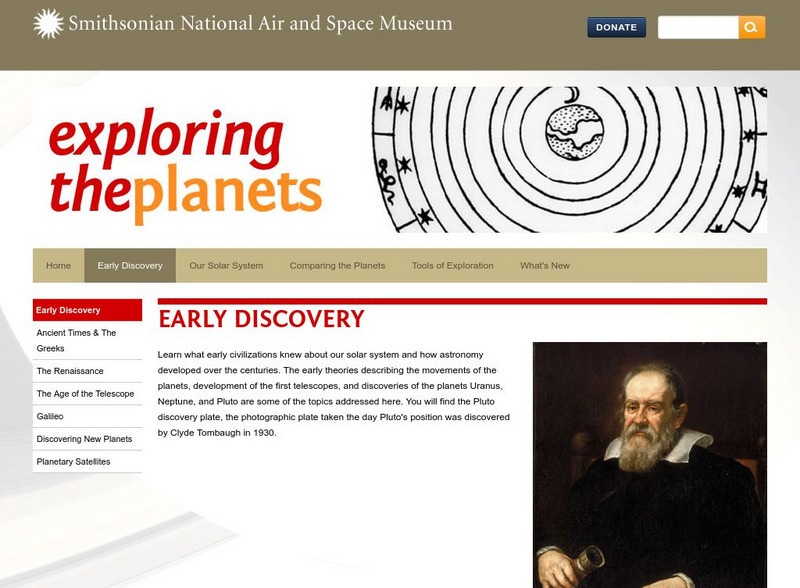
National Air and Space Museum: Exploring the Planets: Early Discovery
This section of the exhibition gives the history of the discovery and study of space starting with the Greeks and Romans through to the early 1900's.
American Museum of Natural History
American Museum of Natural History: O Logy: Stuff to Do: Stargazing
Get started on the road to becoming an expert stargazer by following these recommendations for identifying stars, planets, and constellations. Includes an example of a journal that can be used as a record of your investigations.
Other
Trinity College: The Window: Ibn Rushd
Brief biography from Trinity College of Ibn Rushd, a Muslim scholar who made contributions to many fields of study, including astronomy, philosophy, music, and medicine.

American Institute of Biological Sciences
Action Bioscience: Looking for Life on Mars and Beyond
Learn some of the characteristics of Mars. These characteristics lead some people to believe that life forms may be found on the fourth planet from the Sun.
Utah Education Network
Uen: Lunar Language
This lesson engages students in listening and viewing comprehension strategies to help them learn about the phases of the moon. Students will use a specialized graphic organizer to draw and describe observed moon phases. A sheet with ABC...
California Institute of Technology
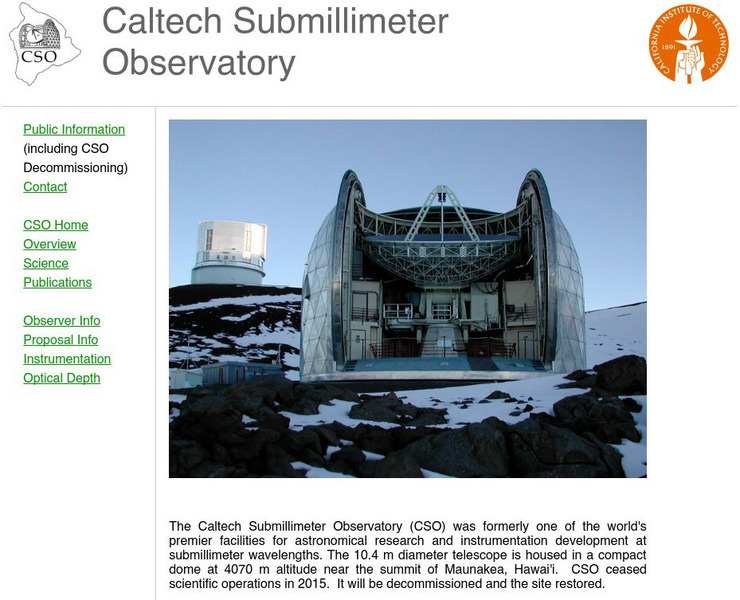
Submillimeter Wave Astrophysics at Caltech: Caltech's Submillimeter Observatory
Homepage of a radio telescope operated by Caltech in Hawaii. This radio telescope focusses on submillimeter frequencies. Be sure to look at the General Information link for info on telescope and the Astrophysics link to find information...

California Institute of Technology
Ipac: Iras Gallery
This site from IPAC is a series of images of various celestial objects and regions as viewed in infrared light. Each photo is accompanied by a caption.
Apple
Apple Learning Interchange: Classroom Ideas
Do you use Appleworks in your classroom? Would you like some ideas that others have used? This site presents some exemplary lessons from other teachers.
National High Magnetic Field Laboratory
Magnet Academy: John Daniel Kraus
For a man whose career involved the entire known universe, John Kraus had a remarkably insular upbringing. He was born and raised in Ann Arbor, Michigan, and earned his bachelor's, master's and doctoral degrees in physics, all at the...
Varsity Tutors
Varsity Tutors: Web English Teacher: N. Scott Momaday
Learn more about N. Scott Momaday's work when you explore the links found within this site. These links provide lesson plans and activities for "The Way to Rainy Mountain" and other works.
EL Education
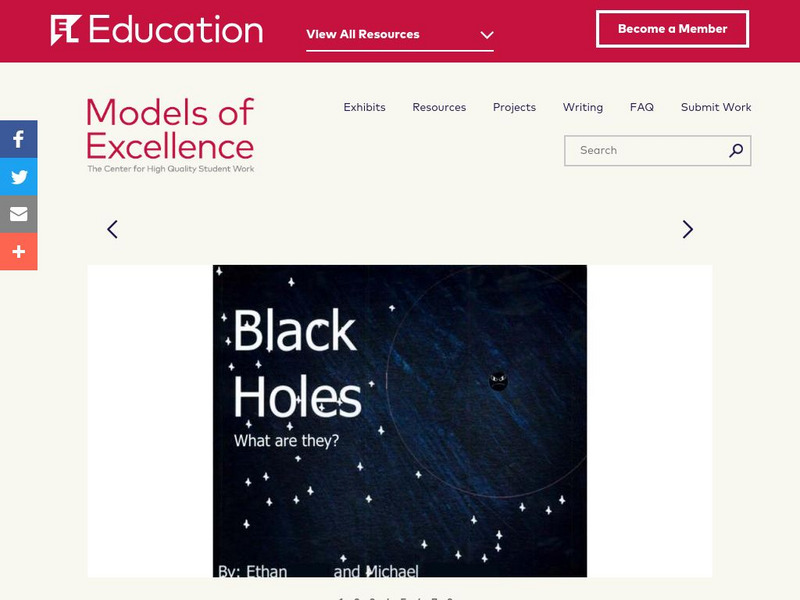
El Education: Black Holes: What Are They?
This is a children's book created by two freshman students during at High Tech High. For this project, the students selected, researched, and wrote an essay on a topic related to astronomy. Then using the information in their essay, they...
National Endowment for the Humanities
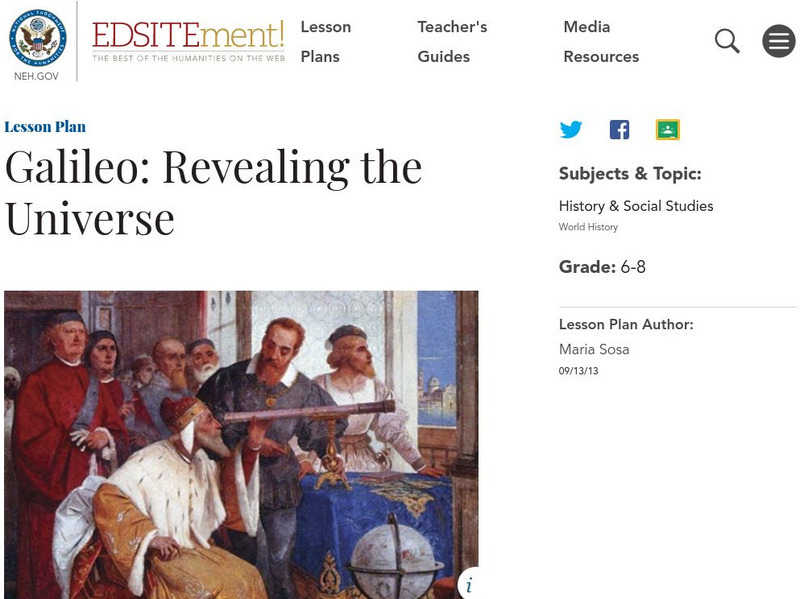
Neh: Edsit Ement: Galileo: Revealing the Universe
In this lesson plan, students will consider "Galileo: Revealing the Universe." The plan includes worksheets and other student materials that can be found under the resource tab.

Texas Instruments
Texas Instruments: Solar System
This activity is designed to assess the comprehension of concepts related to the planets and other astronomical bodies in the Solar System.
Concord Consortium
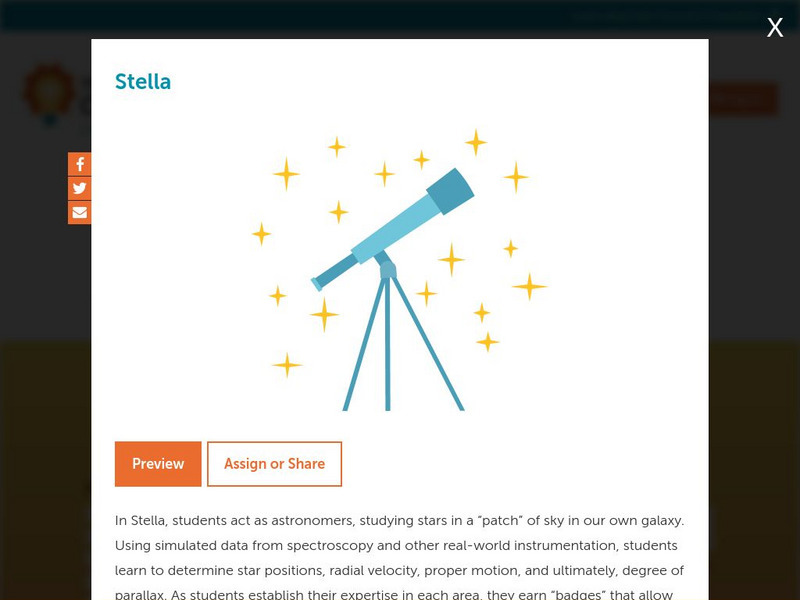
Concord Consortium: Stella
Students act as astronomers, studying stars in a patch of sky in our own galaxy. Using simulated data from spectroscopy and other real-world instrumentation, students learn to determine star positions, radial velocity, proper motion, and...
Curated OER
Sky Server: Quasars
This site from the SkyServer offers information as to what quasars are as well as provides links to strange objects, radio astronomy and research. This is a great sit to check out the brief but factual information on the subject.
Fourmilab Switzerland
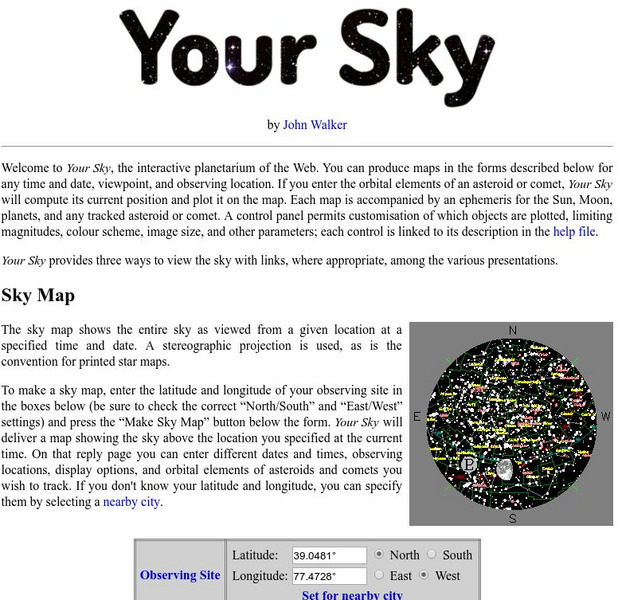
John Walker: Your Sky
You can produce sky maps for any date and time, viewpoint or observing location. See your sky map, horizon view, or track an asteroid or comet on this highly interactive site.