Hi, what do you want to do?






Curated OER
Rhythm and Art: Gesture Drawing
High schoolers explore connections between non-verbal language and art. For this visual and auditory art lesson, students investigate the science of sound and principles of drawing. They then use various genres of music to directly apply...

Curated OER
Learning About Sounds
Students practice identifying different sounds. In this auditory skills lesson, students listen to items that make different sounds. Students discuss the sounds of different items and try to identify the sounds they hear.

Curated OER
The Case of the Crooked Cartoon: Newton's Laws Set the Standard
Students have the opportunity to use higher-level thinking skills and to apply their talents to previously learned material. It provides an opportunity for visual, auditory, and tactile/kinetic learners to utilize their particular...

Curated OER
Determining Cutting Site Locations
Students explore DNA restriction mapping. They cut pieces of paper into lengths representing those produced when specific enzymes are used to cut a strand of DNA.

Curated OER
Exploring Magnets and Magnetism
Here is a very good instructional activity on magnets, magnetism, and magnitic fields that is chock full of great activities for you to implement with your young scientists. Learners discover the properties of magnets, look at the forces...

Curated OER
Cell Division
Students describe the cell cycle. They make a connection between DNA replication and cell division. Students describe the parts of the cell that participate in cell division and the steps of cell division.

Curated OER
The Anacostia River & You
Students are able to give examples of local and global sources of pollution. They explain why certain forms of pollution are detrimental to the environment. Students a create a poster promoting Earth Day's message of environmentally...

Curated OER
Lesson Recap: The Anacostia River & You - Biology Teaching Thesis
Seventh graders give examples of local sources of pollution and postulate reasons as to why local sources of pollution can harm the ecosystem. They address the following question in short answer form: "Why is litter/chemical pollution...

Curated OER
Do You See What I See?
Students engage in a lesson that differentiates between right and wrong types of observations. In order to conduct the experiment they are provided with leaves and nameless objects with different designs. The two are compared and...

Curated OER
Calendar Time
Use circle time to work on counting. Kindergarteners practice the months of the year, say the full date, chart the day's temperature, count to 100, and sing the alphabet song. This kind of daily routine cultivates deep roots for...

Curated OER
Reaction Time 2: Zap!
Students explore critical thinking by conducting a reaction time experiment. In this human brain activity, students utilize a timed Internet worksheet activity to research how fast their brain works when answering questions. Students...

Curated OER
The Frog Experiment
Your science class reads a silly story in which a mad scientist makes absurd conclusions about an experiment that he conducted. One at a time, he cuts off a frog's leg and commands it to jump. With three, two, and one leg, the frog...

Curated OER
Erosion
Students identify and interpret where and how erosion takes place. Students list various ways to prevent erosion from occurring. Students conduct an experiment in small groups on erosion and predict what they believe will happen.

Curated OER
Blood Moving from Heart Around Body Simulation
Students review circulation and blood flow patterns from different parts of the body. They play a game using colored yarn and index cards to simulate blood flow, oxygenated blood, arteries and veins.

Curated OER
Paragraph Writing About Animals
Pupils explore animal characteristics by participating in a paragraph writing activity. In this writing structure lesson, students identify the importance of a topic and transition when writing descriptive sentences about a subject....

Curated OER
Sound Lesson Plan
Students will be able to describe the process by which we are able to hear sound. They also will be able to distinguish different sound intensities. They then use Probeware to prove their hypothesis.

Curated OER
Regional Differences
Learners examine how the brain sends and receives messages by assessing PET scans. They diagram areas of the brain that evaluate various situations. They discover that individuality is due to different responsesnin the brain.

Curated OER
Learning About Weather
Middle schoolers decide what type of weather they would like to write about such as tornadoes, hurricanes, snow, hail, floods, or another type of weather.
Then, they look up the information and jot down notes about that particular...
Georgia State University
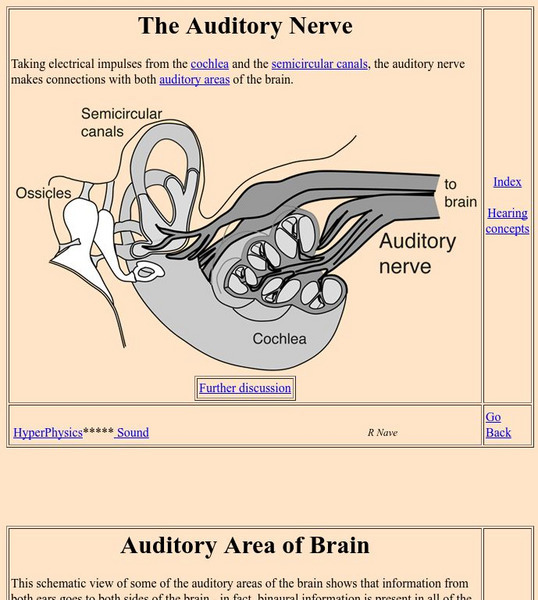
Georgia State University: Hyper Physics: The Auditory Nerve
A good description and function of the auditory nerve. Diagrams, explanations.