



Curated OER
Population Vs Consumption: Which is a Bigger Problem for the Environment & Who is Getting the Lion's Share of the World's Resources?
Students develop critical thinking and awareness about the complexity of natural resource use, wealth distribution, population densities, poverty, and the environment. They think about people living in different parts of the world and...

Curated OER
What makes up YOUR Environment!
Students create their own land or water environment. They make their environment livable for all the different animals they collect to put in it. Students research the types of animals that they can have in their environment, and how...

Curated OER
An Egg is Quiet
Students discover information about animal eggs by reading the book, An Egg is Quiet. In this animal science lesson, students research different animals to find out what their eggs look like. Students use a provided chart to...

Curated OER
The Great MPA Debate
Students study the 'Marine Protected Areas' process. In this ocean lesson students work in groups, conduct research and present it to the class.

Curated OER
Parasite Development and Life Cycle
If you are new to teaching agriculture classes, this outline may be helpful when you are preparing a lecture on parasites in livestock. In addition to lecturing on this topic, the lesson plan suggests that learners research the life...

Curated OER
Water 1: Water and Ice
Students investigate water in its solid and liquid form. In this states of matter lesson, students experiment to see what happens as water goes from a solid, ice, to a liquid, water, and back again. They write about and illustrate the...

Curated OER
Build-A-Bird
Young scholars create an imaginary bird. In this anatomy lesson, students analyze how artists represent birds historically, then determine the anatomical aspects that suit a bird to its habitat. Using this information, young scholars...

Curated OER
Understanding Science Vocabulary And Categorization
Students explore and examine scientific language and categorization as related to commonly known plants and animals. They hypothesize about a specific plant or animal, how it was scientifically named, what concepts and vocabulary is...

Curated OER
Panther Scavenger Hunt
Students research the Internet to fill out their scavenger hunt sheet. For this research lesson students search the Internet for answers to the questions on the scavenger hunt worksheet.

Curated OER
Microarrays: Chipping Away at the Mysteries of Science and Medicine
Young scholars research microarrays on the internet in cooperative groups. Students write an essay describing the use of microarrays in environmental research and in medicine.

Curated OER
Discovering New Species
Students identify animals observed by Lewis and Clark while evaluating the animal's habitat and describing the animal's behavior. Students construct a food web mobile to illustrate the animal's position in the food web in the 19th...

Curated OER
Population and Urbanization
In this population and urbanization worksheet, students match 15 terms with the appropriate descriptions and respond to 8 short answer questions regarding these sociological themes.

Curated OER
Marine Protected Areas
Students design a research project about a Marine Protected Area they chose. In this marine biology lesson plan, students gather fish count and catch data then graph them. They create an information poster about their findings.

Curated OER
the Wonder of Wetlands
Young scholars explore the importance of the wetland ecosystem, its properties and functions, as well as, the many birds, animals, and plant life found there.

Curated OER
Communication in Bees
Eighth graders identify and interpret a scientific investigation and a hypothesis through experimentation and testing a hypothesis. They identify what scientists hypothesized about the communication of stingless bees. Finally, 8th...

Curated OER
A Scientific Approach to Teaching about Evolution
Middle schoolers examine fossils and analyzing their significance in relation to theories of evolution. Hand-outs are provided. This lesson could be supplementary to a broader unit on evolution or geology.

Curated OER
Into the Pond
Seventh graders use a pond to explore macroinvertebrates and other organisms. They use a dichotomous key to classify the organisms and maintain a journal recording their findings.
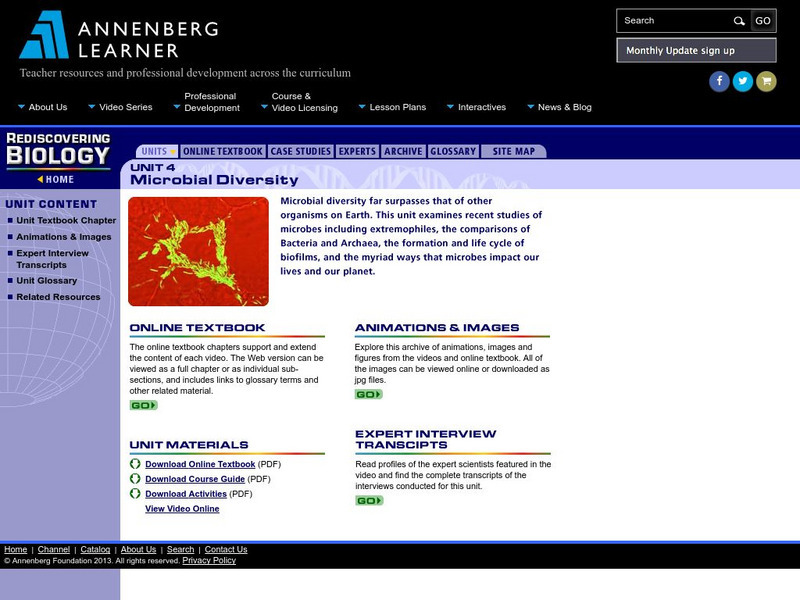
Annenberg Foundation
Annenberg Learner: Rediscovering Biology: Unit 4: Microbial Diversity
A complete learning module on microbial diversity that includes a downloadable textbook chapter, teacher guide, and lesson activities. The chapter can also be viewed online. In addition, there are animations, images, a video, and...
Soft Schools
Soft Schools: Diversity Quiz
Take this interactive, multiple-choice quiz over ecological biodiversity, then review your score and any missed questions at the end.
National Institutes of Health
National Institute of Health: Matching Game for Niehs Birds!
See if you can figure out what different birds eat. This interactive matching game explores the diets of 17 birds commonly found in the US.