



Curated OER
What's Going to Happen at Any Given Barometer Reading?
Fourth graders brainstorm a list of words associated with weather. In groups, they sort the words into categories and observe the weather in their area for a month. To end the instructional activity, they compare the barometer...

Curated OER
1 VS the Mob
Students prepare to become the first to cover four adjacent products, horizontally, vertically or diagonally by selecting factors that make the needed products. They play this game to acquire a healthy appetite for competition between...

Curated OER
Diurnal Temperature Changes and Water Vapor Content
Students determine how much moisture in the air affects the diurnal temperature range. They investigate to determine the different climatological regimes of both the Southern Plains and the world. and greenhouse gases effect the earth's...

Curated OER
Millennium Bridge
Learners read and plot coordinates in all four quadrants and state where a shape will be after translation. They explore the concept of translation using a a four quadrant grid of the of River Tyne running through all 4 quads. In...

Curated OER
Combinations
In this math worksheet, students investigate the concept of using combinations. They compare this with permutations where a different order of the same set of objects is counted separately for the outcome.

Curated OER
What's Left Over?
In this mathematics worksheet, students identify and find the amount remaining after subtracting different amounts from a standard currency unit. Then they select the unit of currency and identify how to present sub-dollar amounts with a...

Curated OER
Matrix operations and Matrix Inverses
Eleventh graders study how to combine like vector's that are matrices. In this matrix operations worksheet, 11th graders combine matrices linearly and define the matrix-matrix product and its properties. Students also study matrix...

Curated OER
MOBILITY, Traveling Lightly: What’s My Footprint?
Students calculate their carbon footprint. In this environmental technology lesson, students listen to a lecture on climate change. Students brainstorm solutions to reduce environmental impact based on travel options. Students calculate...

Curated OER
Word Problem: How Much More?
Second graders solve a subtraction word problem. In this subtraction instructional activity, 2nd graders solve a word problem asking "How much more?" by using the relationship between subtraction and addition.

Curated OER
Addition - Counting On
Second graders solve addition problems without using a calculator. In this addition lesson, 2nd graders solve addition problems by "counting on." Students are taught this specific strategy and given the opportunity to practice.

Curated OER
Percentages On A Grid
Fifth graders show percentages on a 10 x 10 grid. In this percentages lesson plan, 5th graders color in the squares to show a percent.

Other
London Grid for Learning: History of Computing: A Brave New World
This resource aims to teach the history of computing and the effect of landmark moments in computing history on today's world. Crosses different curriculum areas. Explanations of many of the world's significant computers were provided by...
Science Buddies
Science Buddies: Computational Exploration of Protein Function
The DNA in our cells contains our "blueprints," but it's the proteins in our cells that do most of the work. The Human Genome Project has allowed us to start reading the blueprints, but we still don't understand what most of the proteins...
Other
Simple Science: Ramps and Ratios
The interactive tutorial explores ramps and ratios. Learners view and analyze images of ramps and steps to see if they conform to the requirements of the Americans with Disabilities Act. The activity has students measure vertical and...
TeachEngineering
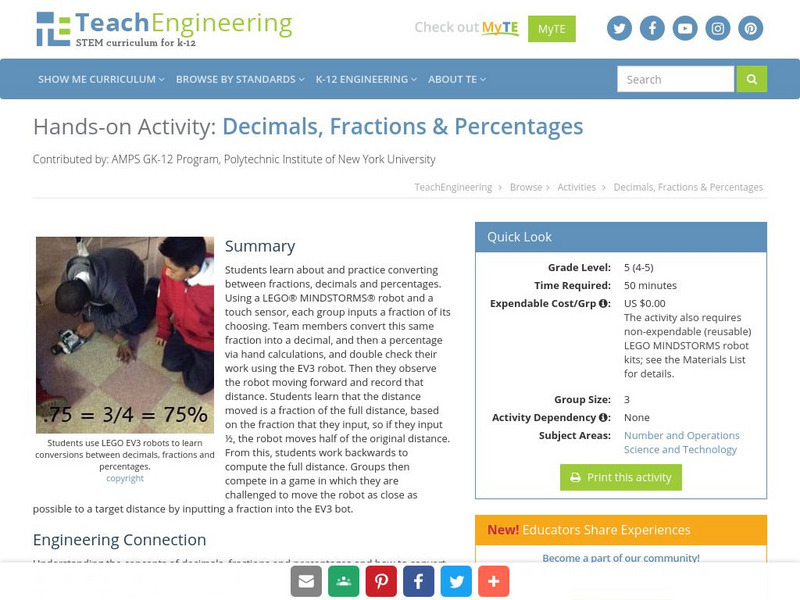
Teach Engineering: Decimals, Fractions & Percentages
Students learn about and practice converting between fractions, decimals and percentages. Using a LEGO MINDSTORMS NXT robot and a touch sensor, each group inputs a fraction of its choosing. Team members convert this same fraction into a...
TeachEngineering
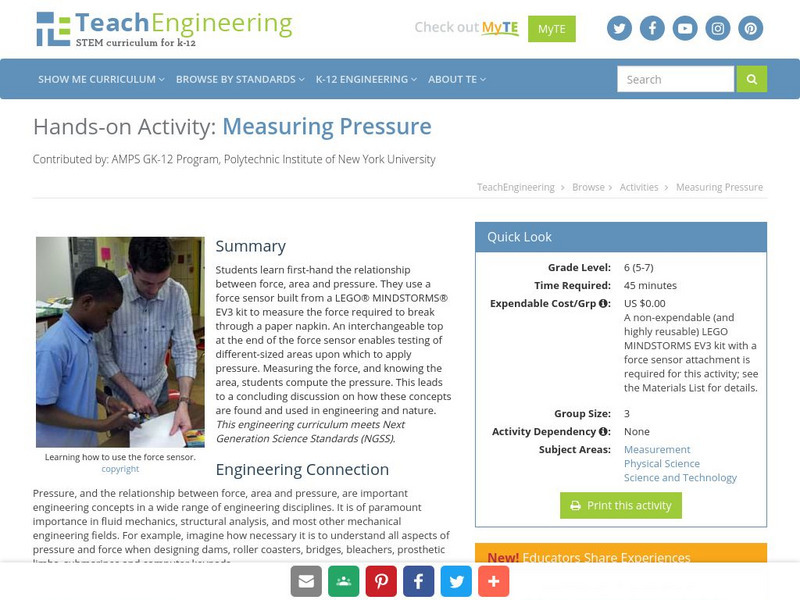
Teach Engineering: Measuring Pressure
Students learn first-hand the relationship between force, area and pressure. They use a force sensor built from a LEGO MINDSTORMS NXT kit to measure the force required to break through a paper napkin. An interchangeable top at the end of...
TeachEngineering
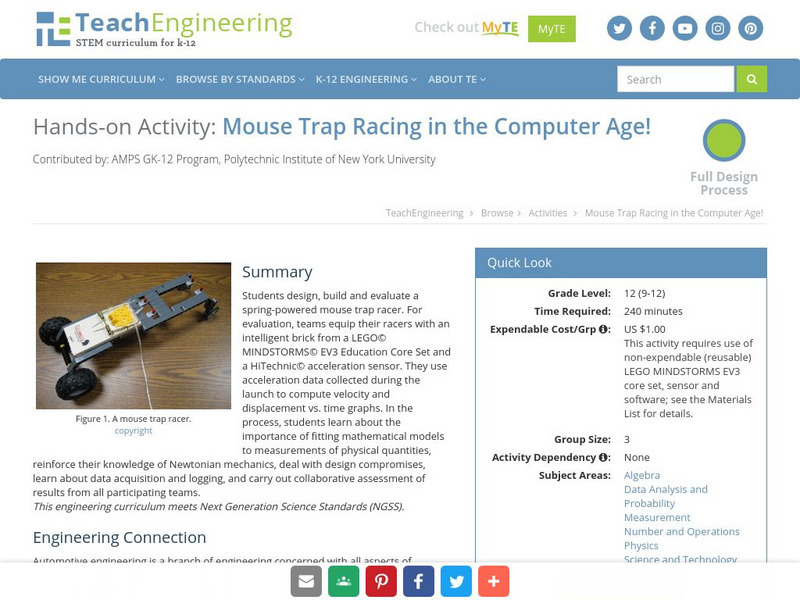
Teach Engineering: Mouse Trap Racing in the Computer Age!
Students design, build and evaluate a spring-powered mouse trap racer. For evaluation, teams equip their racers with an intelligent brick from a LEGO MINDSTORMS NXT Education Base Set and a HiTechnic acceleration sensor. They use...

Khan Academy
Khan Academy: Citizen Science
Learn about citizen science: the participation of the general public in scientific research.

Khan Academy
Khan Academy: Crowdsourcing With a Global Crowd
Explore how crowdsourcing helps us to create common goods, invent new products, and make scientific discoveries.

Khan Academy
Khan Academy: The Digital Use Divide
Learn how researchers find large differences in how effectively various groups of people can use digital technology.

Khan Academy
Khan Academy: The Socioeconomic Digital Divide
Learn about the differences in which households have access to computers and the Internet.

Khan Academy
Khan Academy: The Geographic Digital Divide
Find out more about how the infrastructure of the Internet is not distributed equally.

Khan Academy
Khan Academy: The Global Digital Divide
Learn about the difference in access to technology across the globe.
Other
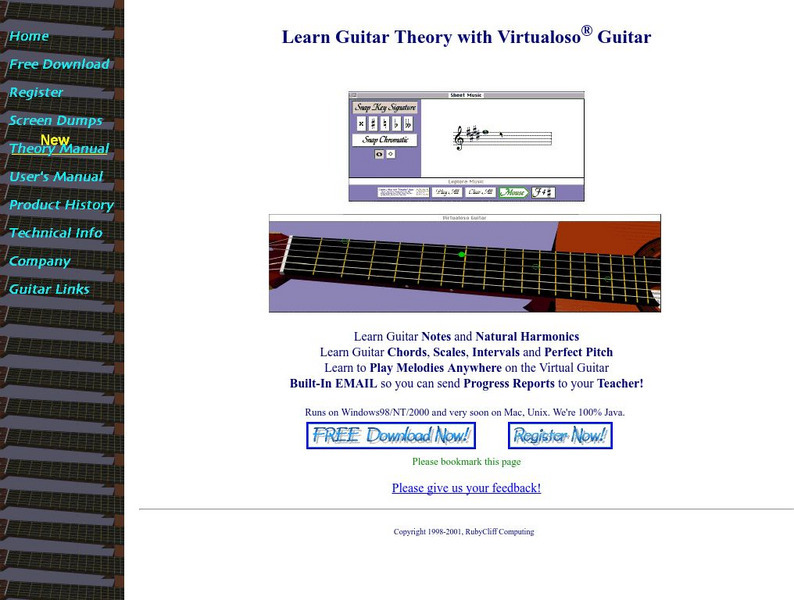
Ruby Cliff Computing: Learn Guitar Theory With Virtualoso Guitar
This is a fantastic site that teaches basic music reading, especially as related to the guitar. Although the site is a promotional software site, the trial version is excellent by itself.