



University Corporation for Atmospheric Research
Ucar: Solar Flare
Solar flares are huge explosions on the Sun that emit lots of electromagnetic radiation.
NASA
Electromagnetic Spectrum: Ultraviolet Waves
Ultraviolet (UV) light has shorter wavelengths than visible light. Though these waves are invisible to the human eye, some insects can see them. The specific wavelength values are given. Uses and applications of these waves are explained.
Space Telescope Science Institute
Amazing Space: Star Light, Star Bright
This online exploration provides an opportunity to identify the different properties of waves and the relationship that exists between energy, wavelength, and frequency. Correlate images from the Hubble Telescope to the wavelength,...

California Institute of Technology
Ipac: Iras Gallery
This site from IPAC is a series of images of various celestial objects and regions as viewed in infrared light. Each photo is accompanied by a caption.
NOAA
Noaa: Space Environment Topics: Radio Wave Propagation [Pdf]
NOAA has produced a series of topic papers for use by teachers and students. This paper is on the increase of radio wave activity and the effects solar emissions have on it. PDF format.
CK-12 Foundation
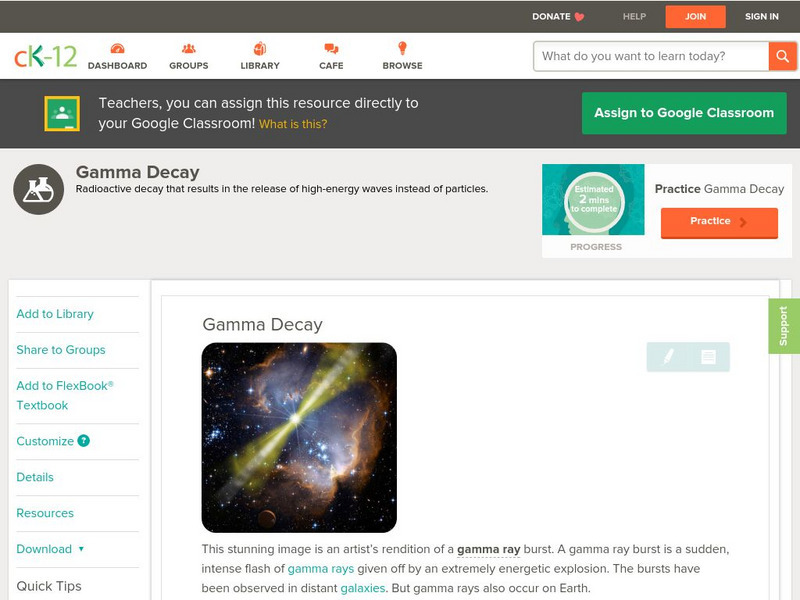
Ck 12: Physical Science: Gamma Decay
[Free Registration/Login may be required to access all resource tools.] Explains how and why gamma decay occurs, what gamma rays are, and why gamma radiation is the most harmful.