



Curated OER
Physics- global warming
Students discuss the concept of global warming and view a multimedia clip on the global warming phenomenon. They statistically analyze mean temperature data and compare a given set of data. Data on atmospheric CO2 is done then they...

Curated OER
The Connection Between Pigment and Light Colors
Pupils learn the procedure for mixing secondary colors from primary pigments and observe the results of mixing two primary colors.

Curated OER
It's All In The Surface: The Effects Of Color & Texture On The Ability Of A Surface To Absorb Solar Energy
Ninth graders examine how dark surfaces absorb more light than light surfaces. They perform an experiment that compares various surfaces abilities to absorb heat, then record and analyze the results.

Curated OER
The Lives of Stars
In this stars worksheet, students review what makes up a star, how astronomers learn about stars, and the different types of stars including low mass and high mass stars. This worksheet has 62 fill in the blank statements.

Curated OER
Eyes in the Sky
Students complete a unit on orbiting spacecraft designed to study astronomical objects. They conduct Internet research on NASA missions, use a satellite dish to downlink information, and construct and launch a rocket out of paper and tape.

Curated OER
Seeing The Sun In A New Light
Students examine the observation of "coronal holes," by x-rays, also about related fast streams and moderate magnetic storms that recur at 27 day intervals. They study NASA'S great observatories.

Curated OER
(S-4) The Magnetic Sun
High schoolers explore magnetism and magnetic phenomena on the Sun.

Curated OER
Cosmic Ray Momentum
Students describe how cosmic rays achieve high kinetic energy via conservation of momentum.

Curated OER
The Universe in a Different Light
Young scholars become aware of some of the objects studied in, and concepts associated with, high-energy astronomy. They do this by participating in card games that teach and review these concepts.

Curated OER
How Did That Get in My Lunch?
Students view "The Danger Zone" to learn about food poisoning and the bacterial causes and prevention. Students look at slides, use a worksheet, "Microbial Bugs"and the internet to identify and learn about each bacterium.

Curated OER
Coefficient of Kinetic Friction and Surface Area
Students investigate coefficient of friction with respect to surface area and applied force in contact with the sliding force.

Curated OER
Good Vibrations
Students demonstrate sound waves and make changes in the waves
resulting in changes in pitch. Students associate changes in pitch in various "musical instruments"with size and shape and the sound waves they produce.

Curated OER
The AM Radio: An Exploration of Communication Using Radio Waves
Students examine the components that are used to make a primitive AM radio. In circuit and radio construction students often are asked to assemble parts are or what function they perform. They examine each main component on an individual...

Curated OER
Wavelength And Resolution
Learners perform a simulation of the workings of an electron microscope to discover that the resolution will need to improved to detect objects in the nano-scale. They use wooden dowels as detectors to determine the shape of objects in...

Curated OER
Vikings In America
Students engage in a lesson that is concerned with the "Vikings Of America" and conduct research using a variety of resources. They view the video to create the context for the lesson. Students use the video as an opportunity for class...

Curated OER
Kinds of Energy Word Search
In this energy word search puzzle, students identify types of energy and related terms. They identify 18 words from a given list. An answer sheet is provided.

NASA
Nasa: Tour of the Electromagnetic Spectrum: Visible Light
Visible light waves are the only electromagnetic waves we can see. We see these waves as the colors of the rainbow. Each color has a different wavelength. Red has the longest wavelength and violet has the shortest wavelength. When all...
CK-12 Foundation
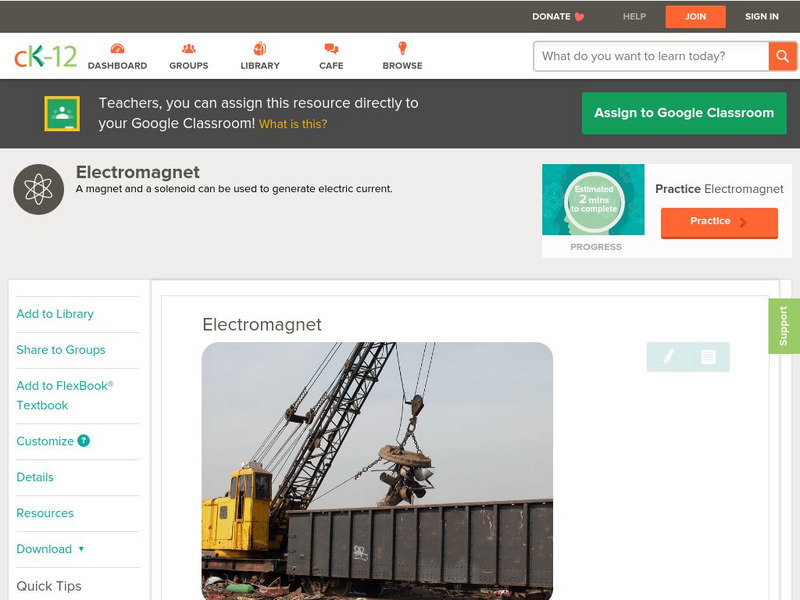
Ck 12: Physical Science: Electromagnet
[Free Registration/Login may be required to access all resource tools.] Explores what an electromagnet is, its strength, and how it can easily be turned on and off.
National High Magnetic Field Laboratory
Magnet Academy: William Gilbert
William Gilbert was an English physician and natural philosopher who wrote a six-volume treatise that compiled all of the information regarding magnetism and electricity known at the time. The work included descriptions of many of...
Lawrence Berkeley National Laboratory
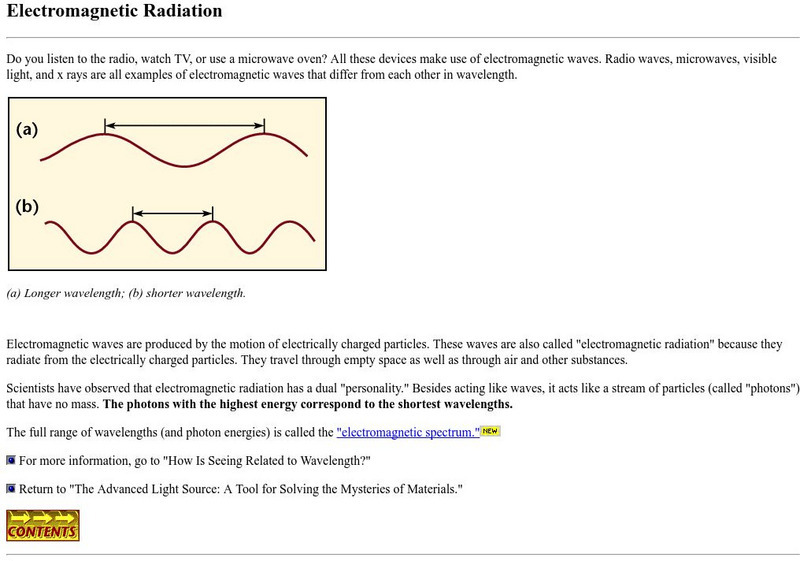
Berkeley Lab: University of California: Electromagnetic Radiation
This page defines electromagnetic radiation. Included are links to more information.
NASA
Electromagnetic Spectrum: Ultraviolet Waves
Ultraviolet (UV) light has shorter wavelengths than visible light. Though these waves are invisible to the human eye, some insects can see them. The specific wavelength values are given. Uses and applications of these waves are explained.
Lawrence Berkeley National Laboratory
Berkeley Lab: Micro Worlds Project: Advanced Light Source
A discussion of the Advanced Light Source (ALS) facility and its use in material analysis and medicine.
National High Magnetic Field Laboratory
Magnet Academy: James Clerk Maxwell
James Clerk Maxwell was one of the most influential scientists of the nineteenth century. His theoretical work on electromagnetism and light largely determined the direction that physics would take in the early twentieth century. Indeed,...
National High Magnetic Field Laboratory
Magnet Academy: Joseph Henry
Joseph Henry was an American scientist who pioneered the construction of strong, practical electromagnets and built one of the first electromagnetic motors. During his experiments with electromagnetism, Henry discovered the property of...