


National High Magnetic Field Laboratory
Magnet Academy: Michael Faraday
A self-educated man with a brilliant mind, Michael Faraday was born in a hardscrabble neighborhood in London. Through the combination of insatiable curiosity and a powerful will to succeed, he transcended his austere beginnings to...

Stanford University
Stanford University: Invisible Rays
This lesson focuses on investigating the electromagnetic spectrum using ultraviolet beads. Students learn how material properties change as the size of the material decreases to the nanoscale.
University Corporation for Atmospheric Research
Ucar: Solar Flare
Solar flares are huge explosions on the Sun that emit lots of electromagnetic radiation.

PBS
Pbs Nova: Relativity and the Cosmos
This well-written explanation of relativity includes animations and pictures which may be helpful in understanding a tough topic.
Friesian School
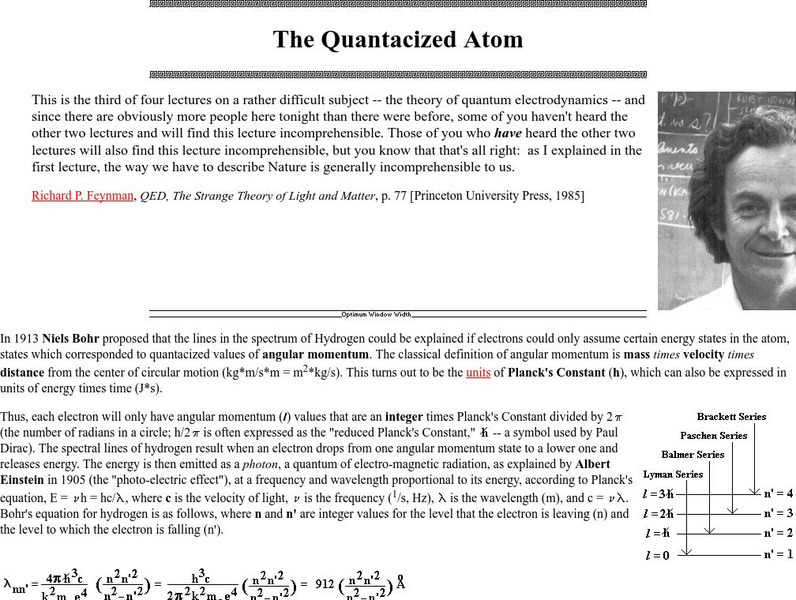
Proceedings of the Friesian School/the Quantacized Atom
A very lengthy page from friesian.com discussing Bohr's theory of electronic energy levels and the explanation of commonly observed atomic emission line spectra. The concept of a photon and Einstein's observation of the photoelectric...
National High Magnetic Field Laboratory
Magnet Academy: Andre Marie Ampere
Although he was not the first person to observe a connection between electricity and magnetism, Andre-Marie Ampere was the first scientist to attempt to theoretically explain and mathematically describe the phenomenon. His contributions...
National High Magnetic Field Laboratory
Magnet Academy: Lee De Forest
American inventor Lee De Forest was a pioneer of radio and motion pictures. He received more than 300 patents over the course of his lifetime, the most important of which was for a three-electrode vacuum tube, or triode, that he called...
National High Magnetic Field Laboratory
Magnet Academy: Heinrich Hertz
The discovery of radio waves, which was widely seen as confirmation of James Clerk Maxwell's electromagnetic theory and paved the way for numerous advances in communication technology, was made by German physicist Heinrich Hertz. In the...
Space Telescope Science Institute
Amazing Space: Star Light, Star Bright
This online exploration provides an opportunity to identify the different properties of waves and the relationship that exists between energy, wavelength, and frequency. Correlate images from the Hubble Telescope to the wavelength,...
NOAA
Noaa: Space Environment Topics: Radio Wave Propagation [Pdf]
NOAA has produced a series of topic papers for use by teachers and students. This paper is on the increase of radio wave activity and the effects solar emissions have on it. PDF format.
Exploratorium
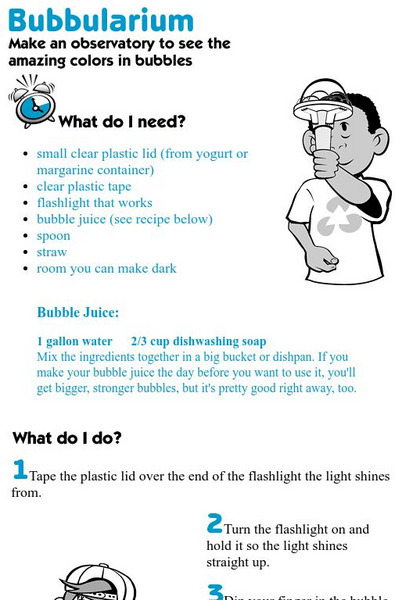
Exploratorium: Bubbularium
What colors do you see in a bubble? Why do you see colors in a bubble? Use this site to find out the answer to these questions with this easy experiment.
National High Magnetic Field Laboratory
Magnet Academy: Hans Christian Orsted
A discovery by Hans Christian Orsted forever changed the way scientists think about electricity and magnetism. While preparing to perform an experiment during a lecture at the University of Copenhagen, he found that the magnetized needle...
Carnegie Mellon University
Telstar: The Sun and Its Energy
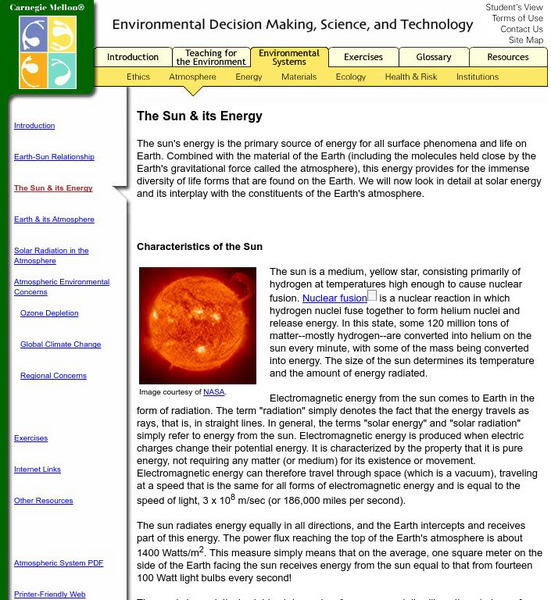
The sun's energy is the primary source of energy for all surface phenomena and life on Earth. Combined with the material of the Earth (including the molecules held close by the Earth's gravitational force called the atmosphere), this...
Carnegie Mellon University
The Sun and Its Energy
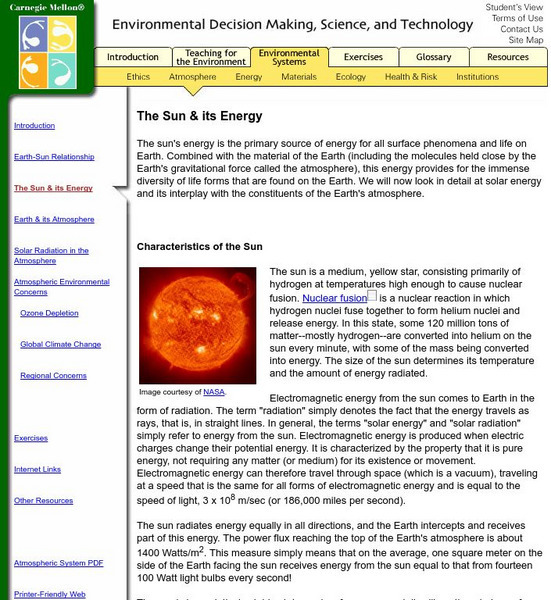
The sun's energy is the primary source of energy for all surface phenomena and life on Earth. Combined with the material of the Earth (including the molecules held close by the Earth's gravitational force called the atmosphere), this...

California Institute of Technology
Ipac: Iras Gallery
This site from IPAC is a series of images of various celestial objects and regions as viewed in infrared light. Each photo is accompanied by a caption.
National High Magnetic Field Laboratory
Magnet Academy: Zeeman Effect 1896
Most of us have seen the rainbow-hued breakdown of the composition of light. Light is of course a form of energy. A magnetic field changes the behavior of light- a phenomenon known as the Zeeman effect.
CK-12 Foundation
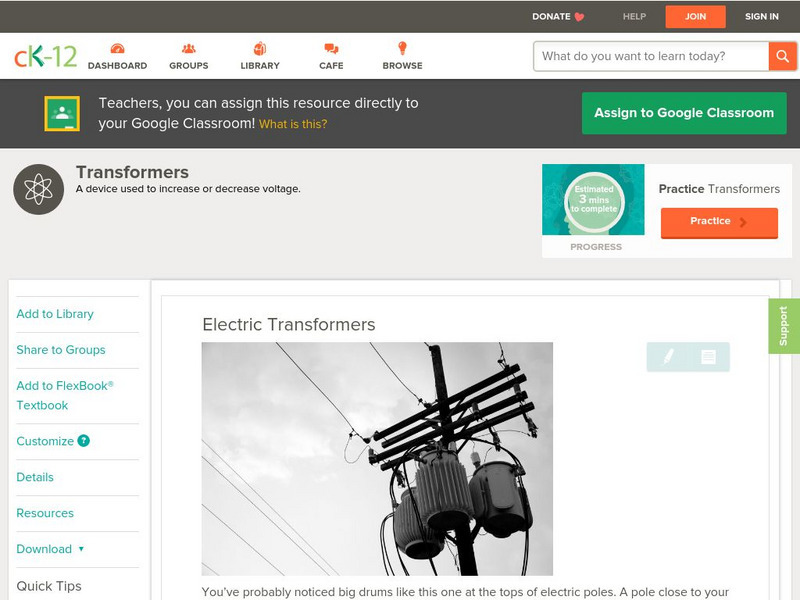
Ck 12: Physical Science: Electric Transformers
[Free Registration/Login may be required to access all resource tools.] Discusses how an electric transformer works and step-up and step-down transformers.
CK-12 Foundation
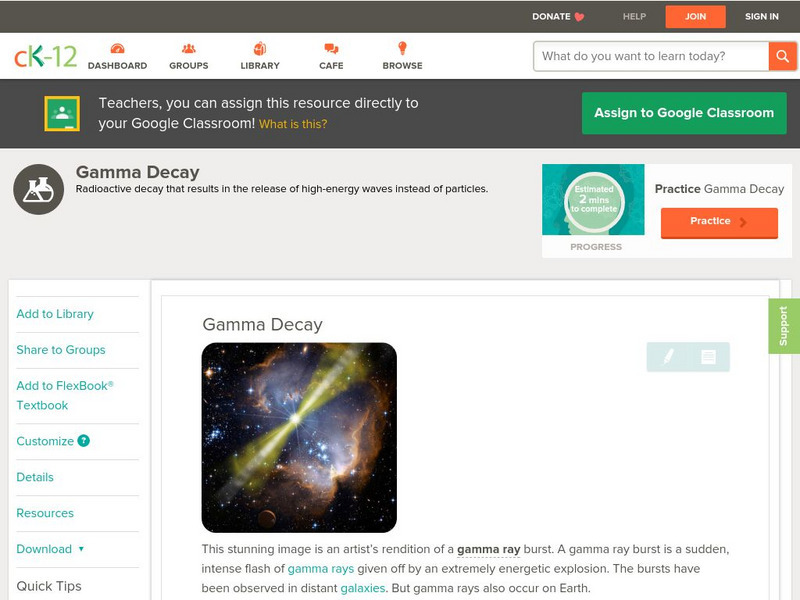
Ck 12: Physical Science: Gamma Decay
[Free Registration/Login may be required to access all resource tools.] Explains how and why gamma decay occurs, what gamma rays are, and why gamma radiation is the most harmful.

Khan Academy
Khan Academy: What Is Faraday's Law?
Do you know how to induce an electromotive force? This reference page will help you understand why Faraday's law mean and how to use it.