



Curated OER
This Lesson Is a Breeze, So Don't Blow It!
Students conduct an experiment to show that air is all around us and that wind is the movement of air. They construct a weather vane to determine which direction the wind is blowing.

Curated OER
Just Passing Through
Students examine the functions of the kidney and its place in the urinary system. They discuss how astronauts go the bathroom in space, examine labeled diagrams of the urinary system, and draw a large scale drawing of the excretory...

Curated OER
Not So Lost in Space
Young scholars investigate how engineers navigate satellites in orbit around the Earth and on their way to other planets in the solar system. They study vocabulary words and participate in studying a satellite by learning about times...

Curated OER
All About Trees
Second graders examine the artwork of Robert Harris and discuss how trees are an important part of their lives. In groups, they discover how people's use of the environment has changed over time and describe the climate and vegetation...

Curated OER
Toddler's Delight
Students are challenged to design a toy or something that can attach to a toddler's car seat to help distract them during long car trips. Students research toddler toys prior to beginning the design process in order to determine the...

Curated OER
Celebrating Heroes That Surround Us
Students investigate the concept of a hero. They write in journals to find definitions and create hero symbols. Also students conduct research to create a banner of quotations made by famous heroes who fall under the definition generated...

Curated OER
Solstice and Equinox
Middle schoolers identify the dates of the solstices and equinoxes and how they relate to the various seasons on Earth. After discussing how the solstice and equinox affect the seasons, students use their bodies to demonstrate the how...

Curated OER
Layers of the Earth
Students identify the layers of the Earth and complete activities for the topic. In this Earth layers lesson plan, students chart their ideas about the Earth's layers and view a PowerPoint for the topic. Students view an apple to learn...

Curated OER
The Sound of Calm
Students examine the relationships that exist between ocean currents, wind and climate. Using those relationships, they discuss how they affect the oceans. They create their own music to represent the sounds of the ocean and share them...

Curated OER
If I Can't See It, How Do I Know It's There?
Students build a model ocean using a variety of materials representing the various levels of the ocean. They collect data about the ocean floor in a partner activity. They practice working with topographical mapping grids.

Curated OER
Body and Mindscapes
Third graders view artwork by Robert Harris of landscapes and mountains. Using a map, they locate and identify the physical features of the Canadian province they live in. In groups, they use one of his paintings and add music to...

Curated OER
Navigating by Landmarks
Third graders examine and apply the relationship between concrete landmarks, abstract written directions, and graphic representations on maps, and then develop their own landmark map for classroom use.

Curated OER
One Square Foot
Students identify, describe, count, tally, and graph life found in one square foot of land.

Curated OER
Mud Fossils
Students create their own fossils in an activity using plaster of paris and a variety of objects which can be fossils, e.g. chicken bones, twigs, shells, etc. After making their fossils, they allow them to dry and discuss time and its...

Curated OER
VH1 Driven: Shakira, Lesson 2
Students watch a video about the life of Latin singer/pop star, Shakira. They research various foreign music styles and discuss how they influence American pop music today.

Curated OER
Elements of Music
Students identify three of the essential elements of music: rhythm, melody and harmony. They discover a simple song which will illustrate these three elements separately and bring them together in a final form. They analyze and critique...
Texas Instruments
Texas Instruments: Go for the Gold
Students explore and use the concept of ratio in a real-world situation. They will make judgments regarding accuracy and precision of measurement.
Texas Instruments
Texas Instruments: Investigating Area Relationships
The interactive Cabri Jr. geometry application makes it easy to measure the area of triangles and quadrilaterals. In this activity, students will explore some interesting area relationships in quadrilaterals.

Texas Instruments
Texas Instruments: Inequalities, They Are Not Just Linear Anymore!
Students study quadratic relationships and explore the process of graphing quadratic inequalities and systems of quadratic inequalities. They will solve these inequalities algebraically and graph them on a coordinate plane.

Texas Instruments
Texas Instruments: Numb3 Rs: It All Started With a Pair of Rabbits
Based off of the hit television show NUMB3RS, this lesson introduces students to the set of Fibonacci numbers and shows how this set is present in many aspects of nature. Through the lesson, students explore the first 13 elements in the...
Texas Instruments
Texas Instruments: St. Louis Curves or Arch? You Pick!
Students explore curve fitting and translations of the parabola.
Texas Instruments
Texas Instruments: Looking at Statistics Through Circles
In this activity, students will measure round objects to determine the circumference and diameter, and use the data to explore geometric concepts of the circle with statistics.
Texas Instruments
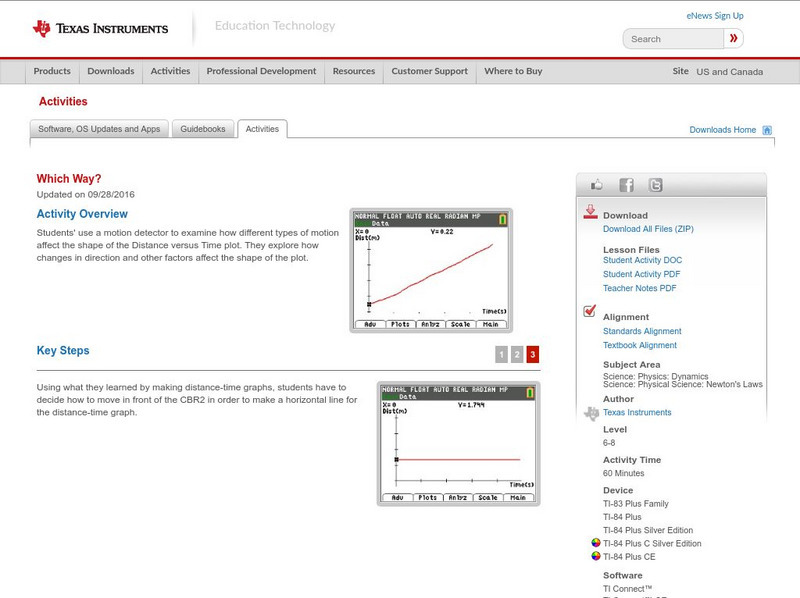
Texas Instruments: Which Way?
Students' use a motion detector to examine how different types of motion affect the shape of the distance versus time plot. They explore how changes in direction and other factors affect the shape of the plot.

Texas Instruments
Texas Instruments: What Is Linear Regression?
In this activity, students will explore finding the line of best fit based on the sum of the squares of the residuals and determine what the linear regression line is.