Hi, what do you want to do?






Curated OER
Protect Your Melon
Learners construct a helmet to protect their heads from falling objects. In this constructing lesson plan, students design this helmet with the lowest cost possible.

Discovery Education
Ahead of the Game
According to the movie Wildcats, "It's the sport of kings, better than diamond rings, football!" It is also, however, the sport of severe concussions and ongoing blows to the head. In order to keep our Seahawks soaring and Broncos...

Curated OER
Sports Helmets and Impact Testing of Polymers
Young scholars test various polymers resistance to impact. In this technology lesson, students collect data and formulate a conclusion. They design their own helmet and present it to class.

Curated OER
Smiley's Egg Drop
Students work in a team of two or three to create an egg-drop helmet. They design a container or helmet for carrying a fragile object at great speeds and determine which construction materials worked best .

Curated OER
Engineering in Sports
Learners explore physical education by completing a quiz in class. In this engineering lesson, students identify different ways engineering has made sports safer such as stronger padding and helmets, stronger equipment and smarter...

Curated OER
Apollo Moon Landing
Students explore paper rockets, learn about the Apollo Program and Apollo spin-offs, and use simple office supplies to design and create a new useful product. This amazing plan is incredibly well written and leads students through a...

National Wildlife Federation
Penguin Fun Facts
What's black and white and can dive up to 1,800 feet under water? That's right, penguins! Learn this and many other amazing facts about these unique birds with this handy reference sheet.

Curated OER
Nerve Racking
Fifth graders study the components and function of the nervous system. They investigate how engineers design biomedical equipment to assist the nervous system and explain how the five senses are affected during spaceflight.

Curated OER
Riding the Gravity Wave
Students write a sketch of an artist or athlete that has pushed the limits on gravity. They explore concepts of rhythm, balance and friction. They examine how engineers design sports equipment.

Curated OER
Desert Tortoise Tale
Students listen to a reading of the "Desert Tortoise Tale" and complete a maze that highlights the different threats the baby tortoise faces along the way. They discuss the reasons the Desert Tortoise is becoming endangered.

Curated OER
Dinosaur Name Parts and Their Meanings
In this dinosaur vocabulary instructional activity, learners analyze the meanings of 52 different dinosaur names by learning the meanings of prefix and suffixes.

Curated OER
How Shocking
Students describe the characteristics of polymers and rubbers and how they improve human lives. In this shock lesson students build a shock absorbing structure using different polymer materials.

Curated OER
How Do Things Fall?
Students observe falling objects. They discover the rate of falling is based on air resistance and not the weight of the objects. They discuss how engineers use this type of information to design aerodynamic shapes.

Curated OER
Memorization Tips: Elements/Symbols
In this chemistry worksheet, students identify ways to memorize the elements and symbols of the periodic table for chemistry. They identify phrases that use each element in a unique way.
Carnegie Museum of Natural History
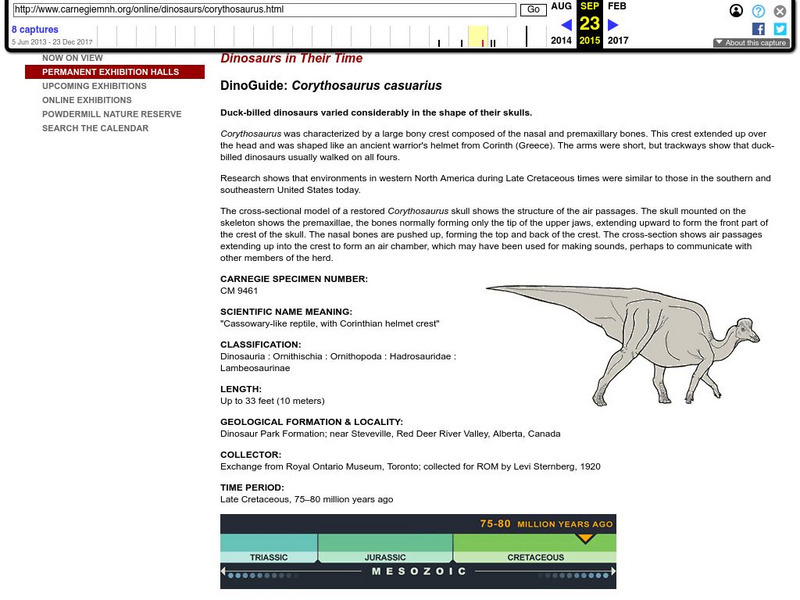
Carnegie Museum of Natural History: Carnegie's Dinosaurs: Dino Guide: Corythosaur
Study a Corythosaurus up close with this concise resource from the Carnegie Museum of Natural History.