Hi, what do you want to do?






Carolina K-12
First Continental Congress, Second Continental Congress, and the Declaration of Independence
Your learners will take on the roles of Congressional members in the year 1775 and devise a plan for America after the onset of the Revolutionary War.

Carolina K-12
Loyalists and Patriots
Your young historians will square off as Loyalists dedicated to the English crown or revolutionaries fighting for a new nation in a role-play of a colonial town hall debate before the American Revolution.

Curated OER
Intolerable Acts
Students examine the implications of North Korea's nuclear testing. They develop a K-W-L chart, read an article, write questions, conduct research on their self-generated questions, and create an exhibit of their findings.

Carolina K-12
On the Road to Revolution: Creating a Living Timeline
Divided into nine topic groups, from the Proclamation of 1763 to the Battles of Lexington and Concord, your young historians research significant events on the road to the American Revolution, then create a two- to three-minute sketch...

iCivics
Hey, King: Get Off Our Backs!
Young historians explore the reason American colonists were unhappy under British rule. Class members complete hands-on activities and participate in a group discussions to understand why colonists drafted the Declaration of Independence.

Middle Tennessee State University
Preparing for Revolution
Class members create a timeline of actions by both the British parliament and the colonists that led to the outbreak of the American Revolution. Groups use the provided Primary Source Analysis Tool to examine and...

Curated OER
Johnny Tremain for the 21st Century
Seventh graders complete a unit of lessons on the American Revolution based on the novel, 'Johnny Tremain.' They define key vocabulary terms, develop a timeline, write a report on a colonial craft, make a colonial flag, and create a...

Curated OER
Candide: A Herber Readiness Activity
“Everything will end up okay if you believe hard enough.” “People create their own luck, good or bad.” Prior to reading Candide, class members respond to an anticipation guide that focuses on the issues of optimism, prejudice, and...

Curated OER
Candide: Problematic Situation
"Would a rational and well-regulated world include human suffering?" "If the plight of human suffering is the 'best of all possible worlds' do humans have freewill?" Class members develop their position on an issue raised by Candide,...

Curated OER
Tolerance and Non-Violence in Civil Society
Students explore the concept of philanthropy. In this Oklahoma City bombing lesson, students submit public responses to the event in order to consider how the tragedy prompted a positive reaction. Extension activities are included.

Curated OER
Civil liberties: Fundamental freedoms
Students explore civil liberties. They list and describe the fundamental freedoms guaranteed to Canadians. Students illustrate how Charter rights are applies. They examine current issues and suggest how the courts might apply Charter...

Independence Hall Association
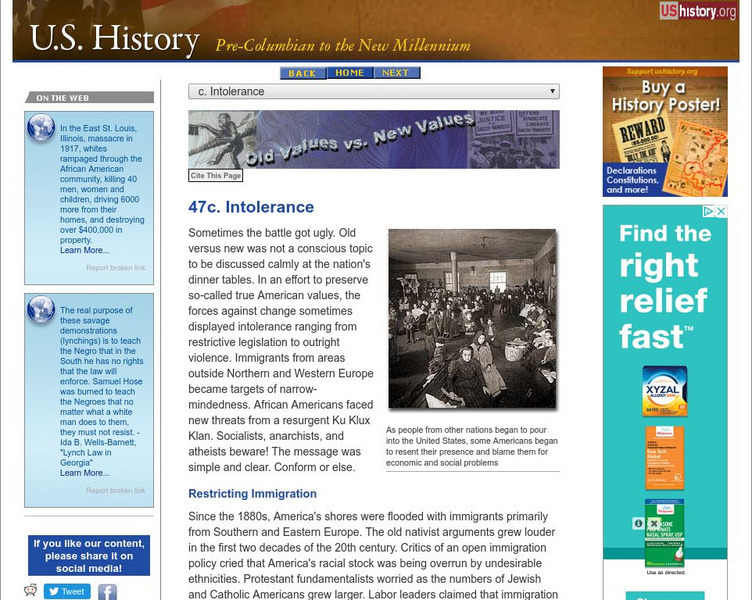
U.s. History: Intolerance
The 1920s was a time of intolerance and a return to nativism, a claim to return to American values, defined as those held by white, western European descendents. Read about the resurgence of the Ku Klux Klan, restriction on immigration,...
Read Works
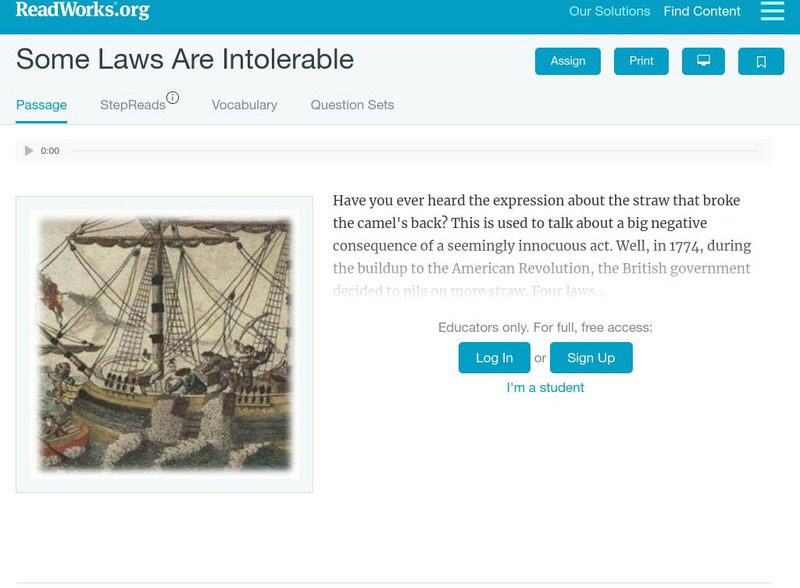
Read Works: Some Laws Are Intolerable
[Free Registration/Login Required] An informational text about the British Acts that lead to the Boston Tea Party and to the writing of the Declaration of Independence. A question sheet is available to help students build skills in...
Other
The History Carper: The Quartering Act of 1774
This site provides the complete text of the second Quartering Act, passed by British Parliament in 1774.