Hi, what do you want to do?






Weebly
Ancient China
From China's physical geography and earliest beginnings of civilization to the Qin and Han dynasties, here is a nicely designed worksheet on ancient China, which includes a graphic organizer and timeline to summarize the reading...

Montgomery County Public Schools
Summer Journal Ideas
Twenty prompts, fifteen starters, and ten situations. What more could you ask for from a list of journal ideas?

Practical Pages
Famous Artist of the Month
Feature one famous artist a month with a series of portraits, biographies, and examples of their gallery. With masters such as Augustus Rodin, Francisco Goya, and Michelangelo, the resource provides opportunities every month for kids to...
Metropolitan Museum of Art
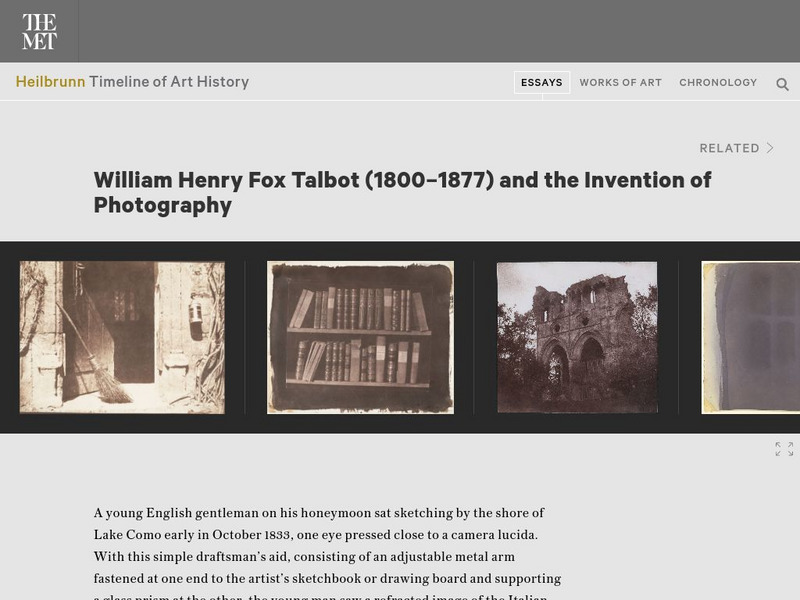
Metropolitan Museum of Art: William Henry Fox Talbot
The Metropolitan Museum of Art provides this informative page on William Henry Fox Talbot(1800-1877)and the invention of photography. With information and pictures this in a nice resource for study.

National High Magnetic Field Laboratory
Magnet Academy: Smoothing Iron 1882
Although not as celebrated as many other scientific inventions, the smoothing iron has its own rich history of development stretching all the way from 400 B.C. to the present.
National High Magnetic Field Laboratory
Magnet Academy: Enrico Fermi
Enrico Fermi was a titan of twentieth-century physics. He outlined the statistical laws that govern the behavior of particles that abide by the Pauli exclusion principle and developed a theoretical model of the atom in his mid-twenties....

Other
History World International: Industrial Revolution
A short history of the Industrial Revolution, the reasons that it began in England, some of the significant inventions that had a major impact, changes in transportation, the rise of labor unions, its spread to the United States, and the...

PBS
Wnet: Thirteen: Freedom: A History of Us: Wake Up, America!
This resource covers the changing of America due to the Industrial Revolution which brought in not only new technology but also opened the door to reform movements. From the series by Joy Hakim, "A History of Us." Includes a teacher's...
National High Magnetic Field Laboratory
Magnet Academy: Lee De Forest
American inventor Lee De Forest was a pioneer of radio and motion pictures. He received more than 300 patents over the course of his lifetime, the most important of which was for a three-electrode vacuum tube, or triode, that he called...
National High Magnetic Field Laboratory
Magnet Academy: Jack Kilby
The integrated circuit fueled the rise of microelectronics in the latter half of the twentieth century and paved the way for the Information Age. An American engineer, Jack Kilby, invented the integrated circuit in 1958, shortly after he...

University of California
University of California: Otis Boykin: Inventor
Otis Boykin (1920-1982 CE) is attributed with developing twenty-six electronic inventions, including devices for guided missiles, IBM computers and a control unit for an artificial heart stimulator.
Other
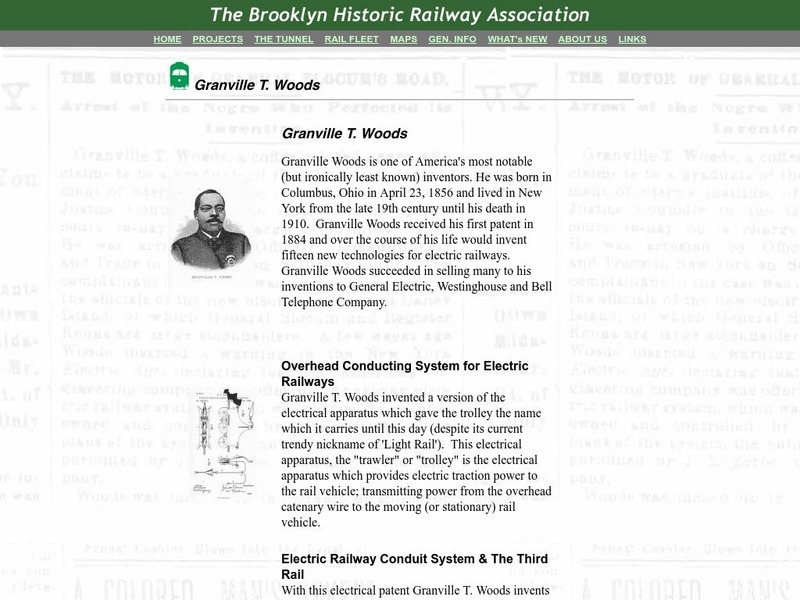
Bhra: Granville Woods
Read this homage to Granville Woods, whose inventions and improvements to the railway system not only made railroad travel safer, but also made the New York City railway system a possibility.
National High Magnetic Field Laboratory
Magnet Academy: Wheatstone Bridge 1843
Read about the device used for measuring resistance in a circuit which was discovered in 1843, but had been invented a decade earlier. The inventor's name was not Wheatstone.
National High Magnetic Field Laboratory
Magnet Academy: Willem Einthoven
Willem Einthoven invented a string galvanometer that lead to the electrocardiogram, which measures heart activity. For his discovery, Einthoven was awarded the Nobel Prize in Physiology or Medicine in 1924.
National High Magnetic Field Laboratory
Magnet Academy: Luigi Galvani
Luigi Galvani was a pioneer in the field of electrophysiology, the branch of science concerned with electrical phenomena in the body. His experiments with dissected frogs and electrical charges led him to suggest the existence of a...
National High Magnetic Field Laboratory
Magnet Academy: John Ambrose Fleming
John Ambrose Fleming was an electronics pioneer who invented the oscillation valve, or vacuum tube, a device that would help make radios, televisions, telephones and even early electronic computers possible. A brilliant innovator,...
National High Magnetic Field Laboratory
Magnet Academy: John Daniel Kraus
For a man whose career involved the entire known universe, John Kraus had a remarkably insular upbringing. He was born and raised in Ann Arbor, Michigan, and earned his bachelor's, master's and doctoral degrees in physics, all at the...

National High Magnetic Field Laboratory
Magnet Academy: William Thomson, Lord Kelvin
William Thomson, known as Lord Kelvin, was one of the most eminent scientists of the nineteenth century and is best known today for inventing the international system of absolute temperature that bears his name. He made contributions to...
National High Magnetic Field Laboratory
Magnet Academy: Michael Faraday
A self-educated man with a brilliant mind, Michael Faraday was born in a hardscrabble neighborhood in London. Through the combination of insatiable curiosity and a powerful will to succeed, he transcended his austere beginnings to...
National High Magnetic Field Laboratory
Magnet Academy: Theodore Maiman
Theodore Maiman built the world's first operable laser. Ironically, Maiman's first paper announcing this momentous achievement, which many other scientists had been racing to complete themselves, was rejected. Since then, however, lasers...
State Library of North Carolina
N Cpedia: Telephones
Telephones began to appear in North Carolina beginning in 1879, three years after Alexander Graham Bell's new invention had first been introduced at the Centennial Exposition in Philadelphia. On 10 March of that year, a telephone was...
Other
Natural Science: Dictionary of Scientific Quotations
A collection of engaging quotations by scientists, inventors, writers, and statesmen about science and invention. With entries from modern-day scientists, such as Francis Crick, and from notable ancients, such as Archimedes.
Other
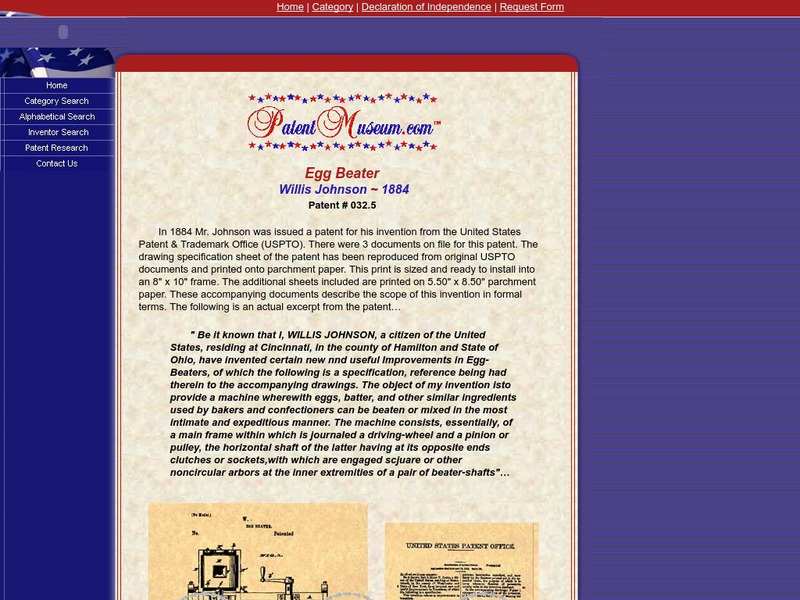
Patent Museum: Egg Beater: Willis Johnson 1884
A brief description to the patent filing and an excerpt from the patent request that Willis Johnson filed for his improvements in the egg beater. Included are drawings submitted with the patent request.