Hi, what do you want to do?






Curated OER
Two Constitutions
Fourth graders participate in a teacher-lead discussion about the United States Constitution and the California State Constitution. They compare the Bill of Rights in the United States Constitution with Califonia's Declaration of...

Curated OER
All Men Are Created Equal
Students discuss the statement "All Men Are Created Equal". Using the internet, they research events in history in which this statement has been ignored and supported by the government. They use this information to write an essay about...

Curated OER
Lee Yick: Fighting Racism
Students study the 14th Amendment, then review and analyze a Supreme Court brief. There was much racism exhibited toward the Chinese immigrants by the European Americans; this came in the form of institutional racism and mob violence....

Curated OER
Erutan
Pupils discuss that governments exist for many purposes. They describe that governments maintain social order, provide public services, provide national security, manage conflict, establish justice, and manage resources.

Curated OER
Powerful Signatures
Students experience famous historical documents that were initiated and propelled by signatures such as Declaration of Independence, U.S. Constitution. They create a school amendment using the information gathered.

Curated OER
Estimating Distances
Fifth graders explore the concept of estimating distances between two places on a map. In this estimating distances lesson plan, 5th graders interpret maps according to measuring distance. Students choose a place on a map and find the...
Curated OER
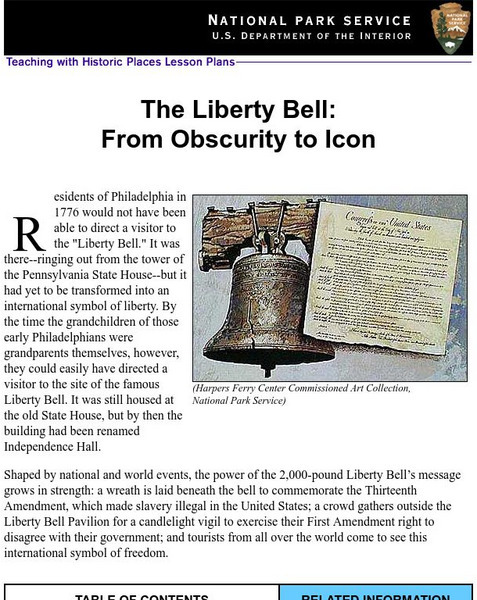
National Park Service: Teaching With Historic Places: The Liberty Bell
Teaching with Historic Places, in collaboration with the National Park Service, provides an extensive lesson plan on The Liberty Bell. Content is laid out with objectives, reading materials, corresponding maps and photographs, learning...

National Council of Teachers of Mathematics
Nctm: Figure This: Statue of Liberty
Is the Statue of Liberty's nose too long? Challenge is to figure out the length of the Statue of Liberty's nose by knowing the length of her arm.
Curated OER
National Park Service: Statue of Liberty
This site provides history and information about the Statue, including information about visiting, the statistics and measurements of the Lady, and historical background of France/U.S. relations. Be sure to click on the "Handbook" link...
Other
American revolution.org: Sins of the Fathers: Religion and Revolution
An academic essay describing the ways in which "religion is an active if not a determinative" cause for the American Revolution. The essay describes three influential areas: (1) religion and liberty, (2) religion and community, and (3)...
Digital History
Digital History: The Emergence of New Ideas About Personal Liberties
American colonists expected to have "English rights" as supported by the Magna Carta and the English Bill of Rights. See how these rights were applied in the trial of John Peter Zenger, whose acquittal reflected the right of freedom of...
Other
Liberty Online: A Summary View of the Rights of British America
Written before the Declaration of Independence, this lengthy essay by Thomas Jefferson argued that the British Government was treating America unfairly. This site contains full text and footnotes within text hyperlinked to panel at...
Other
Sweet Liberty: Roots of Cooperative Federalism
An in-depth article on the roots of cooperative federalism, written by Dan Meador.
Read Works
Read Works: "The New Colossus"
[Free Registration/Login Required] A poem by Emma Lazarus about the Statue of Liberty. A question sheet is available to help students build skills in reading comprehension.
PBS
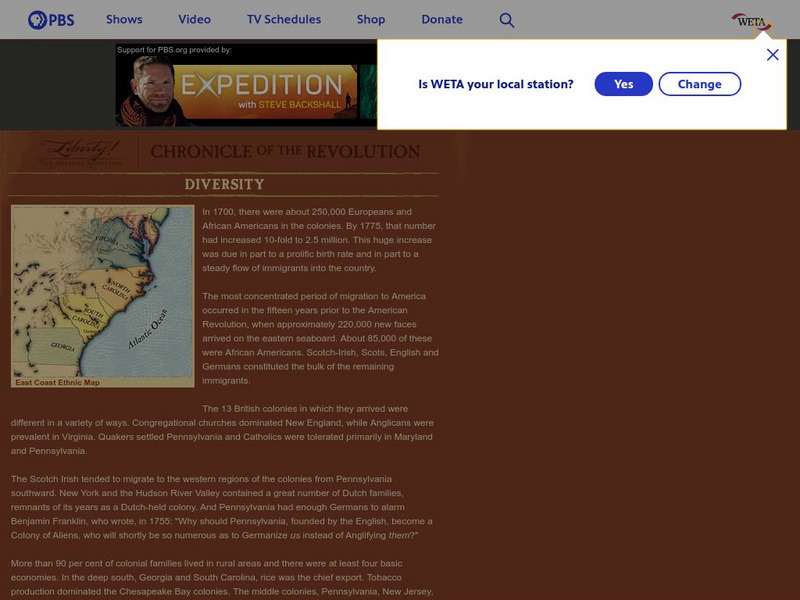
Liberty: Chronicle of the Revolution: Diversity
A brief look at the population increase in colonial America. Find out where all these immigrants came from and what they did in the colonies. From PBS.
Curated OER
Web Gallery of Art: The Genius of France Between Liberty and Death
An image of "The Genius of France between Liberty and Death", created by Jean-Baptiste Regnault in 1795 (Oil on canvas, 60 x 49 cm).
Other
Institute for American Liberty: The First Principles of the Constitution [Pdf]
This article contains information about the principles used to create the Constitution of the United States.
University of Maryland
Howard County Public School System: Foundations of American Government [Pdf]
How was the foundation of today's representative democracy established in early colonial America? Students will be able to source three documents and corroborate evidence to draw conclusions about the development of democratic ideas and...
Gilder Lehrman Institute of American History
Gilder Lehrman Institute: History by Era: Slavery and Anti Slavery
[Free Registration/Login Required] An excellent essay explaining the roots of the anit-slavery movement in the United States in the early 1830s and its evolution over the next twenty-five years. Read about the abolitionists, both white...
University of Groningen
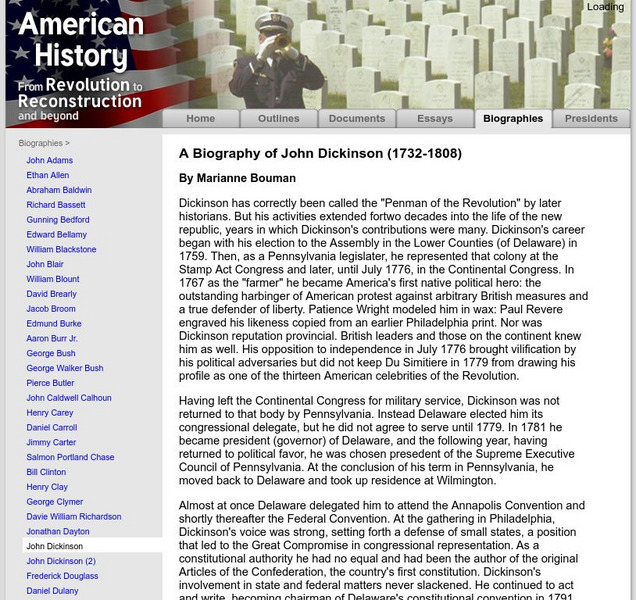
American History: Biographies: John Dickinson (1732 1808)
Dickinson has correctly been called the "Penman of the Revolution" by later historians. But his activities extended fortwo decades into the life of the new republic, years in which Dickinson's contributions were many. Dickinson's career...
University of Maryland
Howard County Public School System: Are All Men Created Equal? [Pdf]
Using primary sources and contextualizing, this lesson attempts to answer the question "Did the ideals of the American Revolution affect the condition of enslaved people?"

United Nations
United Nations: Human Rights
This is the United Nations site devoted to the topic of human rights. The visitor will find links to various declarations, treaties, and news releases.
Hanover College
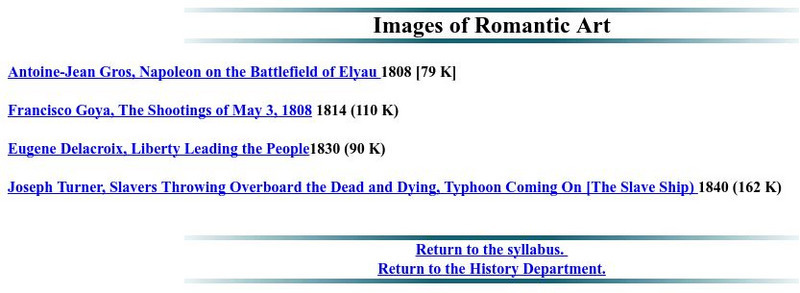
Hanover College: Images of Romantic Art
The Hanover College History offers several excellent images of Romantic Art. The site provides the year each one was created.