Hi, what do you want to do?






Youngzine
Youngzine: Laugh With the 2016 Ig Nobel Prizes
Un-boiling eggs, slippery bananas, and painful insect stings have been award-winning topics at the Ig Nobel ceremonies over the last few years. An Ig prize makes people laugh first, then think.
National High Magnetic Field Laboratory
Magnet Academy: Svante Arrhenius
Svante Arrhenius was born in Vik, Sweden, and became the first native of that country to win the Nobel Prize. The award for chemistry was bestowed to him in honor of his theory of electrolytic dissociation. Arrhenius also developed the...
National High Magnetic Field Laboratory
Magnet Academy: Richard Feynman
Theoretical physicist Richard Phillips Feynman greatly simplified the way in which the interactions of particles could be described through his introduction of the diagrams that now bear his name (Feynman diagrams) and was a co-recipient...
National High Magnetic Field Laboratory
Magnet Academy: Robert Millikan
Robert Andrews Millikan was a prominent American physicist who made lasting contributions to both pure science and science education. He is particularly well known for his highly accurate determination of the charge of an electron via...
Other
Physics Web: Nobel Prize Goes to Semiconductor Pioneers
This site from Physics Web gives information on the 2000 Nobel Prize in Physics. It was awarded to Zhores Alferov and Herbert Kroemer for the invention of semiconductor lasers, integrated circuits and other high-speed electronic devices....
CommonLit
Common Lit: Elie Wiesel's Nobel Acceptance Speech
CommonLit.org is a wonderful resource to use in a Language Arts classroom. Each text is accompanied by guided reading questions, assessment questions, and discussion questions. In addition, students can click on words to see the...
National High Magnetic Field Laboratory
Magnet Academy: Felix Bloch (1905 1983)
Physicist Felix Bloch developed a non-destructive technique for precisely observing and measuring the magnetic properties of nuclear particles. He called his technique "nuclear induction," but nuclear magnetic resonance (NMR) soon became...
National High Magnetic Field Laboratory
Magnet Academy: Gerd Binnig
Gerd Binnig co-developed the scanning tunneling microscope (STM) with Heinrich Rohrer. The STM allowed scientists entry into the atomic world in a new way and was a major advance in the field of nanotechnology. For their achievement,...
National High Magnetic Field Laboratory
Magnet Academy: Heike Kamerlingh Onnes
Heike Kamerlingh Onnes was a Dutch physicist who first observed the phenomenon of superconductivity while carrying out pioneering work in the field of cryogenics. An important step on the way to this discovery was his success in...
National High Magnetic Field Laboratory
Magnet Academy: Paul Dirac
Paul Adrien Maurice Dirac was an outstanding twentieth century theoretical physicist whose work was fundamental to the development of quantum mechanics and quantum electrodynamics. He was awarded the Nobel Prize for Physics jointly with...
National High Magnetic Field Laboratory
Magnet Academy: Peter Debye
Peter Debye carried out pioneering studies of molecular dipole moments, formulated theories of magnetic cooling and of electrolytic dissociation, and developed an X-ray diffraction technique for use with powdered, rather than...
National High Magnetic Field Laboratory
Magnet Academy: Leon Cooper
Leon Cooper shared the 1972 Nobel Prize in Physics with John Bardeen and Robert Schrieffer, with whom he developed the first widely accepted theory of superconductivity. Termed the BCS theory, it is heavily based on a phenomenon known as...
National High Magnetic Field Laboratory
Magnet Academy: Murray Gell Mann
Murray Gell-Mann is a theoretical physicist who won the Nobel Prize for Physics in 1969 for his contributions to elementary particle physics. He is particularly well known for his role in bringing organization into the world of subatomic...
National High Magnetic Field Laboratory
Magnet Academy: Lev Davidovich Landau
While growing up in the Soviet Union, Lev Landau was so far ahead of his classmates that he was ready to begin college at age 13. His parents noticed a particular gift for math in their young son, who was considered a prodigy. It came as...
National High Magnetic Field Laboratory
Magnet Academy: Jack Kilby
The integrated circuit fueled the rise of microelectronics in the latter half of the twentieth century and paved the way for the Information Age. An American engineer, Jack Kilby, invented the integrated circuit in 1958, shortly after he...
Other
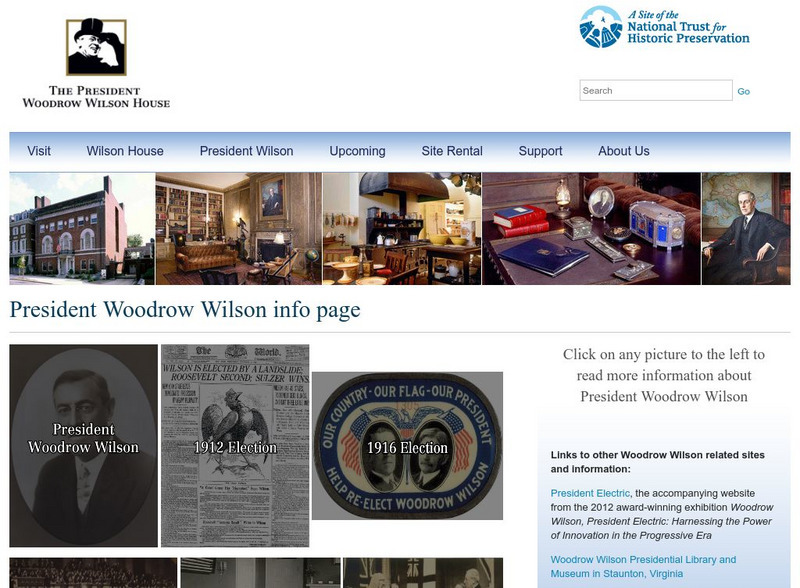
President Woodrow Wilson House: President Wilson
An Overview of the 28th President of the US, Woodrow Wilson. This site includes information about Wilson the Educator, President, War Leader, World Statesman, Nobel Prize Winner, and 20th Century Icon.
National High Magnetic Field Laboratory
Magnet Academy: Willem Einthoven
Willem Einthoven invented a string galvanometer that lead to the electrocardiogram, which measures heart activity. For his discovery, Einthoven was awarded the Nobel Prize in Physiology or Medicine in 1924.
National High Magnetic Field Laboratory
Magnet Academy: Paul Lauterbur
Chemist Paul Lauterbur pioneered the use of nuclear magnetic resonance (NMR) for medical imaging. He developed a technique, now known as magnetic resonance imaging (MRI), in the early 1970s that involves the introduction of gradients in...
National High Magnetic Field Laboratory
Magnet Academy: Wolfgang Pauli
Austrian-born scientist Wolfgang Ernst Pauli made numerous important contributions to twentieth-century theoretical physics, including explaining the Zeeman effect, first postulating the existence of the neutrino, and developing what has...
Other
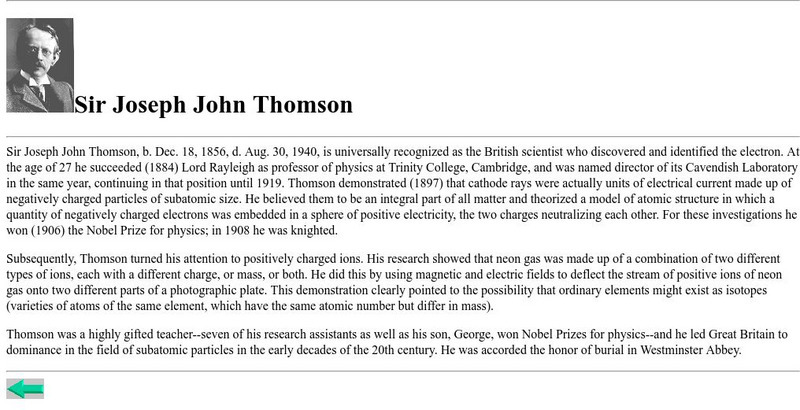
Sir Joseph John Thomson
Have you ever wondered who discovered the electron? The answer is Nobel Prize winning physicist Sir Joseph John Thomson.
Other
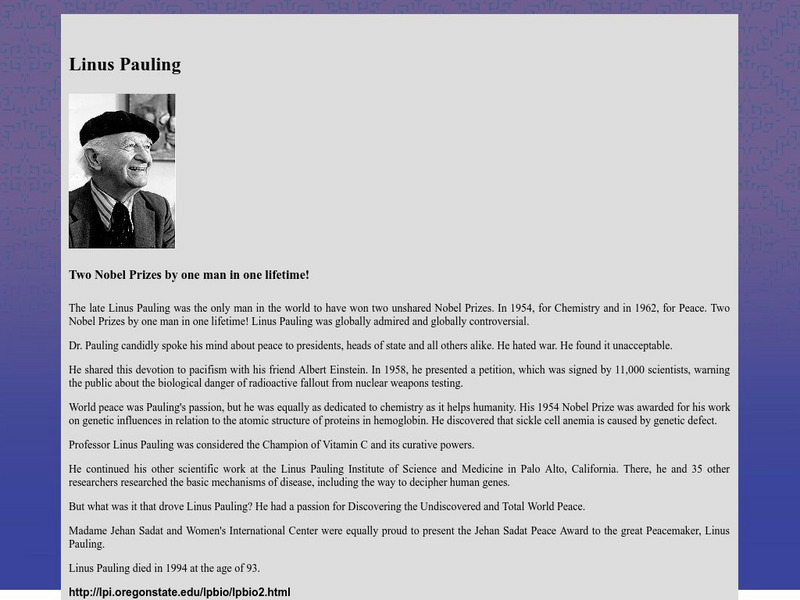
Women's International Center: Linus Pauling
This site provides a biography of Linus Pauling. He was the only man to have won two unshared Nobel prizes. Includes several videos.
National High Magnetic Field Laboratory
Magnet Academy: Klaus Von Klitzing
Klaus von Klitzing is a Nobel laureate who won the award in 1985 for his discovery of the quantized Hall effect, sometimes referred to as the quantum Hall effect. Von Klitzing's discovery resulted from his work exploring a phenomenon...

The Franklin Institute
Marie Curie
Read the history of Marie Curie and her work with radium. Use the tabs above to read more about this scientist, her research, and her rewards.
Authors Calendar
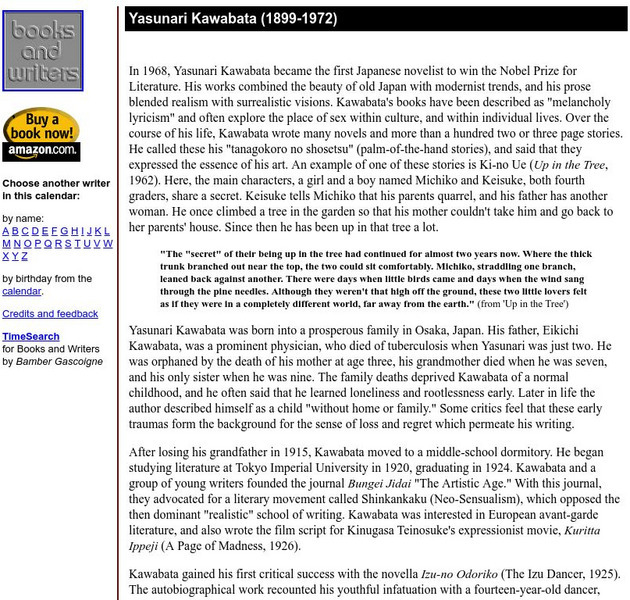
Author's Calendar: Yasunari Kawabata (1899 1972)
This site presents a biography of Yasunari Kawabata, who was the first Japanese novelist to win the Nobel prize for literature. The biography highlights the poetic nature of Kawabata's fiction.