



National Council of Teachers of Mathematics
The Math Forum: How Do You Find Prime Numbers?
This site explains prime number theory and how to find prime numbers.

ClassFlow
Class Flow: Number Theory Order of Operations
[Free Registration/Login Required] This flipchart will help students understand the order of arithmetic operations with rational numbers. It includes exercises and assessment questions.
Science Buddies
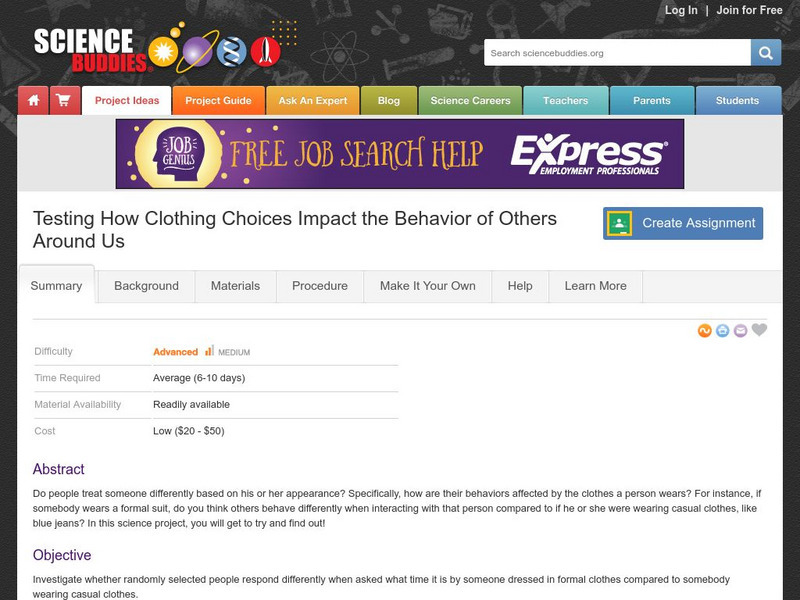
Science Buddies: Testing How Fashion Impacts the Behavior of Others Around Us
There's an old saying that "the clothes make the man" (or woman, we're quick to add nowadays). How true do you think this is? Here's a project with one approach for finding out.
Texas Instruments
Texas Instruments: Numb3 Rs: Driving With Djikstra
Based off of the hit television show NUMB3RS, this lesson introduces students to one of the prominent algorithms in graph theory used to find shortest paths -- the Djikstra Algorithm. The lesson includes four graphs of increasing...
TeachEngineering
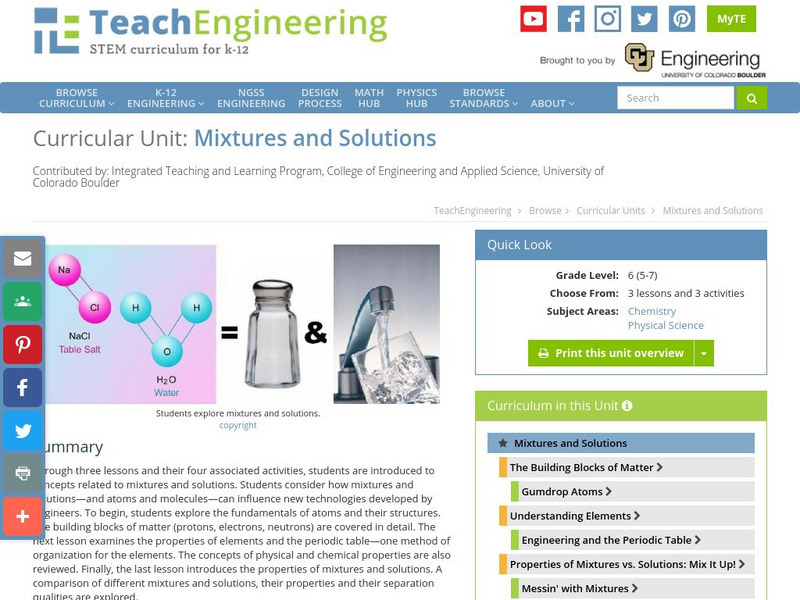
Teach Engineering: Mixtures and Solutions
This unit covers introductory concepts of mixtures and solutions. Students think about how mixtures and solutions, and atoms and molecules can influence new technologies developed by engineers. The first lesson explores the fundamentals...

American Museum of Natural History
American Museum of Natural History: O Logy: How Did the Universe Begin?
Bite-size introduction to two scientists-Hubble and Lemaitre-who played key roles in formulating the theory of the origin of the universe known as the big bang. Includes an interactive timeline on which you can plot out the approximate...
National High Magnetic Field Laboratory
Magnet Academy: Max Planck
In a career that lasted seven decades, Max Planck achieved an enduring legacy with groundbreaking discoveries involving the relationship between heat and energy, but he is most remembered as the founder of the "quantum theory."
National High Magnetic Field Laboratory
Magnet Academy: James Clerk Maxwell
James Clerk Maxwell was one of the most influential scientists of the nineteenth century. His theoretical work on electromagnetism and light largely determined the direction that physics would take in the early twentieth century. Indeed,...

Other
University of Tennessee: The Prime Pages
Here you can find a detailed searchable database of the 5000 largest known primes! Content also includes a glossary, a top 10 records list, prime-music, programs, free downloads, and much more!
Georgia State University
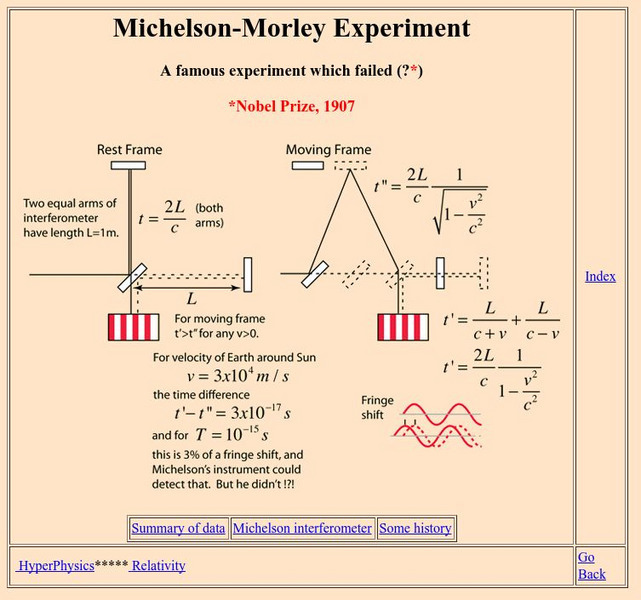
Georgia State University: Hyper Physics: Michelson Morley Experiment
At this site from the Georgia State University is where the proof all starts. One must understand this experiment to have any confidence in relativity. Here's the experimental setup and a summary of the data.
Mathigon
Mathigon: Graphs and Networks: Parties and Dating
This lesson uses handshakes at a party to explain complete graphs, when every vertex is connected to every other vertex. It shows how a formula was created to calculate the number of edges.

University of Alberta
The University of Alberta: Nmr Spectroscopy
1HNMR theory begins in the nucleus of hydrogen. Complete this tutorial on the 1HNMR spectrum graph to learn about the number of equivalent hydrogens, b) the chemical environment of each hydrogen type and c) the number of neighbouring...

Khan Academy
Khan Academy: Smith, Marx, and Keynes
Spanning three centuries of history, from the dawn of the industrial age to modern times, three diverse thinkers developed their own landmark theories on commerce, labor, and the global economy. The three economists profiled in this...
Curated OER
University of St Andrews: Marie Sophie Germain
At a difficult time to be a woman mathematician, Germain was able to submit her works on number theory and receive some acknowledgement.
Other
Carbon 14 Dating
Seven pages all about Carbon 14 Dating. Information on half-life, Carbon 14 used to date specimens and artifacts, limitations, charts and graphs. Michael E. Brown Ph.D. contests that the limitations of Carbon 14 dating support the theory...
National High Magnetic Field Laboratory
Magnet Academy: Peter Debye
Peter Debye carried out pioneering studies of molecular dipole moments, formulated theories of magnetic cooling and of electrolytic dissociation, and developed an X-ray diffraction technique for use with powdered, rather than...
Curated OER
Educational Technology Clearinghouse: Clip Art Etc: Benjamin Franklin
Benjamin Franklin (January 17, 1706 - April 17, 1790) was one of the Founding Fathers of the United States of America. A noted polymath, Franklin was a leading author and printer, satirist, political theorist, politician, scientist,...