Hi, what do you want to do?






Curated OER
Why Do We Need a Government?
Students are introduced to the basic concepts of the natural rights philosophy. After being introduced to the concept of natural rights, students are asked to speculate on what might be the benefits and problems of living in a state of...

Curated OER
Thomas a Becket
Students se of online resources including historical information from the city of Canterbury and a RealPlayer movie about the murder of Thomas a Becket,to learn of the history behind the Canterbury Tales pilgrimage.

Curated OER
Trade Barriers
Students write an editorial piece which takes a position supporting or opposing the free trade policy during the 1790s. After identifying barriers to trade in the 1790s they analyze how their position on the free trade would fit into...

Curated OER
Integtrating Chinese Dance
Students investigate the concept of Chinese dance and how it developed. They practice some of the dances and conduct research the contributions of major choreographers. Students describe the history and cultural significance of each dance.

Curated OER
Scientific Theories
Ninth graders compare and contrast how different models can be used to represent scientific understandings. They evaluate the use of data when considering scientific claims. Students debate a variety of socio-scientific issues and the...

Curated OER
Taxonomy and the World of Microorganisms and Viruses
In this taxonomy worksheet, students understand how organisms are classified using Linnaeus' system. Students classify organisms as either plant or animal. This worksheet has 24 fill in the blank and 6 matching questions.

Curated OER
Who Am I? Famous Scientists
For this scientists worksheet, students read a brief synopsis of a scientist, then try to identify the person, 12 total. Worksheet contains links to additional activities.
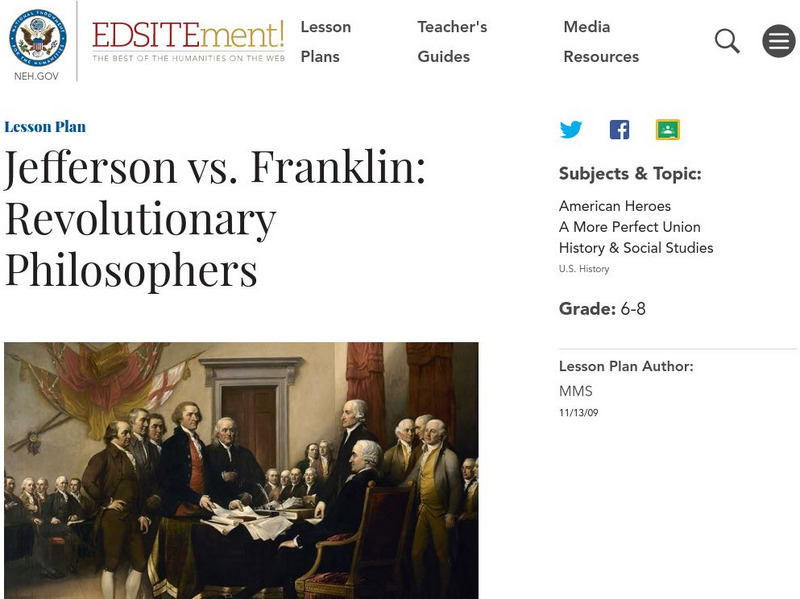
National Endowment for the Humanities
Neh: Edsit Ement: Jefferson vs. Franklin: Revolutionary Philosophers
In this lesson plan, students will consider "Jefferson vs. Franklin: Revolutionary Philosophers." The plan includes worksheets and other student materials that can be found under the resource tab.

Forum Romanum
Outlines of Roman History: The Reign of Marcus Aurelius (Ad 161 180)
Read this entry from William Morey's 1901 text to find out about Marcus Aurelius, one of the five good emperors, who was known as a philosopher.
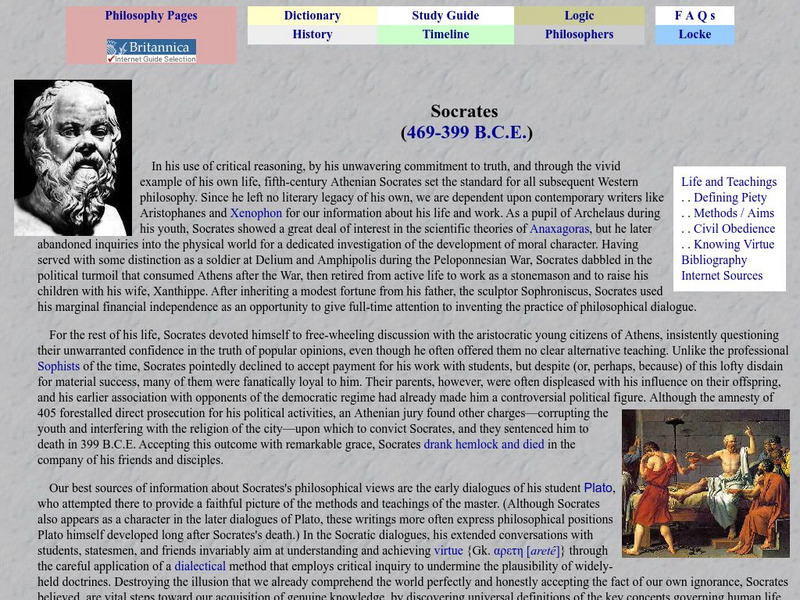
Philosophy Pages
Philosophy Pages: Socrates (469 399 b.c.e.)
Basic-level introduction to Socrates' life. Excellent summary of the main characteristics of Socrates' life in the three dialogues "Euthyphro," "Apology," and "Crito."
Philosophy Pages
Philosophy Pages: The Origins of Western Thought
Scroll down about 1/4 of the page for information on the philosophy of the Milesians. Discusses the beliefs, thinkings, and teachings of the three Milesian philosophers: Thales, Anaximander, and Anaximenes.

Curated OER
Web Gallery of Art: The Three Philosophers
An image of "The Three Philosophers", created by Giorgione from 1508-09 (Oil on canvas, 124 x 145 cm).
Curated OER
Web Gallery of Art: Old Philosopher
An image of "Old Philosopher", created by Pietro Bellotti during the 1670's (Oil on canvas, 73 x 54 cm).
Curated OER
Web Gallery of Art: The Philosopher Cratetes
An image of "The Philosopher Cratetes", created by Luca Giordano, c. 1650 (Oil on canvas, 113 x 90 cm).

National High Magnetic Field Laboratory
Magnet Academy: William Gilbert
William Gilbert was an English physician and natural philosopher who wrote a six-volume treatise that compiled all of the information regarding magnetism and electricity known at the time. The work included descriptions of many of...
Stanford University
Stanford Encyclopedia of Philosophy: Dialetheism
Describes the notion of "dialetheism," the logical theory of true contradictions. Explains its history of development, its philosophical consequences, and its significance for rationality. Excellent bibliography.
Steven Kreis, PhD
The History Guide: Niccolo Machiavelli, 1469 1527
This site has biographical information for Machiavelli (1469-1527 CE), the political philosopher during the Italian Renaissance.
Lumen Learning
Lumen: Romanticism: "Self Reliance" by Ralph Waldo Emerson
"Self-Reliance" is an essay written by American transcendentalist philosopher and essayist Ralph Waldo Emerson. It contains the most thorough statement of one of Emerson's recurrent themes, the need for each individual to avoid...
Other
Thomas More: Description by Erasmus
In this letter written in 1519, Desiderius Erasmus describes his friend Sir Thomas More.
University of Groningen
American History: Biographies: Edmund Burke (1729 1797)
British statesman, parliamentary orator and political thinker, played a prominent part in all major political issues for about 30 years after 1765, and remained an important figure in the history of political theory.
Other
Latter Rain Page: Roger Bacon's Life, Works, Philosophy
Well-rounded biography of Roger Bacon with very clear explanation of his philosophy. The focus is on his belief that knowledge can be attained through scientific experiments and through divine inspiration. Includes brief excerpt from...
Stanford University
Temporal Logic/stanford Encyclopedia of Philosophy
Discusses the temporal logic of Arthur Prior, a type of modal logic. After technical definitions, author addresses related philosophical issues. Also summarizes applications in natural language, computer science, and artificial...
Other
Trinity College: The Window: Ibn Rushd
Brief biography from Trinity College of Ibn Rushd, a Muslim scholar who made contributions to many fields of study, including astronomy, philosophy, music, and medicine.