Hi, what do you want to do?





Alabama Learning Exchange
Alex: Extra! Extra! Supreme Court Case Makes Headlines!
This is a project to conclude the study of the Judicial Branch of our government. The students, working in pairs, will be assigned a landmark Supreme Court case to research in a computer lab setting. They will then construct a one-page...
PBS
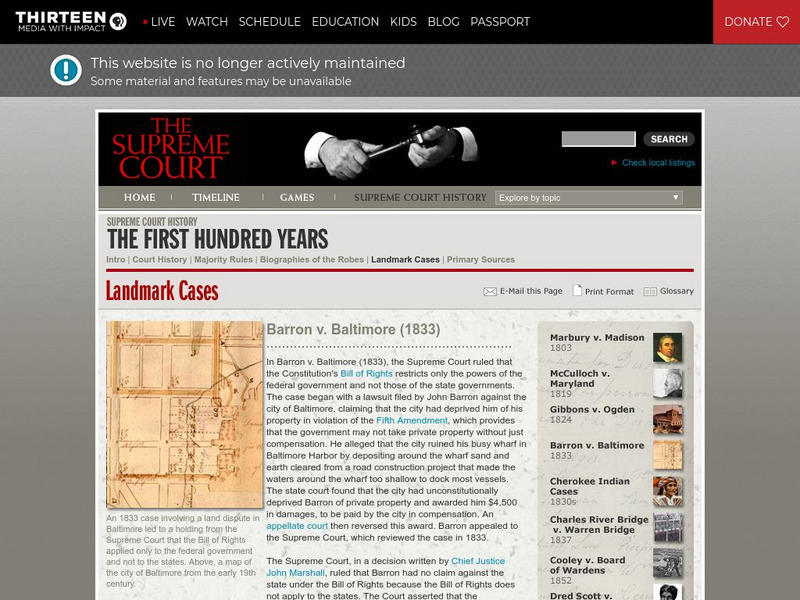
Wnet: Thirteen: The Supreme Court: Landmark Cases: Barron v. Baltimore (1833)
PBS features a summary of the landmark Supreme Court case of Barron v. Baltimore which stated that the freedoms guaranteed by the Bill of Rights did not restrict the state governments. Decision written by Chief Justice John Marshall.
![Digital History: The Supreme Court Decides [Pdf] Website](https://static.lp.lexp.cloud/images/attachment_defaults/resource/large/FPO-knovation.png "Digital History: The Supreme Court Decides [Pdf] Website")
Digital History
Digital History: The Supreme Court Decides [Pdf]
An explanation of the Supreme Court decision in 1911 that broke up the monopoly of Standard Oil, charged with unreasonable restraint of trade. Read commentary that claimed that the decision did not really increase competition in the oil...
Digital History
Digital History: The Supreme Court Orders Desegregation [Pdf]
This site is from a unit called 'African-Americans in the Land of Equality.' It looks at the 1954 decision by the Supreme Court in the Brown v. Board of Education case that ended school segregation.
US National Archives
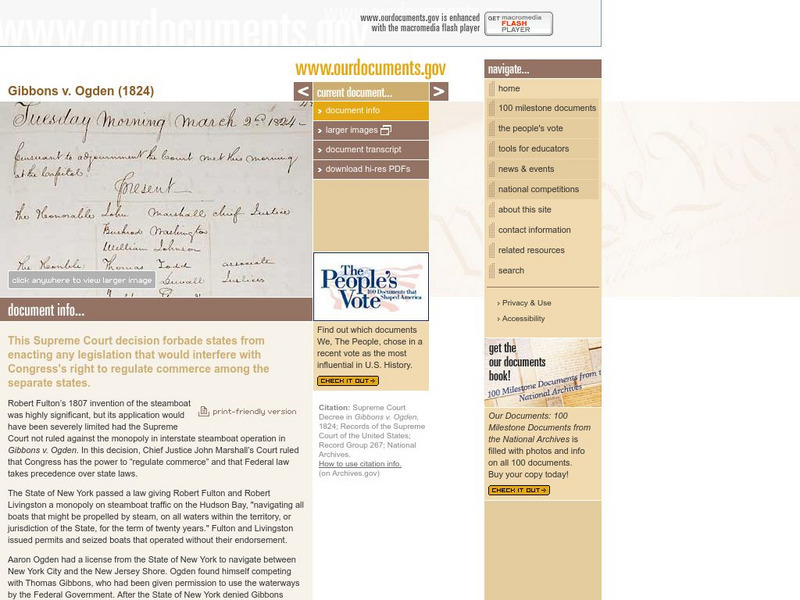
Our Documents: 100 Milestone Documents: Gibbons v. Ogden(1824)
Use this site to learn all about this Supreme Court decision that dealt with interstate commerce. View an image of the original document and read the complete text.

Library of Congress
Loc: Slaves and the Courts
Slaves and the Courts, 1740-1860 contains just over a hundred pamphlets and books (published between 1772 and 1889) concerning the difficult and troubling experiences of African and African-American slaves in the American colonies and...
Read Works
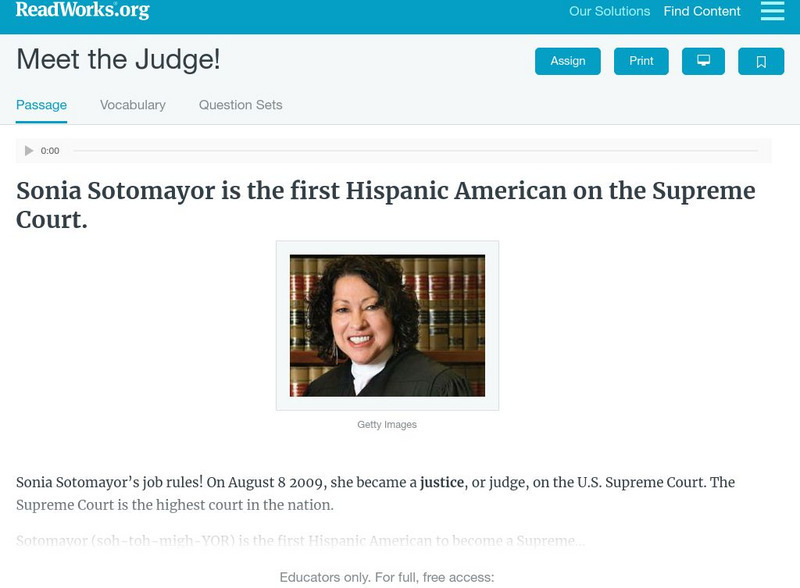
Read Works: Meet the Judge!
[Free Registration/Login Required] An biographical text about Sonia Sotomayor, the first Hispanic American Supreme Court Justice. A question sheet is available to help students build skills in reading comprehension.
Other
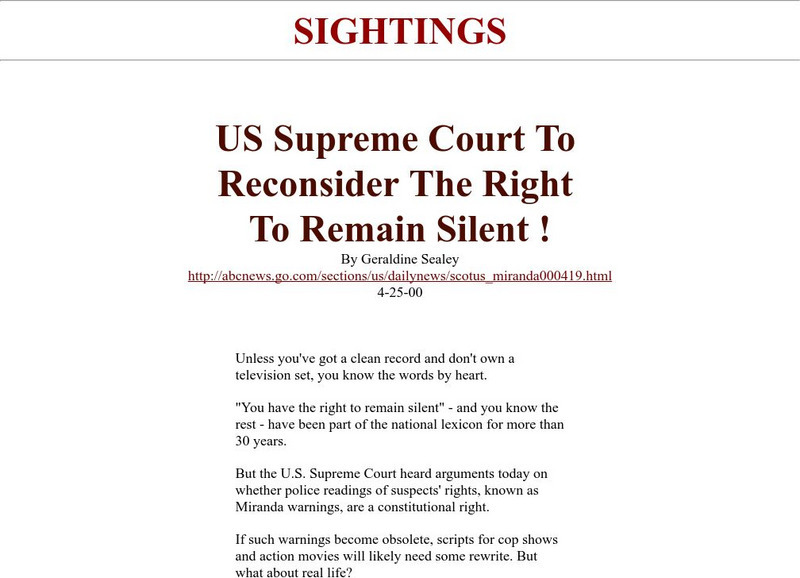
Us Supreme Court to Reconsider the Right to Remain Silent!
This article sums up the anticipated views of Supreme Court members on the occasion of the arguments to reverse the Miranda decision.
PBS
Pbs News Hour: Senate Confirms Samuel Alito
The confirmation of U.S. Supreme Court Justice, with particular emphasis on the fight in the Senate, is highlighted in this report from January, 2006. A transcript, audio, and video are available.
NBC
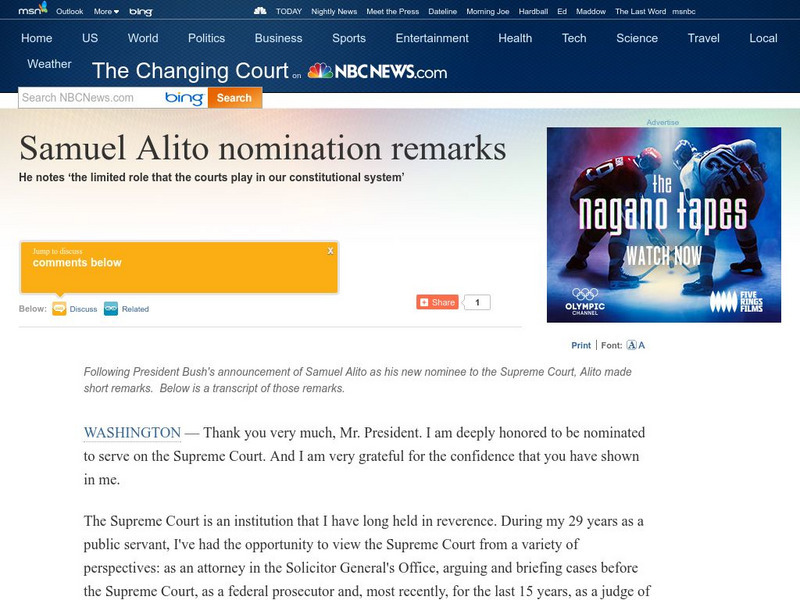
Nbc News: Samuel Alito Nomination Remarks
Samuel Alito's remarks after being nominated by President George W. Bush as the replacement for Sandra Day O'Connor on the U.S. Supreme Court.
iCivics
I Civics: Elk v. Wilkins (1884)
This mini-lesson examines the Supreme Court's ruling that the 14th Amendment's Citizenship Clause did not apply to American Indians born on Native reservations. Students analyze a primary document and discover how the lack of citizenship...

US National Archives
Docsteach: u.s. V. Amistad: A Case of Jurisdiction
Students will analyze specified passages from the Supreme Court's decision in United States v. Libellants of Schooner Amistad to explore the concept of jurisdiction and how a case travels through the federal court system.
iCivics
I Civics: Loving v. Virginia (1967)
This mini-activity covers the basics of the Supreme Court's decision that struck down state bans on interracial marriage. Students learn about the 14th Amendment's Equal Protection Clause, and its use in court cases to challenge a range...
US National Archives
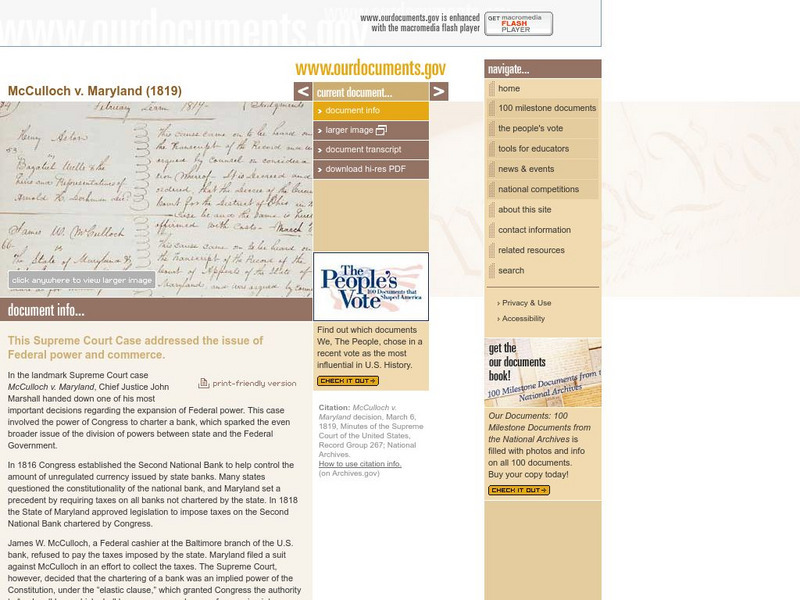
Our Documents: Mc Culloch v. Maryland
Learn about this landmark Supreme Court case on the issues of federal power and commerce. Provides an image of a document from the case files and a transcript of the opinion delivered in 1819 by Chief Justice John Marshall.
iCivics
I Civics: Obergefell v. Hodges (2015)
This mini-lesson covers the basics of the Supreme Court's decision that extended marriage rights to same-sex couples. Students learn about the 14th Amendment's Equal Protection and Due Process Clauses, and how the Court's interpretation...
Independence Hall Association
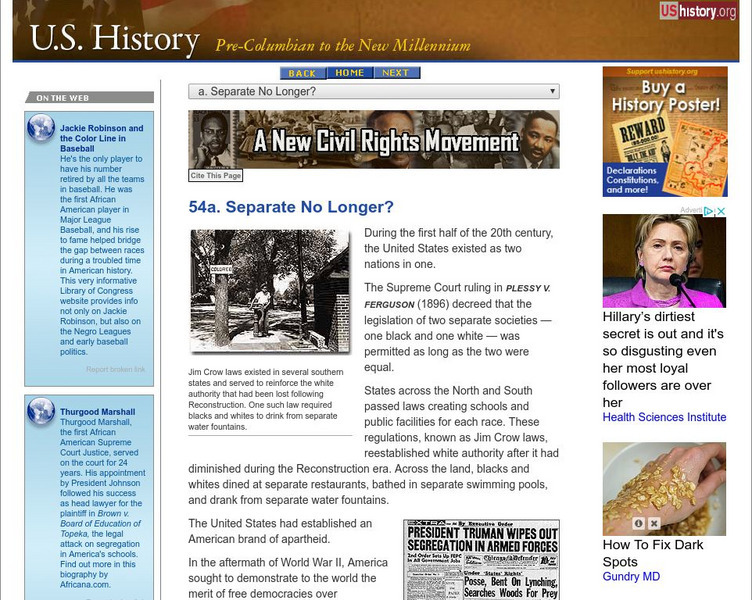
U.s. History: Separate No Longer?
An explantion of how the Supreme Court decision in Brown v Board of Education of Topeka turned the concept of separate but equal on its head. See how they determined that the 14th Amendment was being violated when schools did not fund...

Khan Academy
Khan Academy: Brown v. Board of Education of Topeka
Discusses the famous Supreme Court decision that ended school segregation, Brown v. Board of Education of Topeka (1954).
PBS
Pbs News Hour: Alito Becomes 110th Supreme Court Justice
January, 2006 report on the confirmation and swearing in of Justice Samuel Alito.
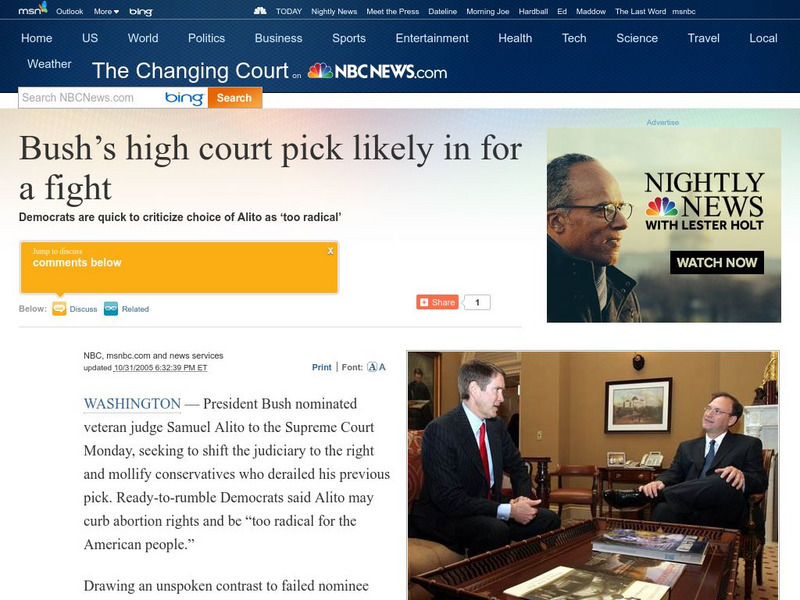
NBC
Nbc News: Bush's High Court Pick Likely in for a Fight
Detailed article from October, 2005 forecasting the difficult road to nomination that Samuel Alito will face in the Senate.
Cornell University
Cornell University: Law School: Amistad Revolt
This site from the Cornell University School of Law provides a brief description of what happened during the Amistad Revolt and gives details concerning the Supreme Court that followed.
Curated OER
Cnn.com:change at the Supreme Court
CNN article providing detailed information on the Senate confirmation hearing of Samuel Alito who was sworn in as the 110th Supreme Court justice on January 31st, 2006.

Cornell University
Cornell University: Law School: Original Jurisdiction What Does It Mean?
This brief article explains the concept of original jurisdiction, especially in terms of the U.S. Supreme Court. There are links in the article to actual cases.
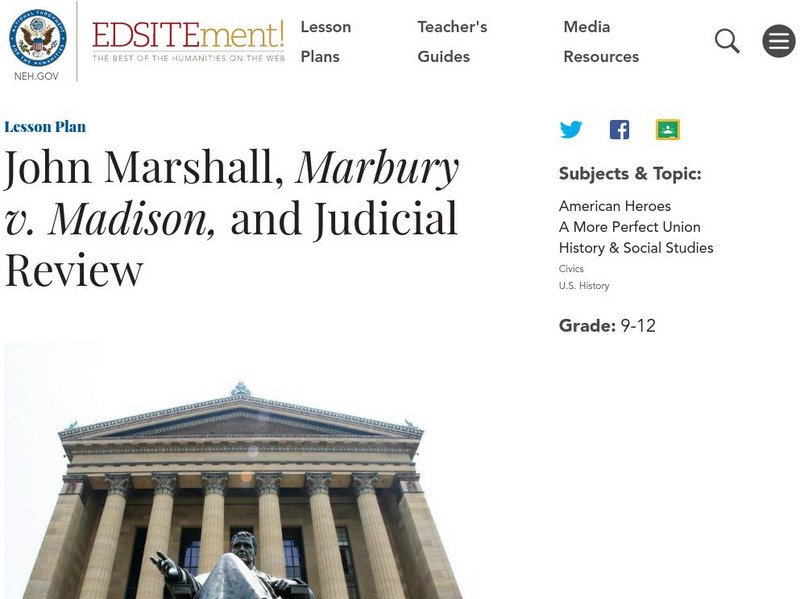
National Endowment for the Humanities
Neh: Edsit Ement: John Marshall, Marbury v. Madison, and Judicial Review
In this lesson plan, students will consider "John Marshall, Marbury v. Madison, and Judicial Review-How the Court Became Supreme." The plan includes worksheets and other student materials that can be found under the resource tab.

US National Archives
Docsteach: From Dred Scott to Civil Rights Act of 1875: Eighteen Years of Change
In 1857, the U.S. Supreme Court ruled in the Dred Scott decision that African-Americans were not citizens of the United States. Yet within 18 years, Black Americans would not only have citizenship, but would be guaranteed the right to...