Hi, what do you want to do?






Curated OER
Whose go the Power: Checks and Balances
After introducing the three branches of US government, test the class' understanding of government powers. They are asked a series of questions regarding a federal act and then, answer which branch has the power of decision making....

Curated OER
Defined: The Different Types of Government
The world is a big place, so it only stands to reason that different forms of government exist. Democracy, autocracy, oligarch, monarch, and dictatorship are all defined. An extensive explanation of US government system is also included....

iCivics
The Road to Civil Rights
Here is a fantastic resource on the civil rights movement! It includes reading materials and worksheets, and particularly highlights major legislation and the role of the judicial branch in the federal government in addressing the...

Curated OER
Individual Rights -- Freedom of Speech at School
Students examine their individual rights at a public school. In groups, they identify the most common ways of expressing themselves and why they should limit their speech in public. They compare and contrast two cases in which they...

Curated OER
Fractured Facts for Civics
In this fractured facts for civics worksheet, 9th graders correct 24 sentences by replacing certain phrases if they are incorrect, but not all need to be corrected, answers are included.

Curated OER
American Government Worksheet 1
In this American government worksheet, students respond to 12 true/false, 11 alphabetical order, 15 fill in the appropriate articles, 15 matching, and 1 cryptogram about the structure of the American government.

Curated OER
Documents and Symbols and American Freedom
Students complete a unit of lessons on the documents, symbols, and famous people involved in the founding of the U.S. government. They create a personal bill of rights, write a found poem, design a flag, conduct research, and role-play...

Curated OER
Right on Time!
Learners read portions of biographies about human rights activists before participating in a jigsaw activity in which they report out on what they read. They made a timeline of one of the human rights activist's lives. They write a...

Curated OER
Bill of Rights -- Americans with Disabilities Act
Middle schoolers focus on the First and Ninth Amendments of the Bill of Rights. Before visiting a museum, they examine the Americans with Disabilities Act. During the visit, they work together with a museum member to watch a video and...

Curated OER
The Piano
Second graders read The Piano and become familiar with racial discrimination. In this racial discrimination book instructional activity, 2nd graders answer comprehension question to focus on the importance of the book. ...

Curated OER
Should the United States Have a Central Bank?
Students assess the validity of a national bank. They study the importance of McCullough v. Maryland. They review the arguments of Hamilton and Jefferson. They analyze the Tenth Amendment and the debate over state v. federal power. They ...

Curated OER
The Trial of Dred Scott
Students study the trial of Dred Scott. They investigate the New York Times reporter and simulate writing about the trial for a newspaper. They identify the 5Ws from the play using a graphic organizer and present their findings to the...

Curated OER
Debating Teenage Rights
Students deal with 'real world' questions in settings that resemble Congress or the courtroom. They identify a problem, find causes, research possible solutions, determine the best solution, and plan a means of implementing the best...

Curated OER
The Trail of Tears by Joseph Bruchac
In this Trail of Tears worksheet, students fill in the blanks with words given to the Trail of Tears. Students fill in 19 blanks on this worksheet.

Curated OER
Exploring the Three Branches of Government
Students view a PowerPoint presentation to explore the three branches of government. Using this infromation, they identify the people, buildings and responsiblities of each branch. They complete a worksheet using the internet and take a...

Curated OER
Crisis in the Classroom: Little Rock & Boston
Students examine periods and instances of racial disharmony in the aftermath of segregation in the South, and de facto segregation in the North. They analyze causes of antagonism between racial groups and explore possible solutions.
![Digital History: The Supreme Court and the New Deal [Pdf] Website](https://static.lp.lexp.cloud/images/attachment_defaults/resource/large/FPO-knovation.png "Digital History: The Supreme Court and the New Deal [Pdf] Website")
Digital History
Digital History: The Supreme Court and the New Deal [Pdf]
Read about the conflict between the laws and regulations that were passed during Franklin Roosevelt's New Deal and the interpretation of the commerce clause by the Supreme Court. Roosevelt had a plan to change the Supreme Court. See...
US National Archives
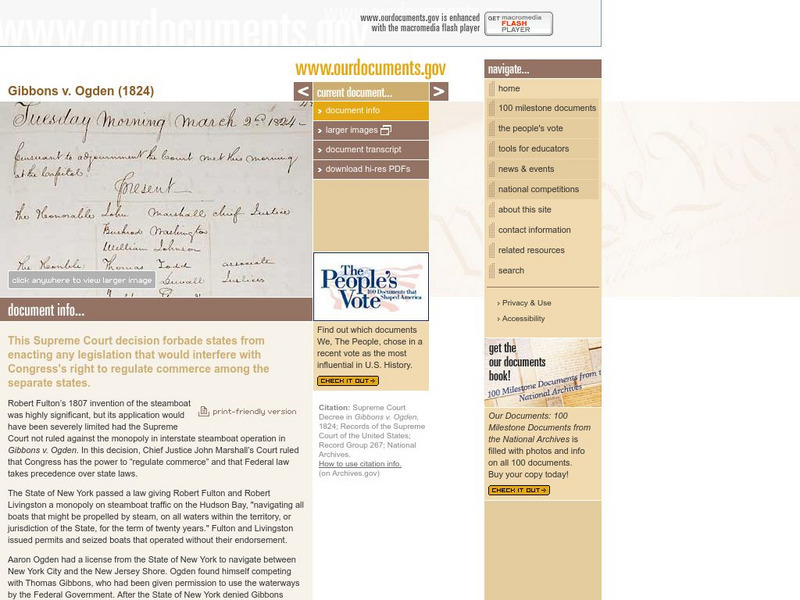
Our Documents: 100 Milestone Documents: Gibbons v. Ogden(1824)
Use this site to learn all about this Supreme Court decision that dealt with interstate commerce. View an image of the original document and read the complete text.
Cornell University
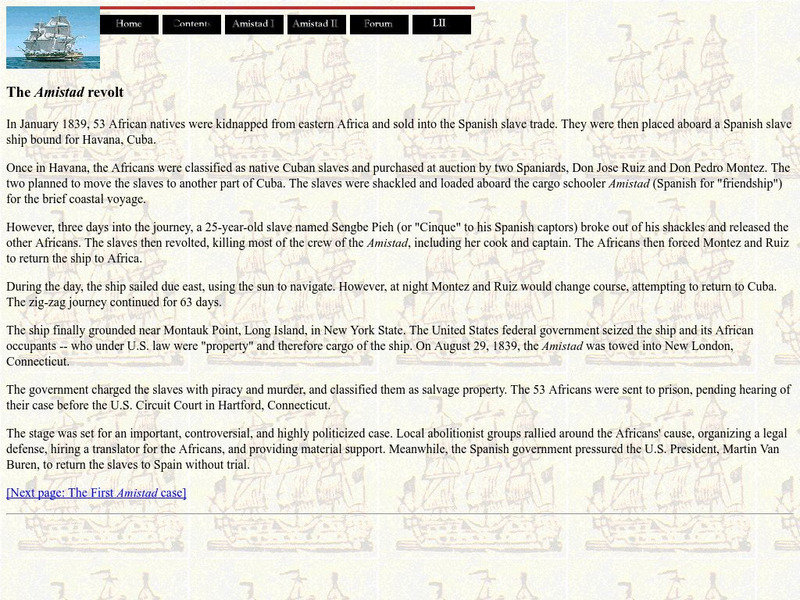
Cornell University: Law School: Amistad Revolt
This site from the Cornell University School of Law provides a brief description of what happened during the Amistad Revolt and gives details concerning the Supreme Court that followed.

Cornell University
Cornell University: Law School: Overview of Marriage
This web page, which is provided for by the Cornell University Law School, explains the process of getting married and its origin.

Cornell University
Cornell University: Law School: Original Jurisdiction What Does It Mean?
This brief article explains the concept of original jurisdiction, especially in terms of the U.S. Supreme Court. There are links in the article to actual cases.
PBS
Pbs News Hour: Senate Confirms Samuel Alito
The confirmation of U.S. Supreme Court Justice, with particular emphasis on the fight in the Senate, is highlighted in this report from January, 2006. A transcript, audio, and video are available.
Independence Hall Association
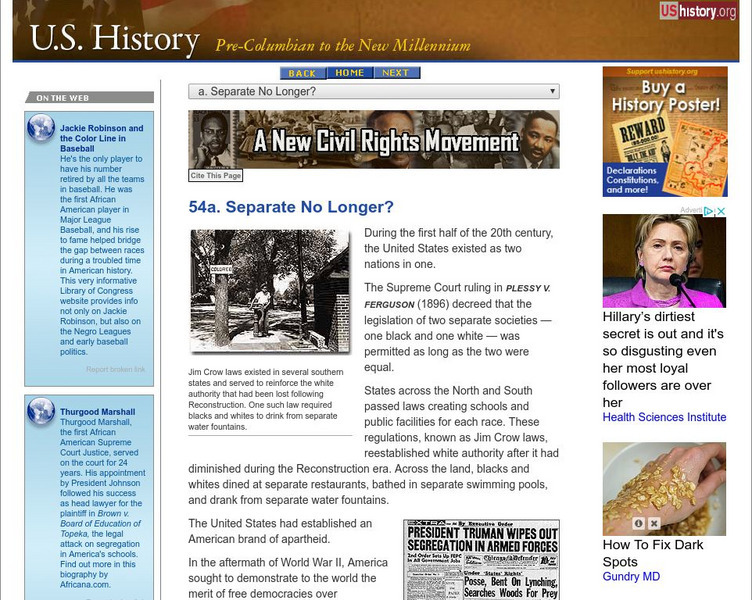
U.s. History: Separate No Longer?
An explantion of how the Supreme Court decision in Brown v Board of Education of Topeka turned the concept of separate but equal on its head. See how they determined that the 14th Amendment was being violated when schools did not fund...
Cornell University
Cornell University: Law School: Tort
At the Cornell Law School you can read a very simple definition of the legal term "tort" and read about the 1993 Supreme Court case "Smith v. United States."