



Curated OER
Right on Time!
Students read portions of biographies about human rights activists before participating in a jigsaw activity in which they report out on what they read. They made a timeline of one of the human rights activist's lives. They write a...

Curated OER
Famous Firsts Vocabulary
In this vocabulary worksheet, students read the statements about famous firsts celebrated in Black history month. Students write the 10 names to complete the statements.

Curated OER
Current Event Quiz:High School
It's important to keep high schoolers updated on current events. They will answer a series of 40 true/false questions highlighting major events occurring between September 4, 2001 and September 24, 2001.

Curated OER
Utah's Judicial Branch
Seventh graders explain that the judicial branch of Utah's government interprets laws and reviews the consitutionality of laws.

Curated OER
What Effect Does A Communities Attitudes/Values/And Beliefs Effect Student Behavior And Influence Curriculum
Learners examine how race relations effect the kinds and amount of educational resources individual schools receive within a school district.

Curated OER
Listerine: Miracle Liquid or Product in Search of a Purpose?
Students analyze and research the claims of Listerine advertisements and commercials. They observe commercials and ads, then participate in numerous activities to determine the credibility of the claims made by Listerine. Students...

Curated OER
Famous Firsts Crossword
For this crossword puzzle worksheet, students read the 10 clues about famous firsts for Black history. Students use the words in the word bank to complete the puzzle.

Curated OER
Super Spreadsheets
Students develop a spreadsheet containing statistical data. They describe and interpret the data to make conclusions. They review the differences between an unorganized spreadsheet verses an organized one.

Curated OER
Debating Teenage Rights
Young scholars deal with 'real world' questions in settings that resemble Congress or the courtroom. They identify a problem, find causes, research possible solutions, determine the best solution, and plan a means of implementing the...

Curated OER
Airborne & Special Operations Museum- Grade 5
For this gallery scavenger hunt worksheet students answer 11 questions about the displays in the Airborne & Special Operations Museum (location unknown).

Curated OER
Fractured Facts for Civics
In this fractured facts for civics instructional activity, 9th graders correct 24 sentences by replacing certain phrases if they are incorrect, but not all need to be corrected, answers are included.

Curated OER
3 Branches of Governement
Sixth graders use the "Making the Grade" books, citizenship packets, and the "Ben's Guide" website to create a poster and a report on their assigned government branch. They then present their poster and report to their classmates.

Curated OER
Quotas and Jim Crow Laws
Young scholars examine the use of quotas and Jim Crow laws. They discuss discrimination against minority groups both historically and in contemporary society. Students examine an affirmative action case and discuss the controversies...

Curated OER
Individual Rights -- Freedom of Speech at School
Young scholars examine their individual rights at a public school. In groups, they identify the most common ways of expressing themselves and why they should limit their speech in public. They compare and contrast two cases in which they...

Curated OER
Social Studies: Exploring Japan
Fourth graders examine the culture and environment of Japan, beginning with a KWL chart. They use clay and cups of water to construct representations of the Japanese Islands. After designing flags representing farming and food, 4th...

Curated OER
Famous Firsts Challenge
In this Black history month worksheet, students read the statements about Black history month. Students select the best answer to complete the 10 statements.

Curated OER
Punctuation Exercise
Are you looking for a way to practice tricky punctuation? Use this worksheet as a homework assignment or warm-up activity. Young grammarians are given 20 sentences to punctuate using semicolons, colons, dashes, quotation marks, or...

PBS
Wnet: Thirteen: The Supreme Court: Landmark Cases: Dred Scott v. Sandford (1857)
PBS features a summary of the landmark Supreme Court case of Dred Scott v. Sanford which ruled that African Americans are not American citizens, and therefore could not sue in federal court. Decision written by Chief Justice Roger B. Taney.
PBS
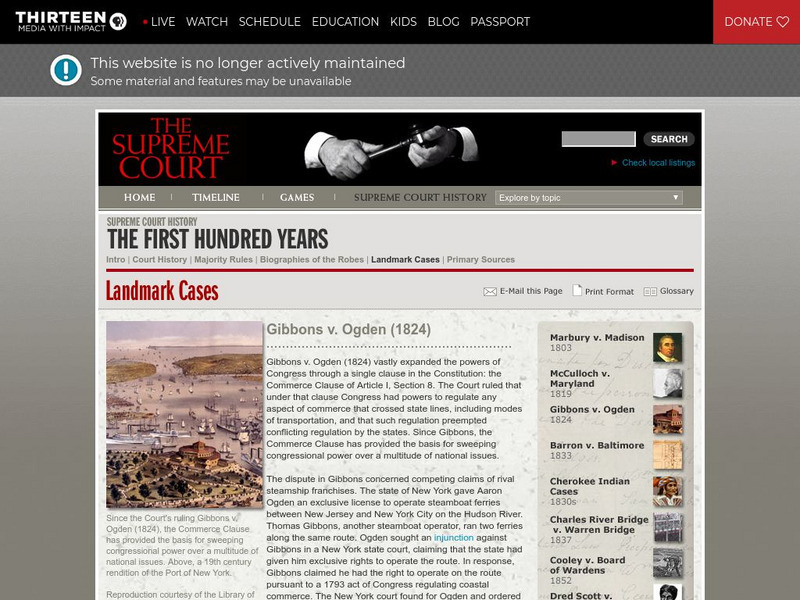
Wnet: Thirteen: The Supreme Court: Landmark Cases: Gibbons v. Ogden (1824)
PBS features a summary of the landmark Supreme Court case of Gibbons v. Ogden which dealt with congressional powers through the Commerce Clause of Article I, Section 8. Decision written by Chief Justice John Marshall.
Other
Age of Jefferson and Jackson:john Marshall: The "Man Who Made the Court Supreme"
Read a thorough essay discussing the many important decisions handed down by the Supreme Court while John Marshall was Chief Justice. There are hyperlinks to each of the decisions.
![Digital History: The Supreme Court and the New Deal [Pdf] Website](https://static.lp.lexp.cloud/images/attachment_defaults/resource/large/FPO-knovation.png "Digital History: The Supreme Court and the New Deal [Pdf] Website")
Digital History
Digital History: The Supreme Court and the New Deal [Pdf]
Read about the conflict between the laws and regulations that were passed during Franklin Roosevelt's New Deal and the interpretation of the commerce clause by the Supreme Court. Roosevelt had a plan to change the Supreme Court. See...
Digital History
Digital History: The Supreme Court Decides [Pdf]
An explanation of the Supreme Court decision in 1911 that broke up the monopoly of Standard Oil, charged with unreasonable restraint of trade. Read commentary that claimed that the decision did not really increase competition in the oil...
Digital History
Digital History: The Supreme Court Orders Desegregation [Pdf]
This site is from a unit called 'African-Americans in the Land of Equality.' It looks at the 1954 decision by the Supreme Court in the Brown v. Board of Education case that ended school segregation.
PBS
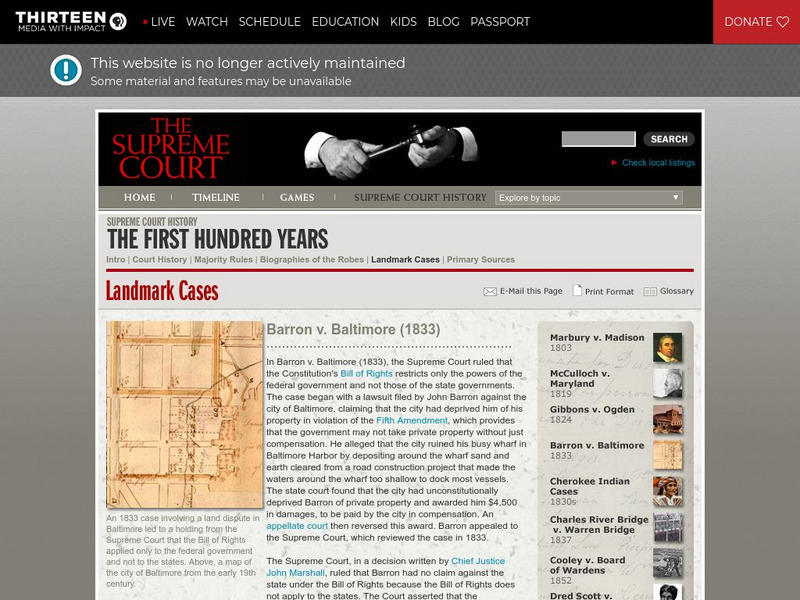
Wnet: Thirteen: The Supreme Court: Landmark Cases: Barron v. Baltimore (1833)
PBS features a summary of the landmark Supreme Court case of Barron v. Baltimore which stated that the freedoms guaranteed by the Bill of Rights did not restrict the state governments. Decision written by Chief Justice John Marshall.