


Crash Course
Crash Course Biology #27: Circulatory & Respiratory Systems
Hank takes us on a trip around the body - we follow the circulatory and respiratory systems as they deliver oxygen and remove carbon dioxide from cells, and help make it possible for our bodies to function. [11:40]
Crash Course
Crash Course Chemistry #27: Solutions
Tutorial illustrating the ideas of solutions and discussing molarity, molality, and mass percent. Also, why polar solvents dissolve polar solutes, and nonpolar solvents dissolve nonpolar solutes. [8:21]

Crash Course
Crash Course Psychology #17: The Power of Motivation
Crash Course video tells the incredible story of Aaron Ralston and teaches us about theories, evolutionary perspectives and the power of motivation. [11:19]
Crash Course
Crash Course Kids 17.2: A Change of Scenery
The world changes. It really does! But sometimes it changes so slowly that we don't notice it. Other times it changes REALLY FAST!!! In this episode of Crash Course Kids, Sabrina talks about some of the reasons things can change quickly...
Crash Course
Crash Course Literature #3: Love or Lust? Romeo and Juliet Part Ii
In this Crash Course video, John Green returns to William Shakespeare's Romeo and Juliet to explore the themes of true love, lust, and whether Romeo and Juliet were truly, deeply in love, or they were just a pair of impetuous teens. How...

Crash Course
Crash Course Economics #16: Globalization, Trade, and Poverty
Crash Course video in which Jacob and Adriene talk about poverty and extreme poverty and explain the impact, good and bad, of globalization. [9:01]

Crash Course
Crash Course Psychology #10: Altered States
Crash Course Psychology video with Hank Green talks about altered states of consciousness, including hypnosis, psychoactive depressants, and non-drug induced hallucinations. [11:18]

Crash Course
Crash Course Biology #17: Evolutionary Development: Chicken Teeth
Hank introduces us to the relatively new field of evolutionary developmental biology, which compares the developmental processes of different organisms to determine their ancestral relationship, and to discover how those processes...
Crash Course
Crash Course Biology #6: Plant Cells
Hank describes why plants are so freaking amazing - discussing their evolution, and how their cells are both similar to & different from animal cells. [10:28]

Crash Course
Crash Course Astronomy #41: Dark Matter
Find out that the matter we can actually observe in the universe isn't all there is. Galaxies and other large structures in the universe are created and shifted by a force we detect mostly indirectly, by observing its impact, dark...
Crash Course
Crash Course A&p #30: Blood, Part 2 There Will Be Blood
It's time to start talking about some of the terrible things you can do to your own body, like blood doping. We'll start by explaining the structure and function of your erythrocytes, and of hemoglobin, which they use to carry oxygen....

Crash Course
Crash Course Psychology #23: Controversy of Intelligence
Crash Course video in which host Hank Green delves into the controversy surrounding intelligence asking what intelligence is and how can it be defined or assessed. [12:38]

Crash Course
Crash Course World History #18: Int'l Commerce and the Indian Ocean Trade
In this Crash Course video, John Green teaches you the history of the Indian Ocean Trade. John weaves a tale of swashbuckling adventure, replete with trade in books, ivory, and timber. Along the way, John manages to cover advances in...
Crash Course
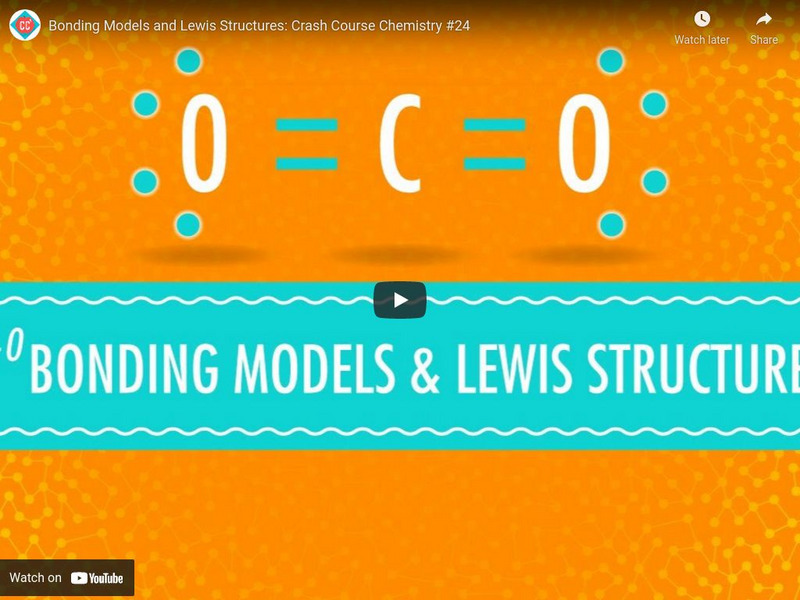
Crash Course Chemistry #24: Bonding Models and Lewis Structures
In this crash course, explore why scientists develop scientific models like Lewis Structures, and how people can learn from them.

Crash Course
Crash Course Economics #26: Game Theory and Oligopoly
Crash Course video talks about what constitutes an oligopoly and how it is different from a monopoly. [9:55]
Crash Course
Crash Course Kids 16.2: Up, Up and Away
So what makes the wind? You might be surprised to learn that it has to do with two of Earth's spheres; The hydrosphere and the geosphere. In this episode of Crash Course Kids, Sabrina takes us to the beach to chat about how the wind...
Crash Course
Crash Course Astronomy #34: Binary and Multiple Stars
Stellar mass black holes form when a very massive star dies, and its core collapses. Black holes come in different sizes, but for all of them, the escape velocity is greater than the speed of light, so nothing can escape, not matter or...

Crash Course
Crash Course Government and Politics #41: Party Systems
Craig Benzine looks at the history of political party systems in U.S. government and why they have changed over the years in this Government and Politics Crash Course video. [10:47]

Crash Course
Crash Course Government and Politics #50: Foreign Policy
The final Crash Course Government and Politics video on foreign policy talks about the global scale and potential to affect the largest number of people. [9:59]

Crash Course
Crash Course A&p #34: Digestive System, Part 2
Nearly 200 years ago, Alexis St. Martin was shot in the stomach. He was saved by local army doctor William Beaumont, but had to live out his remaining years with a gaping hole in the stomach -- allowing Beaumont to learn a lot about how...

Crash Course
Crash Course Astronomy #5: Eclipses
This crash course tackles the topic of eclipses. Learn about both the solar and lunar types. [10:32]
Crash Course
Crash Course Chemistry #23: Polar & Non Polar Molecules
A crash course in molecular symmetry and electronegativity with information about about polar and nonpolar molecules.
Crash Course
Crash Course Astronomy #31: High Mass Stars
Massive stars fuse heavier elements in their cores than lower mass stars. This leads to the creation of heavier elements up to iron. Iron robs critical energy from the core, causing it to collapse. The shock wave, together with a huge...

Crash Course
Crash Course Us History #42: Ford, Carter, and the Economic Malaise
Crash Course video narrated by the witty John Green in which he discusses the complex reasons for a lagging economy of the Ford and Carter Administrasions during the 1970s. [13:24]